

The 2006 film Tekkonkinkreet holds the distinction, perhaps dubious, of being the first major anime feature directed by an American. From what I can find, director Michael Arias isn’t even of Japanese descent. While it’s not at all unusual for foreign filmmakers to make movies in Hollywood, something about the idea of an American going to Japan to make anime has a whiff of cultural appropriation.
Maybe that’s not fair. According to his Wikipedia page, Arias moved to Japan when he was a young adult, speaks fluent Japanese, and established a career as a visual effects artist there. He also produced The Animatrix for the Wachowski siblings before stepping into a director’s chair. His Tekkonkinkreet was successful and mostly well-regarded in Japan. Watching it, I have nothing specific to say I disliked about the film, beyond the fact that it feels familiar to other famous anime movies. Even on that front, however, derivativeness is a wider problem in the entire anime industry, not specific to the content here. Would I have ever noted anything strange about the movie if not for the director’s English-sounding name? Probably not.
“Strange” kind of comes with the territory for anime anyway, doesn’t it?
| Title: | Tekkonkinkreet |
| Year of Release: | 2006 |
| Director: | Michael Arias |
| Watched On: | Blu-ray |
| Also Available On: | 4K Ultra HD Blu-ray Various VOD purchase and rental platforms |
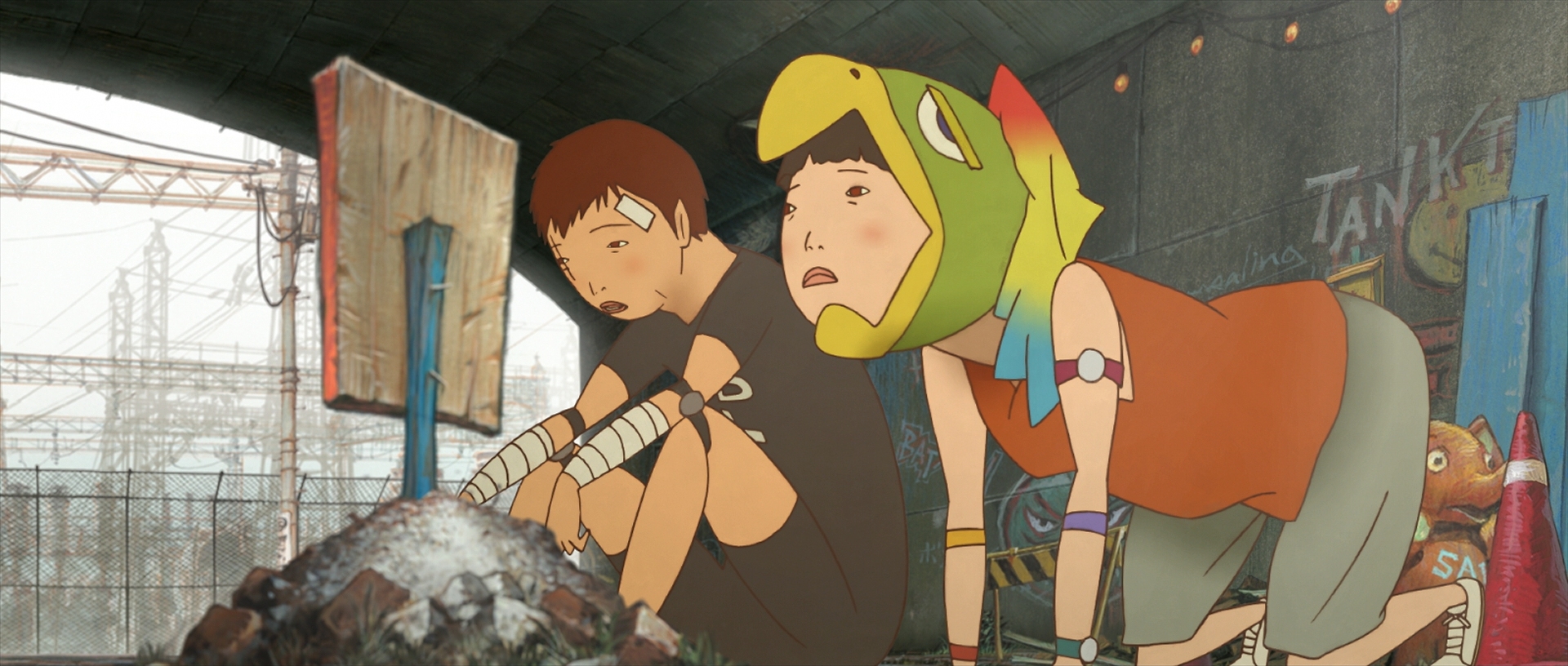
Based on a manga series also known as Black & White by author Taiyō Matsumoto, Tekkonkinkreet is set in a near-future dystopian metropolis bursting at the seams from over-development aided by corporate corruption and organized crime. In the slum district of Treasure Town, two young orphans, named Black and White, make camp in the hollowed-out shell of a wrecked car. They manage to get by with some skill at pickpocketing and other petty robberies. As leader of their two-person gang he calls the Cats, the older Black fancies himself ruler of the town, a great crime kingpin to be envied and feared.
Oddly, in this world, superpowers are taken for granted and no one questions either Black or White’s abilities to leap impossible heights or glide through the air. That’s apparently not too unusual a sight. Equally weird, the younger White is repeatedly said to be a boy, yet is clearly drawn and voiced like a girl in the Japanese soundtrack. This is never commented upon. White also has developmental issues and Black is fiercely protective of him.
The Cats routinely face rivalries from other small-time teenage gangs, and Black takes great pleasure in outsmarting and intimidating them. Unfortunately, his world gets shaken up by the entrance of real yakuza mobsters, who have no patience for his childish nonsense and begin moving into the area to clear out the locals. Behind them is an unsavory real estate developer named Snake, who plans to level Treasure Town and rebuild it into a gentrified tourist attraction. If a couple bratty kids should get in his way… well, that’s what hired goons are for. And if the goons can’t handle the situation, Snake has no reservations about sending some monstrous assassins to finish the job.
Judging by the character names, it’s pretty obvious that Tekkonkinkreet is more than a little bit on-the-nose in its themes. Snake’s appearance looks like he was genetically engineered to be a villain and had no other path in life. The manga and movie’s title is a pun based on a phrase for hardened concrete (yes, I had to look that part up), a metaphor reflecting both the urban sprawl and Black’s resolve to hold onto his home, however meager it may be.
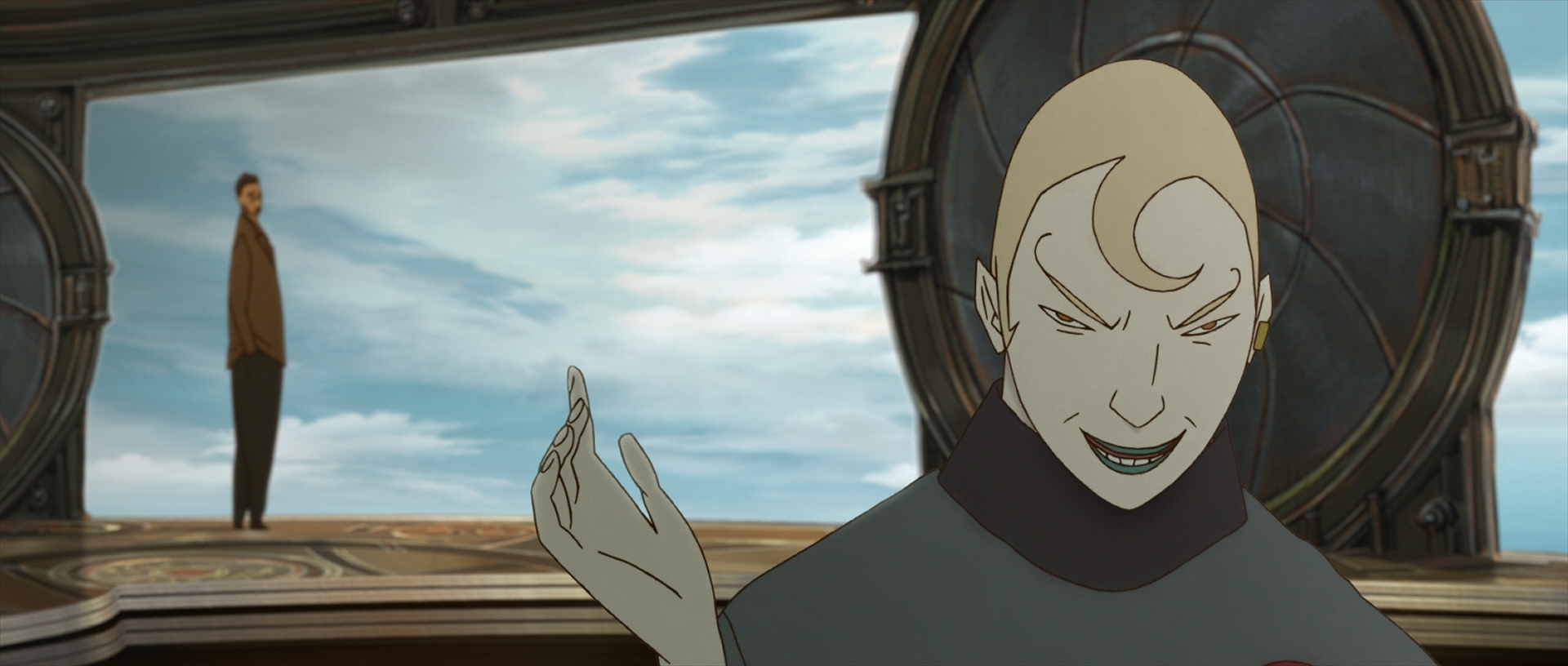
More interesting, the story features many separate layers of characters, from the street urchins and minor gangs to the adult cops and yakuza, up to the real crime lords in the wealthy elite. Although some of them (especially Snake) are caricatures of good or evil, others have surprising depth and complexity, with moments of real emotion in their fates.
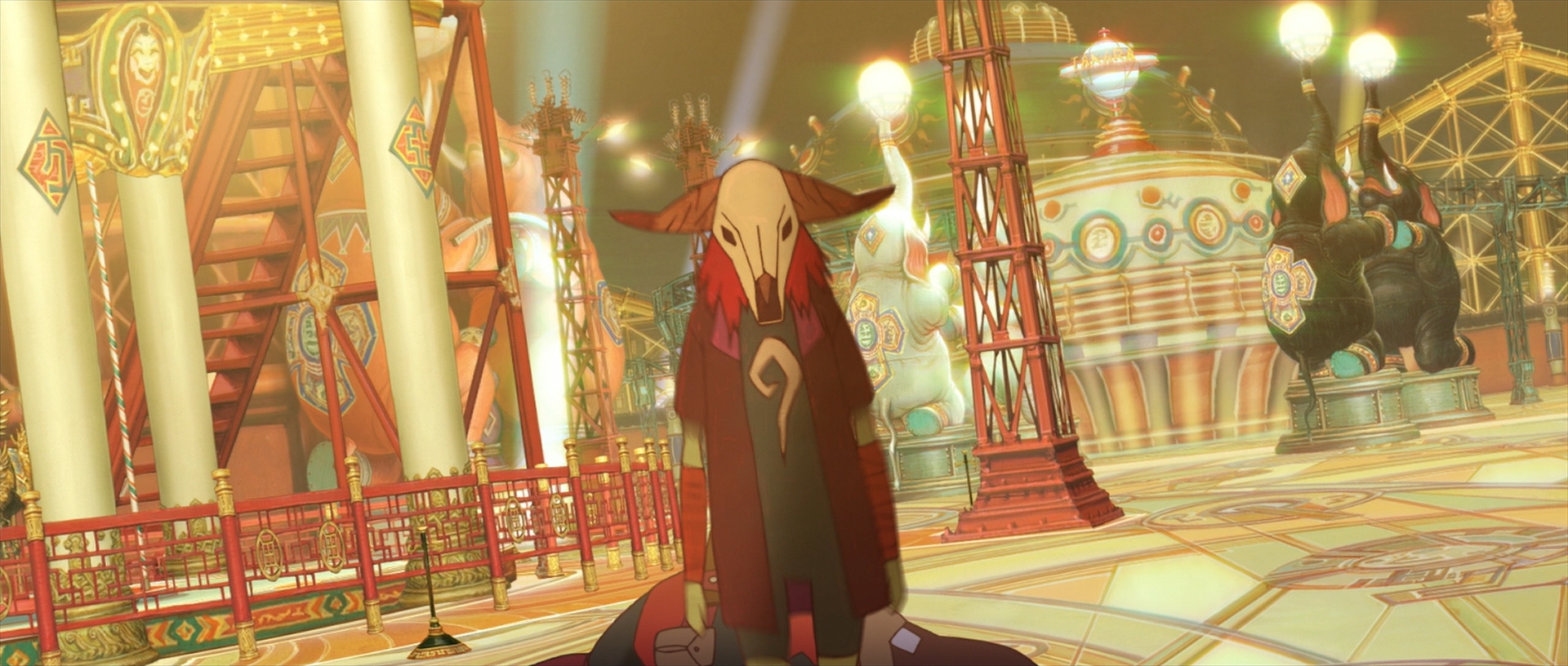
The film is also densely woven with symbolism, some of it exceedingly obvious and some that may take several viewings to unpack. Snake’s plan, when fully enacted by terrible means, comes with a realization that he’s actually made Treasure Town a better, safer, more attractive place for the general public, at the expense of harming those who lived there. With no small amount of irony, we learn that the center of it is a family-friendly theme park called Kiddie Kastle, made by displacing and crushing the lives of children already suffering under a cruel system that has abandoned them.
Most dystopia-based anime films live in the shadow of Katsuhiro Ōtomo’s groundbreaking Akira, and Tekkonkinkreet is far from an exception. The cluttered urban landscape could well be an extension of Neo-Tokyo, and the plot climaxes with a battle of superhuman action that ends with the sort of surreal, almost indecipherable WTF-ery that blew everybody’s minds in 1988 but has since become an anime staple.
The story of two young children struggling to survive an unforgiving world also attempts to evoke Isao Takahata’s masterpiece Grave of the Fireflies for emotional stakes, to mixed results. As hard as it tries, Tekkonkinkreet can’t live up to all its influences.
What Arias brings to the table is a dynamic visual style with what looks like handheld camerawork flying through an expansive environment it can barely take in, racing to keep up with characters frequently several steps ahead of it, and played to a very cool electronica score by a British band called Plaid. I’m not sure I fully buy into his decision to animate those characters to look like they stepped out of a Beavis and Butt-Head cartoon, with lumpy and ill-proportioned bodies and simplistic, untextured faces. The contrast between the human characters and the much more detailed background is striking, but also perplexing, like two unrelated movies smashed together.
All told, Tekkonkinkreet is an interesting and ambitious movie, but falls short of becoming the great one it strives to be. I’m glad I finally pulled my copy off the shelf where it had been sitting unwatched for more than a decade. How often I’ll do so again is unclear.
The Blu-ray
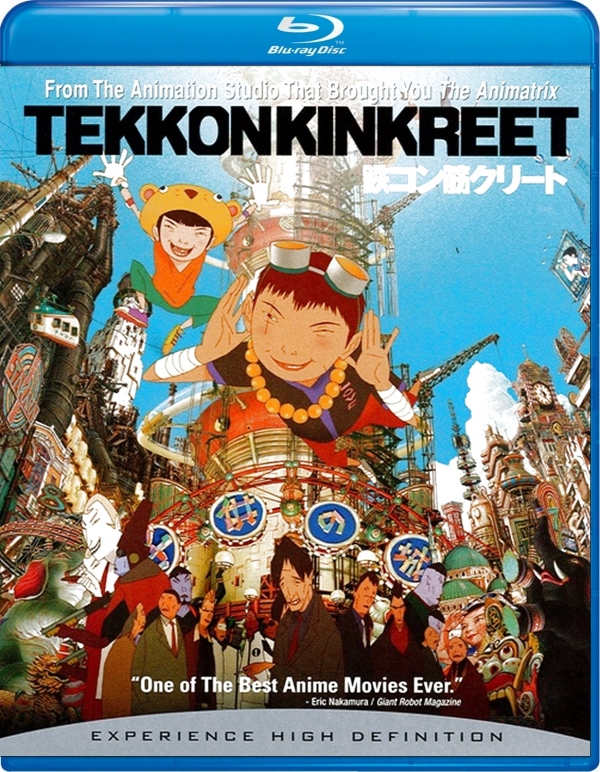
Sony released Tekkonkinkreet on Blu-ray in the American market in 2007. While still early days for the format, the disc is at least a little bit better than the same studio’s Blu-ray release of Satoshi Kon’s Paprika the same year. I make this comparison not because the two films have any creatives in common (to my knowledge, they don’t), but because the animation for both was originally rendered at about 720p resolution and then upscaled to 1080p for Blu-ray.
The 2007 Blu-ray has been out of print for a while and appears to sell for inflated prices on the secondary market today. That seems bizarre to me considering that GKIDS later licensed the title and released a remastered version of it on 4K Ultra HD Blu-ray only a few months before this writing in 2026, and the new 4K edition is cheaper and easier to obtain than the old 1080p copy. Nonetheless, I already had the 2007 disc on hand (purchased for $9.99 during a sale back in 2011, according to my records), and that’s what I watched for this review.
The Blu-ray’s 2.35:1 image is fairly soft, but I’m inclined to believe that’s mostly a factor of the animation originating at 720p (whereas Sony’s release of Paprika showed obvious signs of DNR as well). Contributing to this, the human characters are drawn without much surface or textural detail. However, I’ll acknowledge that the state of digital video compression in 2007 likely plays a role in that softness. Some color banding artifacts also intrude every once in a while.
Otherwise, the picture is bright, colorful, and generally pleasing. The 2.35:1 framing sometimes looks overly tight at the top of the image. I don’t know if that’s a transfer issue or just the way the movie was animated. Thankfully, this disc doesn’t have any unwanted shrinking with pillarbox bars on the sides, as the Paprika disc does.
I haven’t seen the 4K remaster, but trailers for it look almost as soft as this one. Modern upscaling and encoding processes may very well yield some improvement, but only so much can be derived from a 720p source. As rarely as I’m likely to watch Tekkonkinkreet in the future, the old Blu-ray is good enough for my needs.
The movie’s soundtrack is offered in a choice of Japanese uncompressed PCM 5.1 or lossy Dolby Digital 5.1 (for those whose equipment can’t process the PCM 5.1), plus an English dub in Dolby Digital 5.1. Frustratingly, the disc defaults to the dub. The Japanese track and English subtitles must be selected manually.
Equally frustrating for those few of us with 2.35:1 Constant Image Height projection screens, the subtitles are positioned with one line in the picture and one in the lower letterbox bar. Thankfully, I have a Blu-ray player with a feature that can adjust the subtitle placement.
In Japanese, the opening lines of dialogue are very low in volume, spoken as whispers. It seems that nobody told the dubbing actors to do that, because that dialogue is significantly louder in English. Once past the opening, the Japanese track gets much louder and more immersive, with very effective surround usage and a good amount of bass. Fidelity is excellent, especially for the score.
Extras on the Blu-ray are limited to a commentary track, a 43-minute “director’s diary” making-of piece, and a 11-minute interview with the director and both members of Plaid. I sampled all of these and found every one of them very dull.

