
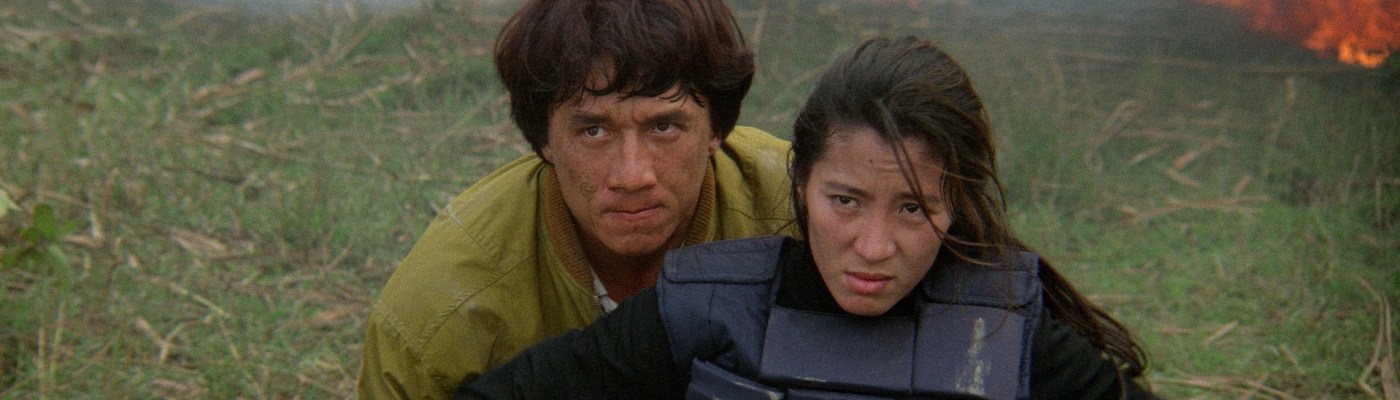
I hadn’t watched Jackie Chan’s “Police Story Trilogy” in so long that I’d forgotten the franchise also had a fourth entry (First Strike), a Michelle Yeoh spinoff (Supercop 2), and at least two movies described as reboots but in which Chan plays unrelated characters who also happen to be police. During most of that time I’d felt, and even recently stated, that Police Story III: Super Cop was the best of the series. Rewatching it again now, I’m not sure I still feel the same.
Don’t get me wrong, Super Cop is a quite entertaining and worthy sequel with one hell of an action finale. However, the movie takes a surprisingly long time to warm up and isn’t quite as much fun over its entire length as I remembered.
| Title: | Police Story III: Super Cop |
| Also Known As: | Ging chaat goo si III: Chiu kup ging chaat Police Story 3: Supercop Supercop |
| Year of Release: | 1992 |
| Director: | Stanley Tong |
| Watched On: | 4K Ultra HD Blu-ray |
| Also Available On: | Blu-ray Pluto TV Various VOD rental and purchase platforms |
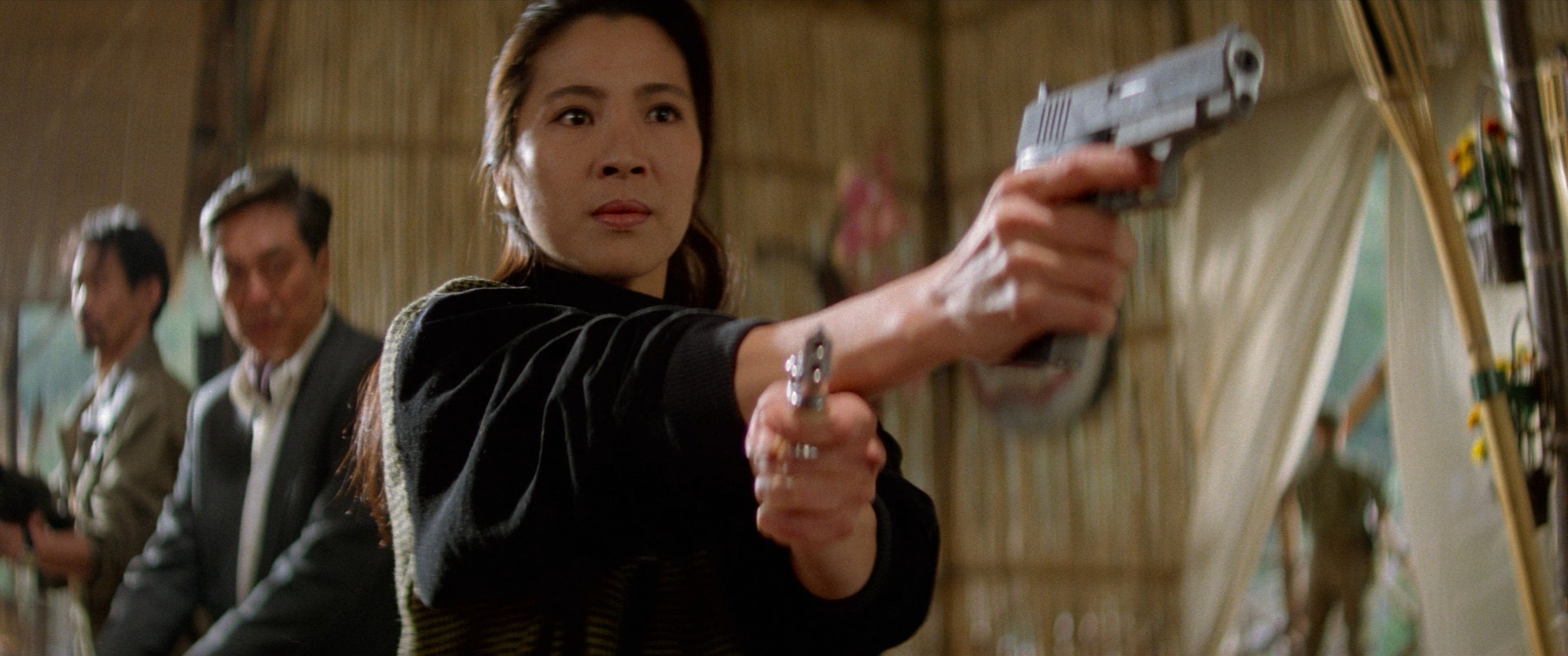
The irresistible sales hook for Police Story III was that the film featured the team-up of Hong Kong superstars Jackie Chan and Michelle Yeoh going toe-to-toe with one another, and fists or feet to the faces of countless bad guys. With those two leads and the Police Story franchise legacy behind it, the movie promised plenty of acrobatic martial arts fighting and crazy daredevil stunts. In the United States, Miramax chief Harvey Weinstein found the package so appealing that he bought distribution rights and released the movie to the American market on its own, under the title of just Supercop (compressed to one word) with no reference to it being a sequel to anything. Unfortunately, he also chopped several minutes out of the runtime, dubbed the whole thing into English, and slapped an ill-fitting hip-hop soundtrack onto it. Nevertheless, Super Cop / Supercop was a big hit in both Asia and North America. Naturally, real fans preferred the longer Hong Kong cut with its original soundtrack, as they should.
The first Police Story from 1985 showcased Jackie Chan at his prime, with some truly amazing physical stunts and fight choreography, but it also had a thin plot and very long stretches filled with broad slapstick comedy that hasn’t all aged well. A bit where Chan’s character hangs up on a rape victim because he’s too busy answering other phone calls especially grates. The 1988 sequel Police Story 2 tried to even the balance a little with more plot and less comedy, to mixed results. Police Story III continues that trend, emphasizing the plot a lot more and toning down the comedy (still a big part of the formula) to be less stupid or offensive. I just wish that plot were more interesting or that the movie was better structured around it.
As director of the first Police Story, Chan made a very smart decision to jump straight into the action with a huge shootout and stunt set-piece to let viewers know what kind of movie it’d be. The plot stuff followed after that as filler between the opening and the climax. For Police Story III, Chan bumped action and stunt coordinator Stanley Tong up to the director’s chair. Whether it was Tong’s decision or Chan’s I couldn’t say, but one or both of them apparently wanted to tell a real story this time, something more than just an excuse to string a bunch of fights together.
In this one, the Chinese government requests help from the Hong Kong police to stop a notorious crime lord named Chaibat (Kenneth Tsang) from smuggling drugs between the two territories. (This takes place before the 1997 British handoff of Hong Kong to China.) Because he’s known for doing anything it takes to stop criminals, and also because his superiors don’t care how much damage and destruction he might cause outside the island, so-called “super cop” inspector Chan Ka Kui is assigned the job, and he’s eager to take it.
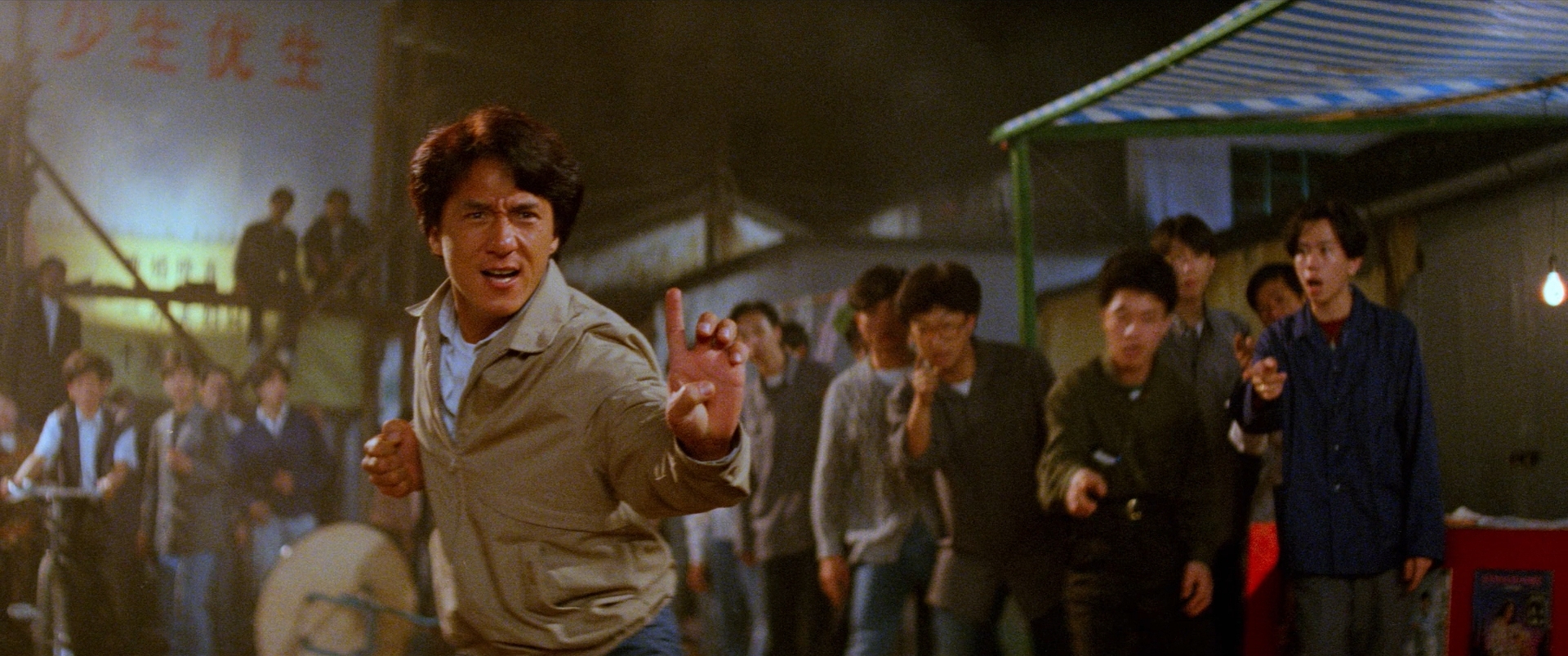
Arriving on the mainland, Chan is greeted by his INTERPOL liaison, Superintendent Jessica Yang (Yeoh), a no-nonsense policewoman less than impressed by his undisciplined attitude or behavior. After Chan infiltrates Chaibat’s gang, Yang also steps in to assist by playing his younger sister. The gist of the rest is that the two grudging partners struggle to maintain their covers among Chaibat’s henchmen while working their way up the chain to arrest the big boss.
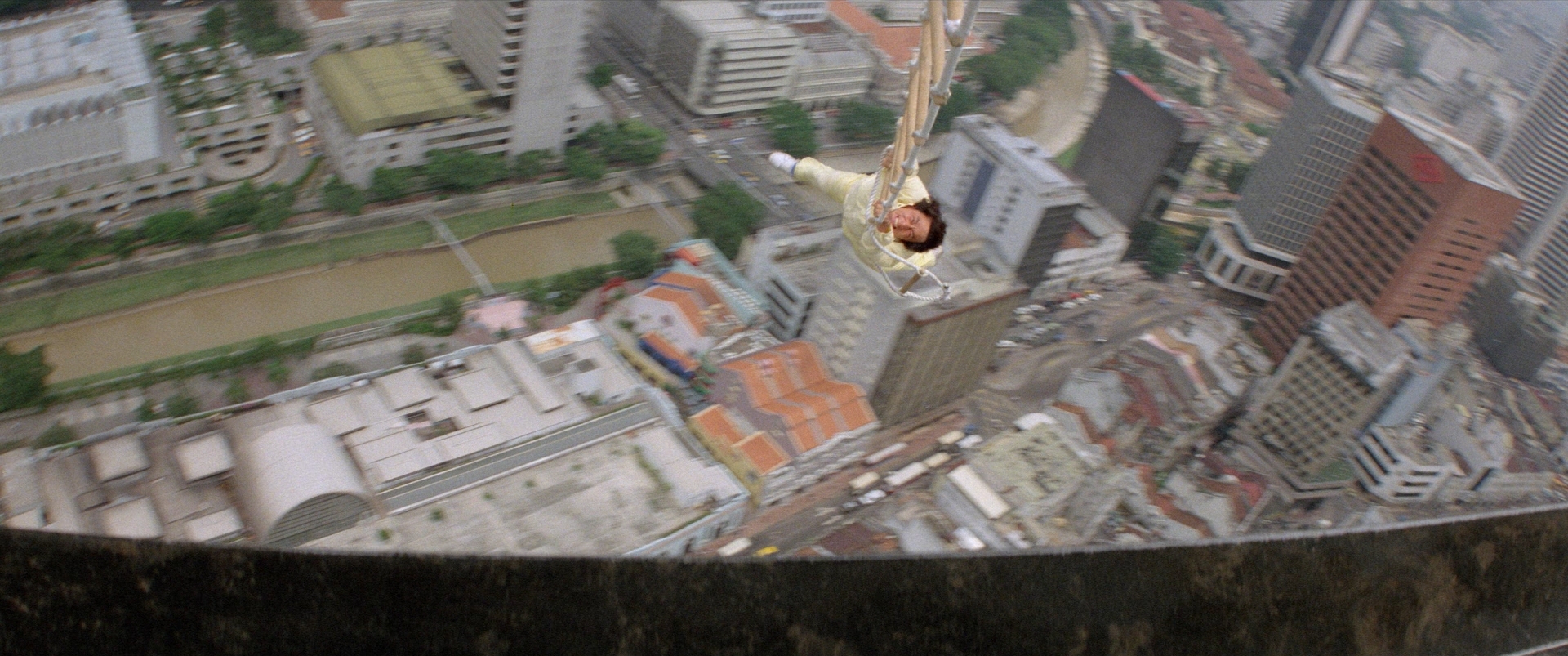
Honestly, the plot aspect remains pretty simplistic and unoriginal, and the film spends an inordinate amount of time setting it up. (If it has any merit at all, Weinstein’s Miramax cut trims out some of the boring parts at the beginning.) The first action scene of note doesn’t happen until more than a half hour in, and isn’t particularly exciting. A few fights here and there are well choreographed to show off the skills of both Chan and Yeoh, but the movie doesn’t really kick into gear until the last act, with an extended and downright jaw-dropping stunt climax involving a train, a motorcycle, and a helicopter, all built around Jackie Chan’s willingness to put his own life in danger to entertain his audience. It’s fantastic stuff, and rightfully sent viewers out of the theater buzzing with excitement, especially those in America who might not have seen much of Jackie Chan’s other work beforehand, nor Michelle Yeoh’s.
For the most part, the charisma of the two stars is enough to hold the movie together even through its duller sections. Maggie Cheung also appears for a little while, once again wasted as Chan’s oblivious girlfriend May, whose main role this time is to get kidnapped and give Ka Kui some additional stakes in needing to rescue her.
Some of the humor is dumber than it needs to be, but less so than the first two installments in the series. On the whole, I’m not sure where to rank Police Story III anymore. As you can tell, I’ve cooled on it a bit since my last watch. Although its high-point is a real stunner, and its low points don’t fall quite as steeply as those in the first Police Story, I’m inclined to say that the original movie is more exuberant fun overall. I didn’t expect to feel that way going in. Maybe I’ll change my mind again the next time I watch them.
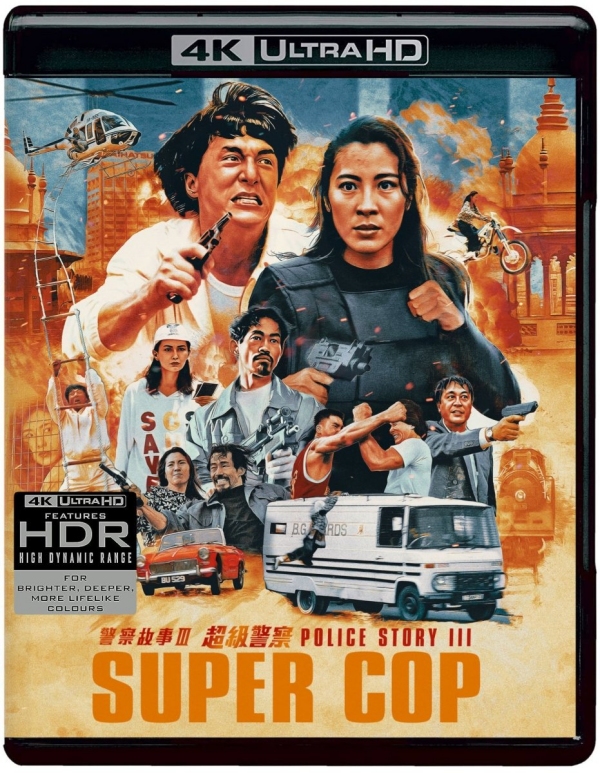
The 4K Ultra HD Blu-ray
Like a great many classic Hong Kong action films, Police Story III had a complicated and frustrating history on home video over the years, especially in the American market. The movie (titled just Supercop) was first released on Blu-ray here in 2011 by budget label Echo Bridge, on a disc containing only the shortened 91-minute Miramax cut with an English dub soundtrack.
Following that disappointment, a so-called “fan restoration” by bootleg label Hong Kong Rescue appeared somewhere around 2019 (an exact date is difficult to pin down), with a reworked Version 2.0 in about 2020. I told the story of Hong Kong Rescue in my review of John Woo’s The Killer. In brief, the one-man operation seemed to have started with good intentions but later ended in total disaster, with many unfulfilled promises and customers losing money. Nonetheless, the Police Story III disc actually came to fruition and was a respectable effort to give fans the best home video version of the movie possible at the time.
A legitimate restoration based on a 4K scan of original film elements arrived on Blu-ray in 2022 from Eureka Entertainment in the UK. That 4K master made its way to 88 Films in North America, which released a 4K Ultra HD Blu-ray in 2023. Initial copies came as a pricey Limited Edition containing a bunch of physical swag such as a poster, art cards, and a book. A standard edition (the one under review here) with just the 4K UHD and accompanying regular Blu-ray followed in 2024.
Annoyingly, my copy arrived with the Blu-ray on the right side of the case and the UHD on the left, the opposite of what I would normally expect. That led me to put the Blu-ray into my player and get very confused as to why my projector never kicked into HDR mode. It took me a few minutes to figure that out and swap discs.
The UHD and Blu-ray in the case contain both the original 96-minute Hong Kong cut and the 91-minute Miramax cut. Because I’m not a philistine, I of course focused on the Hong Kong version.
Considering that the movie wasn’t always photographed in proper focus, even during some simple dialogue scenes, the 4K Ultra HD transfer is satisfyingly sharp and detailed, much more so than prior home video releases, but I’ll be frank that I don’t see much difference between the Blu-ray and the 4K. The picture has good colors, though not much sense of HDR either. Letterboxed to its theatrical 2.39:1 aspect ratio, the framing of the image often looks cramped at the top edge. I don’t know if that’s a transfer flaw of being zoomed in too much, or just the way the movie was shot.
Audio options for the Hong Kong cut are offered in a choice of a Cantonese Dolby Atmos remix, the original Cantonese mono, a Cantonese “home video” stereo 2.0 remix that originated on VHS, and an English mono “classic dub.” I started with the Atmos but found its attempts at surround envelopment annoyingly gimmicky. Many of its sound effects, especially gunfire, are rolled-off and dull.
I finished the remainder of the movie in its original Cantonese mono. That track has different issues, such as sounding a little too bright and harsh, but gunfire is a lot crisper and overall it just feels more authentic and organic to the film in ways the Atmos remix doesn’t at all. I’m glad that both are available, but I’ll likely stick with the mono in the future. As for the VHS stereo mix or the English dub, I had no interest in wasting time with either of those, sorry.
The disc’s case art claims that the English subtitles over the Hong Kong version are “newly translated,” but they appear to be line-for-line identical to those on the bootleg Hong Kong Rescue disc. In any case, another shot at the translation is definitely needed. The wording is often very awkward, and for some reason subtitles can’t be turned off at all during the end credits song.
The U.S. Miramax cut can be watched with an English DTS-HD Master Audio 5.1 dub track or Cantonese mono. The case mentions English subtitles on that version but doesn’t say anything about the translation, and I didn’t feel like investigating.
Bonus features include an audio commentary by producer Frank Djeng, several featurettes and interviews, and some trailers and TV spots. None of them interested me enough to watch.
Related
- Jackie Chan
- Michelle Yeoh
Note: Screenshots on this page were taken from the Blu-ray edition of the film and are used for illustration purposes only.

