
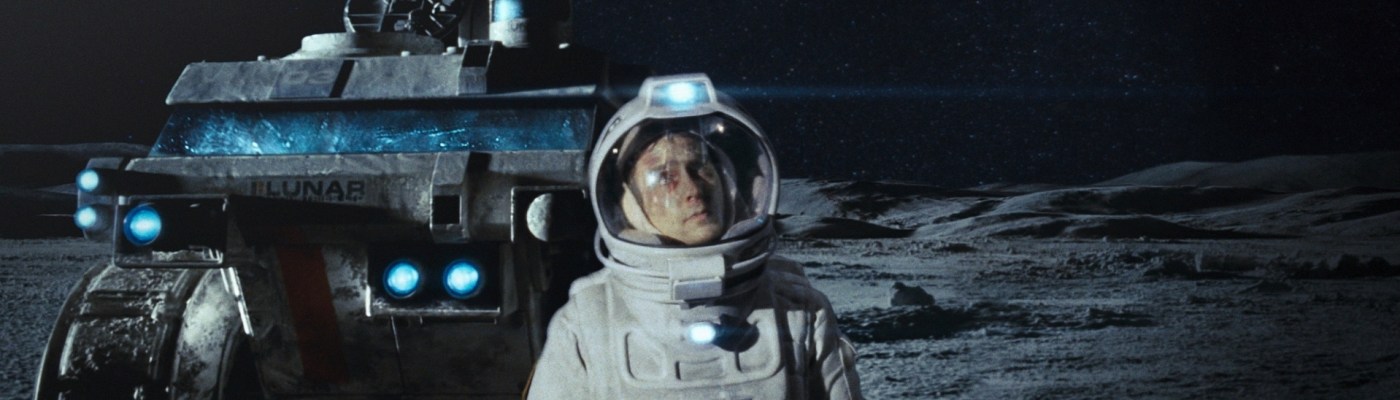
Despite its sci-fi trappings and high-concept premise, the 2009 drama Moon is primarily an understated character piece about isolation, personal identity, and the dehumanizing oppression of unchecked corporate greed. Unlike most science fiction cinema these days, the film has no action scenes and no suspense-filled set-pieces of note. Mostly, it’s a one-man showcase for character actor Sam Rockwell (just shy of a decade before his Oscar win) to demonstrate his range and prove that he could carry a movie on his own. Well, almost on his own. Of all people to show up unexpectedly, Rockwell may get some help from… Sam Rockwell.
Technically, the movie also features a vocal performance by Kevin Spacey in a significant role. At the time it was made, the two-time Oscar winner’s involvement must have seemed like a huge windfall for a low-budget production in need of some box office appeal. Sadly, Spacey’s later personal scandals can detract from appreciation of his earlier work. Looking back from a couple decades’ distance, his name in the credits may do more harm than good for the film’s marketability, even though he stays entirely off-screen.
| Title: | Moon |
| Year of Release: | 2009 |
| Director: | Duncan Jones |
| Watched On: | Blu-ray |
| Also Available On: | 4K Ultra HD Blu-ray Tubi Various VOD rental and purchase platforms |
With a setting in a dystopian near-future, Earth’s energy crisis has been solved by the discovery of an element called Helium-3 found, obviously, on the moon. Mining and harvesting there are controlled solely by the monopoly of mega-corporation Lunar Industries. For the most part, these tasks are automated and self-sufficient. However, the presence and oversight of one human is required in the event of a system or mechanical failure that can’t be resolved remotely. That task currently falls to Sam Bell (Rockwell), who’s effectively the maintenance man for an operation that largely doesn’t need him.
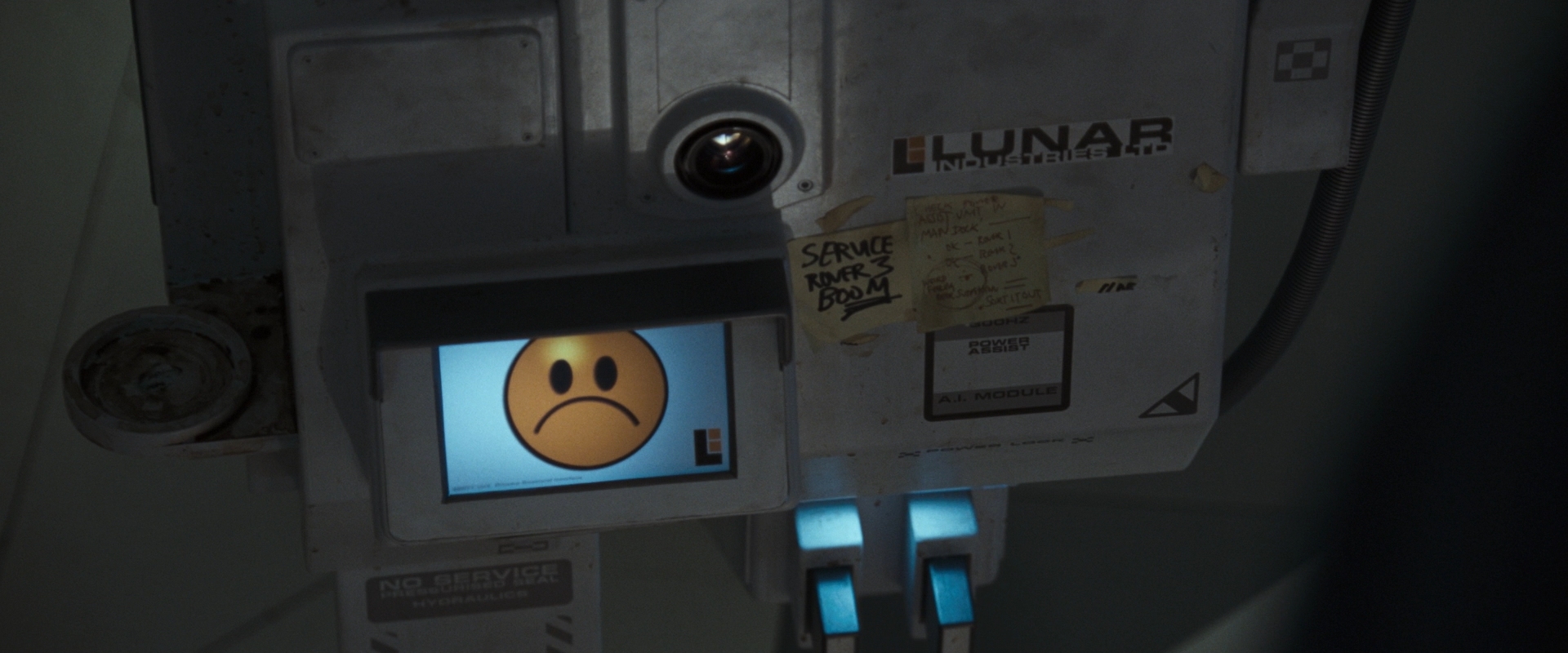
Nearing the end of his three-year contract, Sam is exhausted and lonely beyond measure. His only companion on the lunar base is an A.I. assistant called GERTY, voiced by Spacey in a calm and reassuring monotone. GERTY can move around and physically interact with Sam via a boxy robotic contraption that hangs from the ceiling. Inflection in its speaking is conveyed by a series of emojis displayed on a small screen that serves as its face.
Artificial as it may be, GERTY is as close to a friend as Sam can get in his situation, but as the days count down, Sam eagerly awaits a return to his family on Earth. Frustratingly, direct communication with them has been made impossible by damage inflicted from a solar flare, or so he’s told. The best he can get are periodic messages pre-recorded for him. Some have mysterious jumps where footage might have been edited.
Shortly before his scheduled exit, Sam is injured while attempting to repair a malfunctioning harvester far outside the base. Somehow, he awakens back inside, on a bed in the medical bay. GERTY is vague in its explanation of what happened, but Sam is determined to investigate for himself. The result of this leads to the discovery of not just a second human, but specifically a second Sam Bell, exactly like him and sharing most of the same memories. Needless to say, that’s a little distressing.
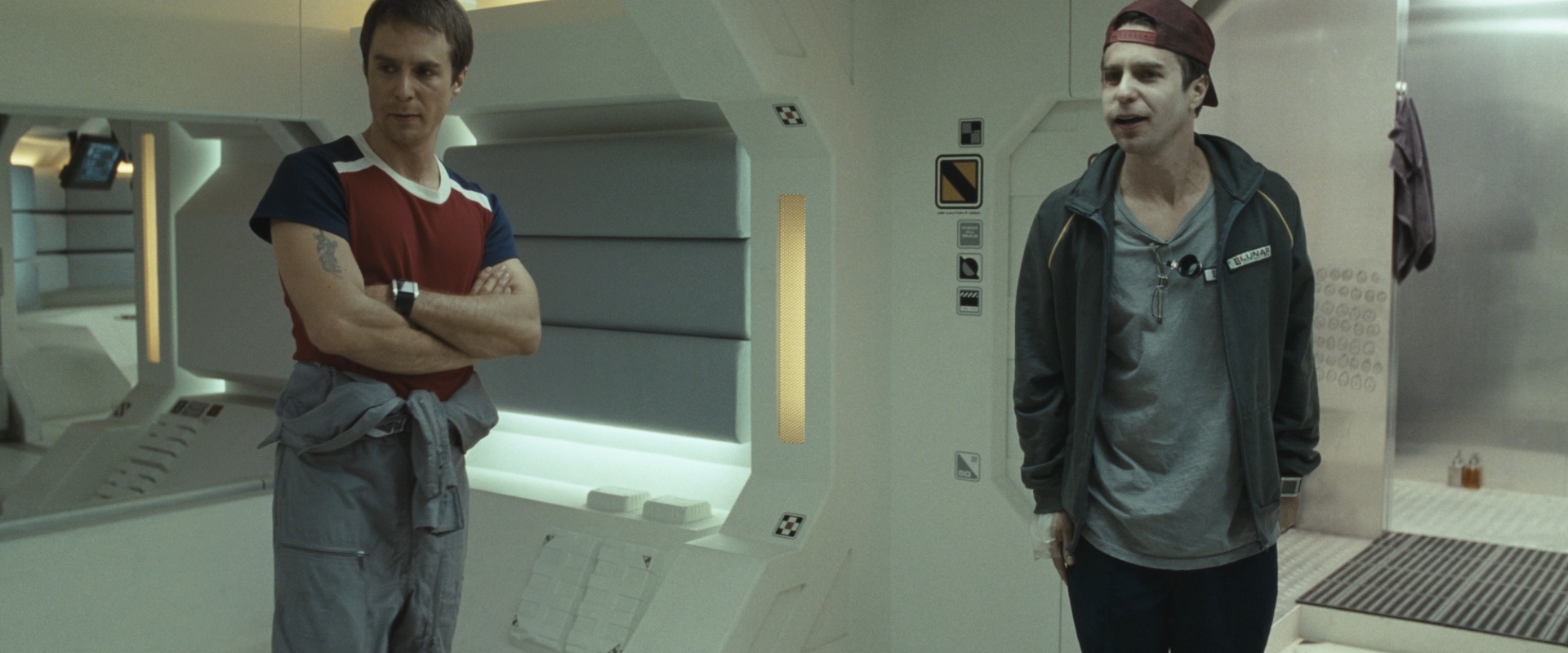
Any viewer moderately familiar with science fiction should be able to figure out the general answer to this mystery, as do the two Sams, though one is quicker to believe it than the other. The specifics come down to the exploitation of human beings by an inhumane business that treats them as commodities or products to be used and disposed of as needed. As wealth inequality grows exponentially worse in our real world, I fear that theme may remain relevant forever.
For his part(s) in this, Sam Rockwell does a remarkable job of crafting distinct performances for the two Sams. One is weary and beaten-down from years of servitude, lack of human connection, and a failing body. The other is fresher, faster to take in and process new information, and angry about what he finds. They may be the same person, but are years apart in life. The actor makes each clear, never to be confused with the other, and the film’s visual effects team does a clever job of creating the illusion that the two characters exist in the same frame at the same time.
Moon was an ambitious production made for very little money. While some of its visual effects appear seamless, others more plainly look like miniatures or digital composites. For the purposes of narrative convenience, the story takes some liberties with science and physics. For example, the interior of the lunar base impossibly has normal Earth gravity while the lunar landscape outside has more accurate low gravity, the difference between them immediately changing when a character enters or leaves.
In general, the balance of these things works and is more charming than distracting. Budgetary constraints notwithstanding, director Duncan Jones (son of singer David Bowie, as should be widely known information by now) has a meticulous yet subtle attention to detail. The white-walled moonbase set evokes the sterility of 2001: A Space Odyssey, but is covered in dirt and grime from lack of resources (or effort) to keep it clean. The technology available in this future is advanced enough to develop some remarkable things, such as a habitable structure on the moon, and cloning, but what’s actually made available for Sam to use is much more limited, by intention.
The film is a very focused character drama that never gets too heavy-handed with either messaging or themes. Although it asks some metaphysical questions about the nature of identity, this isn’t Tarkovsky’s Solaris. The movie has a comprehensible plot and narrative structure, lacking pretension as it unravels its mysteries. Moon is designed as entertainment, not just philosophy. Both stories, however, are contemplative and, ultimately, deeply sad. Even if one of the Sams returns to Earth, what life can he have and for how long?
The Blu-ray
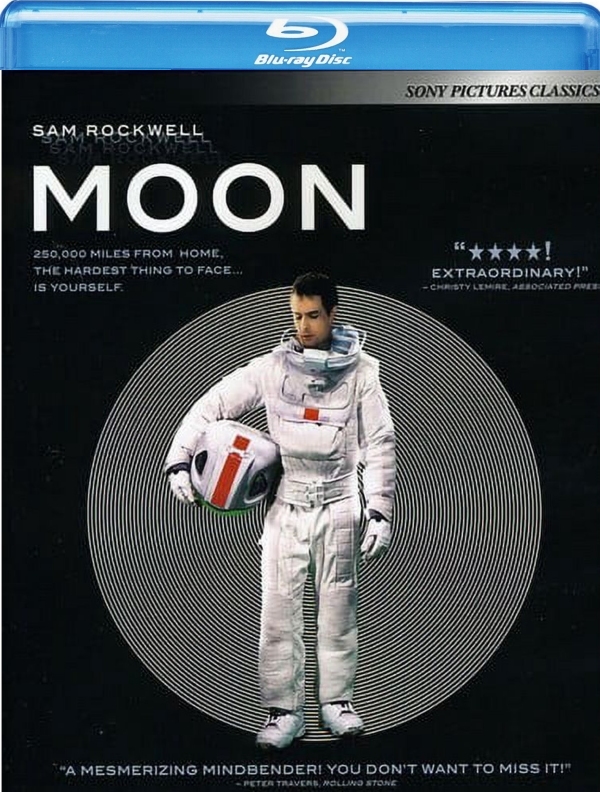
Sony released Moon on Blu-ray in 2009. The disc immediately shows its age by opening with a Blu-ray format promo and three forced trailers for unrelated movies before the main menu. The studio later issued a 4K Ultra HD Blu-ray upgrade in 2019. However, because the movie was shot on the Super 35 film format and finished on a 2K Digital Intermediate, I questioned the benefit of or need for a 4K upscale. Now having rewatched the older Blu-ray, I have doubts about my thought process there. At the same time, I still don’t entirely feel a need to buy a new copy.
After the frustrations of all the junk before the menu, the Blu-ray also shows its age in the quality of its video transfer, which is only moderately sharp, and in fact often frustratingly soft. Some of that may be due to the movie’s original photography or digital compositing, perhaps even deliberate to mask the seams between live action and visual effects, but I suspect a lot is just due to dated encoding of the disc. The 2.40:1 image may even be slightly misframed, as the top border often cuts questionably low just above or sometimes into the characters’ foreheads.
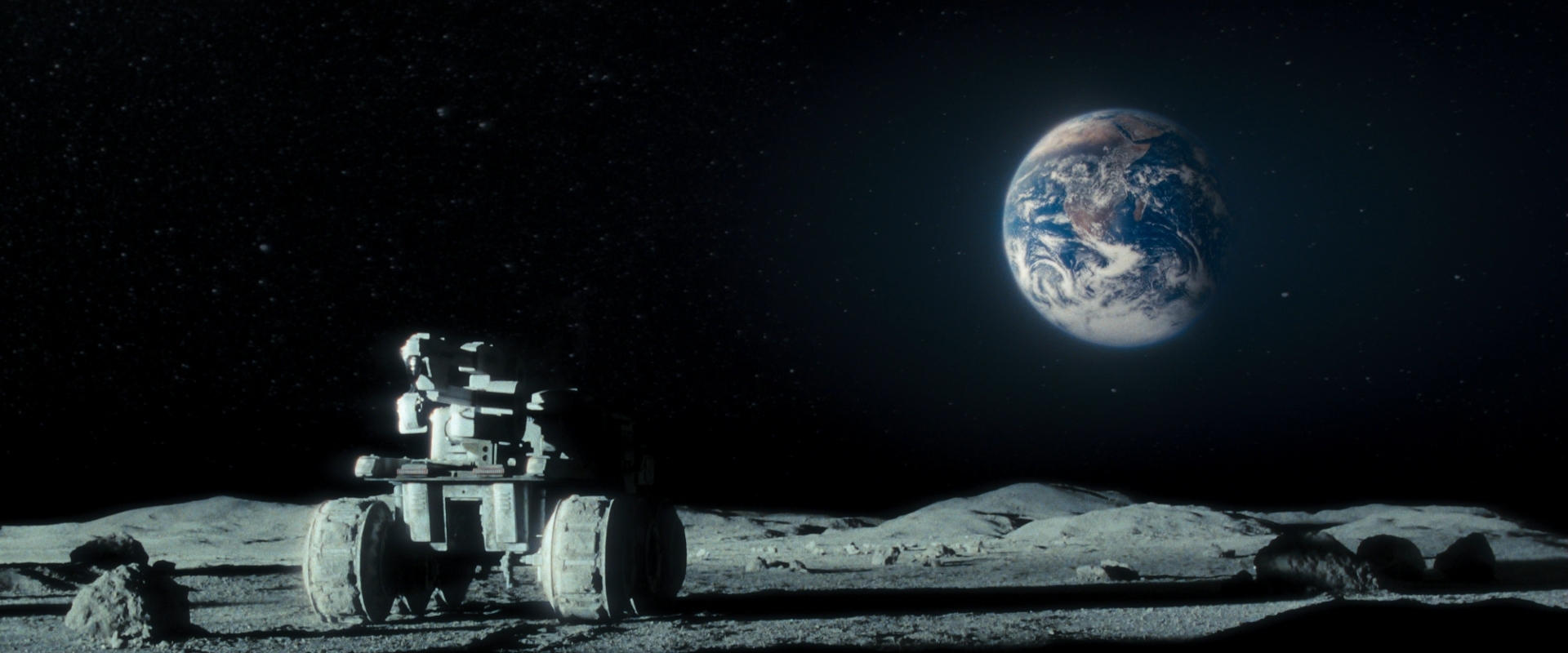
The photography is naturally designed to emphasize a stark divide between the all-white interiors of the moonbase and the blackness of space. Yet as a production from the early 2000s, it can’t avoid a bias toward teal-and-orange shading where none is needed. That part’s unlikely to ever change.
Upscaled from 2K or not, I suspect that the 4K remaster could yield a discernible improvement in sharpness just by virtue of better encoding, and that HDR could improve contrast and highlights. Of course, I can’t confirm that without watching it. If I were starting at this from scratch, I’d undoubtedly go toward the 4K first. Nevertheless, the Blu-ray remains adequate enough in general that I’m not compelled to run out for a replacement.
Fortunately, the Blu-ray still excels in the quality of its DTS-HD Master Audio 5.1 soundtrack, which demonstrates very nice dynamic range right from the opening. Although the movie’s sound design isn’t overly showy, it finds occasion for a few impressive bass hits and a fair amount of rumble. Fidelity of the Clint Mansell musical score is also excellent and spreads well across and around the soundstage.
The 4K disc offers a remixed Dolby Atmos soundtrack, but honestly, I see no need for it and can hardly fathom why it was made. The movie already has a good amount of surround activity, and nothing in any scene ever calls out for overhead effects. What’s the point of redoing the whole thing into Atmos? If anything, I fear that the track would wind up with much weaker bass and dynamic range, as is too often the case with modern sound mixing (and remixing).
Bonus features on the Blu-ray consist of two audio commentaries, a 2002 short film by Duncan Jones called Whistle, a making-of featurette and another on the visual effects, a couple Q&As, and a trailer. The link the Sony’s BD-Live portal is long since disabled, and never led to anything specific for this movie anyway.
I watched the Whistle short and the VFX featurette. The latter surprised me with a revelation that almost every appearance by GERTY was fully CGI, which made me appreciate the subtlety of some digital effects I had assumed were practical. Meanwhile, the 28-minute Whistle has an interesting premise, but the shot-on-video photography, in standard-definition on the disc, makes it look like a cheap TV production and the visual effects there are quite rudimentary.


Comments from bots have been deleted. They will not be tolerated here.
LikeLike
I enjoyed this movie quite a lot, but I did go in cold and knew almost nothing about it; I just heard it was pretty good. I’ll have to give it another watch.
Have you thought about watching Source Code with the guys? I’m thinking of it because I believe I watched Moon and this one around the same time. The guys might dig Source Code with the mystery and all.
LikeLiked by 1 person
It’s on my list of potential topics. No sure when we’ll get to it. I mostly play this by ear.
LikeLike
I enjoy this film. The memory that will always stick with me is that I downloaded a screener torrent before it was released, and my cable internet provider sent a letter to my house saying Sony contacted them, etc.
LikeLike