
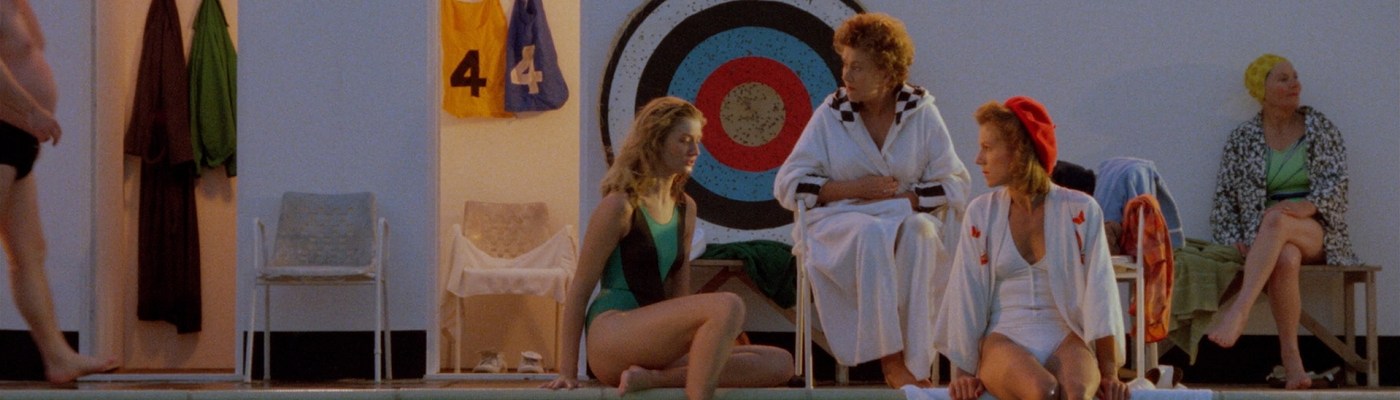
In many interviews and talks, Peter Greenaway has declared with some certainty and no small amount of pomposity that narrative and character development are not only inessential, but weaknesses of the cinematic medium. He treats his work not as “movies” in the widely-accepted sense, but as a form of visual art in motion, the sort of thing best appreciated in a museum setting rather than a multiplex auditorium. As such, his films are meant as intellectual and philosophical statements, the result of which is that many of them feel alienating to viewers expecting a traditional story they can follow. Greenaway’s 1988 Drowning by Numbers is one of the few that might appeal to at least a slightly wider audience.
Make no mistake, Drowning by Numbers is still very much an art film that plays by rules only Greenaway could dream up. With hardly an exception or two, characters bear no resemblance to the way actual human beings might behave, nor the plot to anything that could plausibly happen in a realistic world. What the movie does have, however, is a playful tone that decidedly lightens the rigid structure and pretentiousness of the piece. Until it doesn’t anymore.
| Title: | Drowning by Numbers |
| Year of Release: | 1988 |
| Director: | Peter Greenaway |
| Watched On: | Blu-ray |
| Also Available On: | Hoopla Roku Channel Tubi Amazon Prime Video (rental) |
The film follows three generations of women in the same family, all of whom commit similar crimes with nary a hint of regret. Fed up with her drunken husband’s infidelities and boorish behavior, the elder Cissie Colpitts (Joan Plowright) drowns him in a bathtub. She feels no emotion about it afterward, neither fear nor sorrow. It’s merely a thing that needed doing for a long time. When she informs her daughter Cissie (Juliet Stevenson) about the murder she’s committed, the younger accepts the act with great amusement. Having no attachment to the man, she’s quite pleased by this development. Not surprised either is Cissie’s niece Cissie (Joely Richardson), who simply wonders why it took so long.
While not terribly concerned with the legal implications of what has happened, the Colpitts find it expedient to draw in the involvement of local coroner Madgett (Bernard Hill), for propriety’s sake if nothing else. In love with all three women and desirous of the affections of any one of them, he declares the death a heart attack and accidental drowning. To this, the four consider the matter settled. No one in their seashore English village particularly believes this story they’ve concocted, but nor do any of them seem to care. Soon enough, it feels like everyone knows what happened and shrugs it off.
As if inspired by her mother, Cissie in turn drowns her own husband in the ocean, finding him too dull and emotionally remote for her liking any longer. Madgett is greatly frustrated by this, as he will now have to come up with excuses to explain the unlikely coincidence. Five will get you ten he also has a good inkling of what’s about to happen next.
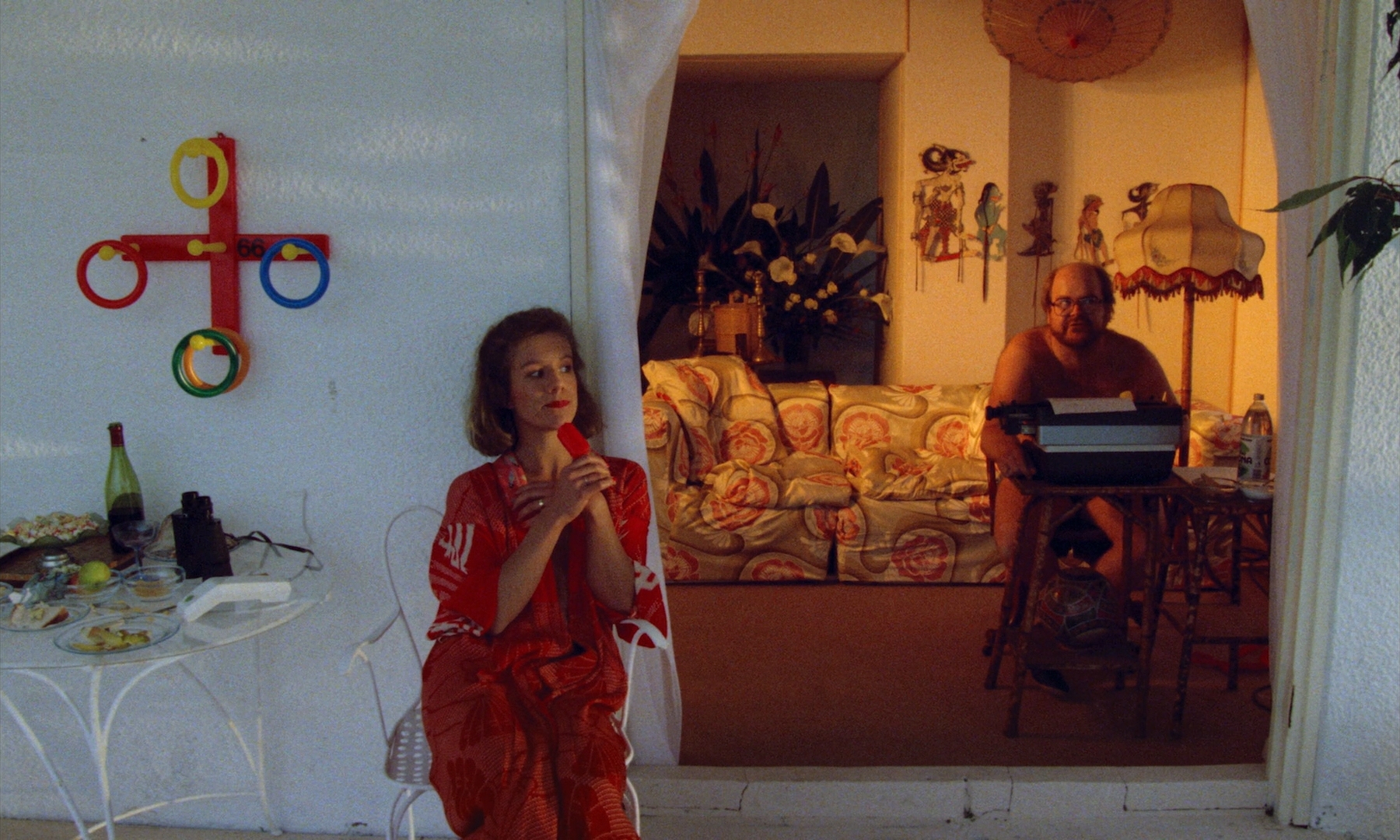
Unlike many of Greenaway’s films, Drowning by Numbers does have a mostly coherent, albeit irrational story. Much in the vein of the classic Arsenic and Old Lace, it’s a black comedy about charming yet remorseless murderesses, the men they plant six feet under, and the accomplice who must grudgingly help cover up their crimes. The difference here is Greenaway’s peculiar method of telling the tale with highly stylized imagery, a very mannered film grammar, and aloof performances that prevent emotional attachment to any of the characters. The director wants you to understand that this is an art piece first, entertainment a distant second.
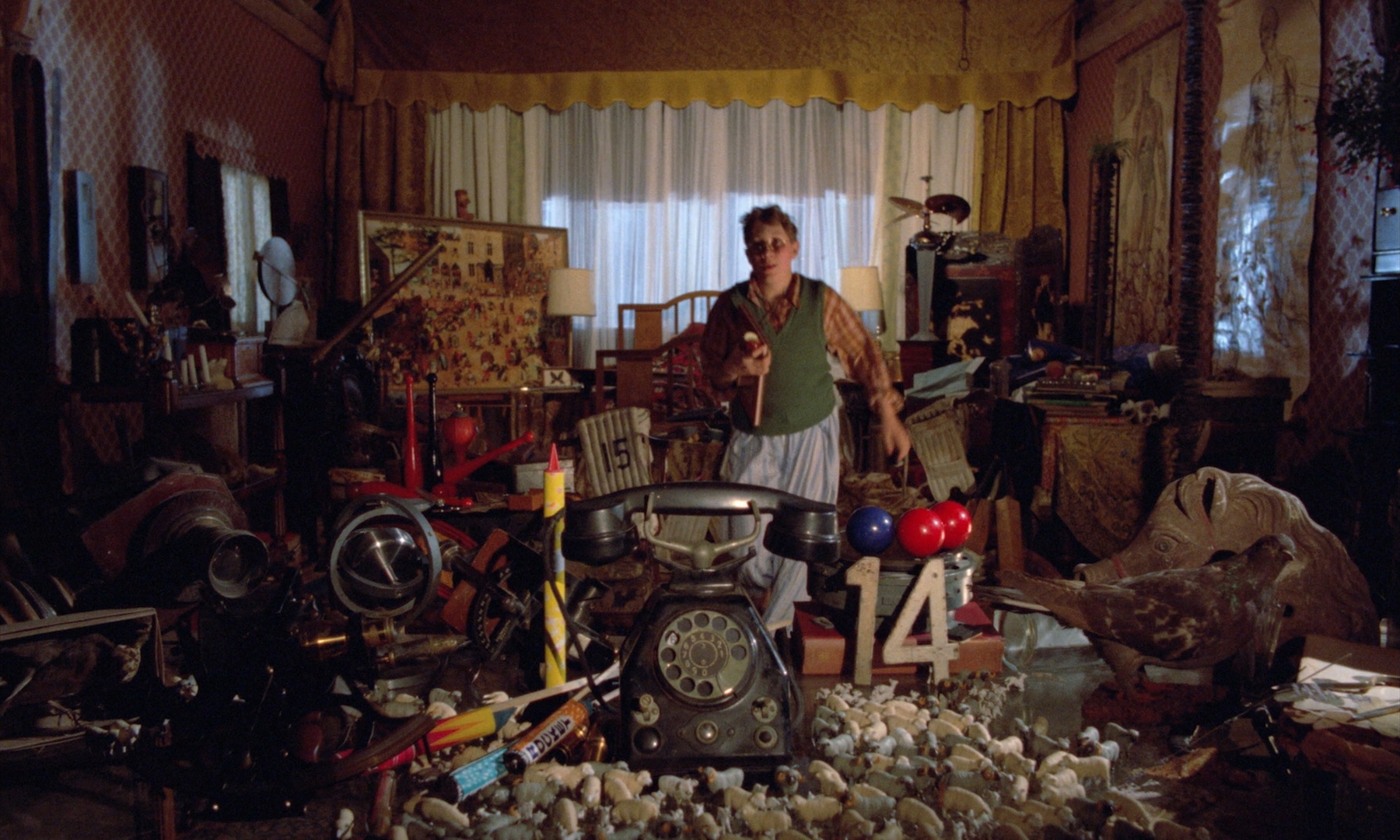
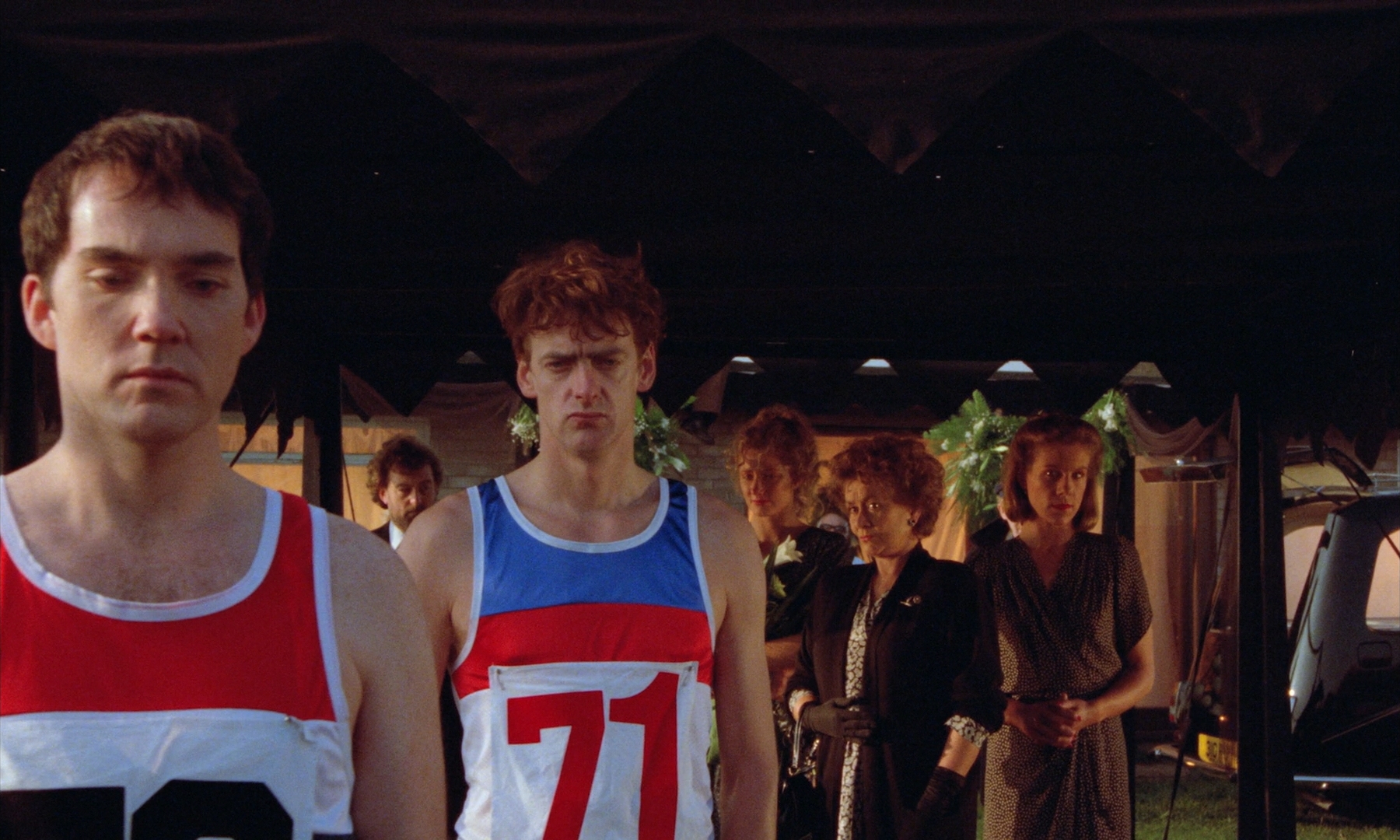
Like everything Greenaway makes, the film consists of many obsessions, from list-making to fictional games with impossible-to-follow rules. The main gimmick this time around is that the story proceeds in a numerical fashion. As a young boy named Smut compulsively counts the leaves on a tree or the bees in a hive among countless other things, the director places a series of digits throughout the cluttered art direction, advancing from 1 at the beginning to 100 at the end, with many random out of sequence mixed in just to sow confusion in the counting. Some evolve naturally from the scenes, others planted without logical reason to exist. Many are flagrantly apparent, some almost subliminally hidden among the details. Finding them all, especially the ones in proper order, may require seven or eight viewings. A stirring and deliberately repetitive Minimalist score by Michael Nyman propels the device forward.
Fans of the director, and there are many, will feel on cloud nine trying to decipher his almost impenetrably dense symbolism and themes. Greenaway’s exaggerated stylization will endlessly fascinate those on his wavelength. The abundant nudity of both genders certainly doesn’t hurt. Even so, many will have less patience for the artifice and opt out early. This is how all his movies operate. Honestly, I doubt Greenaway himself would object too much to the description “pretentious.” Using that term is less an insult than a statement of fact. The director has great pretension to use cinema as a vehicle to express his artistic and metaphysical thoughts and ideas.
As mentioned, in general, Drowning by Numbers operates at a lighter pitch than other Greenaway work, which too often leans toward the dry and dour. The sly humor may appeal to more than his usual audience. Be that as it may, the story takes a very dark turn at the end, more so than the rest. I’m sure the filmmaker would argue that a movie so preoccupied with death, even a comedy, must acknowledge the hard truth of it. Nevertheless, I fear that eight or nine out of ten viewers (myself included, unfortunately) will feel he goes too far and sours what came before.
The 4K Ultra HD Blu-ray
For many years, the prospect of watching a Peter Greenaway film in any form of high-definition quality seemed remote, if not impossible, due to a tangle of distribution rights issues. Over the past decade, those problems finally started to clear up when several of his movies were remastered and released on Blu-ray, and now one all the way to 4K.
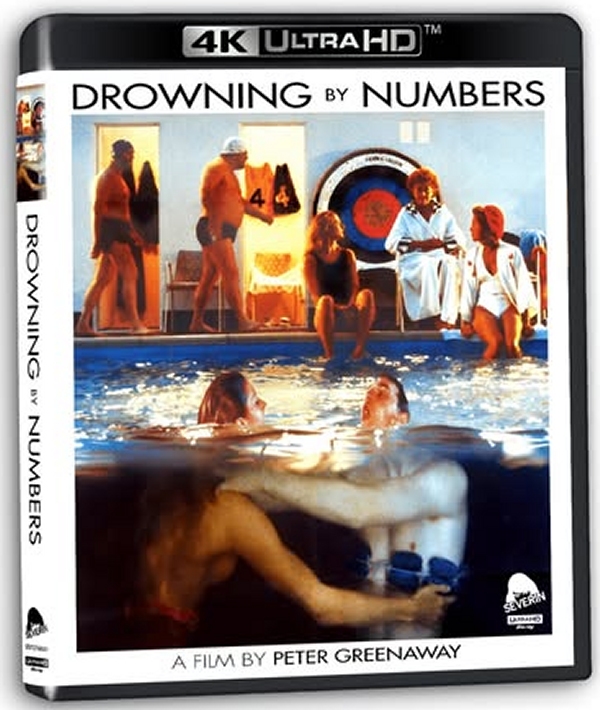
Drowning by Numbers came to Blu-ray in the United Kingdom in 2015, but an American release was postponed until 2023, whereupon it was licensed to Severin Films for this market. The Severin dual-format Blu-ray and 4K Ultra HD Blu-ray package arrived in two configurations, either a Limited Edition with slipcover or a standard edition without. Despite its less appealing artwork (in which one character’s head is awkwardly Photoshopped in half), I opted for the latter. Be advised that both discs have an exceedingly loud main menu screen. I recommend muting your volume until the movie starts.
Although the film’s 35mm photography has always been a little soft, the 4K transfer likely pulls the most out of it that can be gotten from the source, which the packaging claims to be a scan of the original camera negative. Mildly pillarboxed to an aspect ratio of 1.66:1, the image is decently sharp and detailed on the whole, some scenes more than others. I’d argue that one scene in particular has a little too much clarity, in that a supposed corpse can be seen breathing.
The picture is perhaps too bright, but HDR is well applied for a pleasing contrast range. Greenaway’s work is famous for the director’s playful use of colors, which are vivid and striking most of the time, though some appear oversaturated, especially when flesh tones veer too far into orange.
A Dolby Stereo production upon its release, the movie’s soundtrack is provided only in DTS-HD Master Audio 2.0 format here. The “stereo” description on the packaging may be misleading, as Dolby Stereo was always a surround sound format and this track is fully intended to be decoded with an upmixer such as Dolby Surround or DTS Neural:X. Doing so, the mix is mostly restrained with directional surround effects, except for fireworks that zoom around the soundstage.
Michael Nyman’s musical score is rendered with rich fidelity but not a lot of dynamic range. I might have liked the stringed instruments to reverberate a little deeper. The track has very little bass overall, until a thunderstorm near the end.
Both the Blu-ray and 4K discs contain an audio commentary by director Peter Greenaway. Many years ago, I heard the man speak in a Q&A session after a museum screening of one of his movies. My wife and I both found his pronunciation of “cinemaaaahh” hilarious at the time. Fortunately, that’s toned way down in this track, which is quite jovial, if still a bit pretentious. Unlike some comparable filmmakers, he’s very pleased to discuss his inspirations (literary, artistic, and filmic), explain his use of symbolism, and point out many of the hidden details he snuck into the production.
Additional features are found only on the Blu-ray disc. These include a 14-minute interview with Greenaway (recorded in 2022), a 10-minute interview with actor Bernard Hill, a tedious vintage half-hour featurette, an animated gallery of storyboard art, and a shockingly dull trailer.
Related
- Film from Z to A Article Index
- Peter Greenaway (director)
Note: Screenshots on this page were taken from the Blu-ray edition of the film and are used for illustration purposes only.


Wow…reading your review of this movie was exhausting enough…I don’t think I could actually watch it. I enjoy engaging with something deeper, but this guy and his movies sound insufferable.
LikeLike
The thing about Greenaway is that he’s extremely pretentious but also endlessly fascinating. He was obviously a huge influence on Wes Anderson, whose entire aesthetic of elaborately cluttered production design and formalist staging of scenes is basically borrowed directly from Greenaway, but in a more audience-friendly fashion and without the copious nudity.
(Seriously, Greenaway is a big fan of Renaissance artists and treats each film like one of their paintings, and he has a remarkable ability to convince almost any actor to go full-frontal on camera for him.)
Greenaway’s most famous and most successful film was The Cook, the Thief, His Wife & Her Lover. It’s an incredibly dark black comedy that shows off his perverse sense of humor and ability to push an audience’s buttons while still holding their attention.
LikeLike
I can understand that and even appreciate it, but at some point it just becomes another person pushing my buttons…and I have that enough in my everyday life. Why would I seek that out?
I am a sucker for a dark comedy, so maybe I’ll check the movie you mentioned out. Who knows? I might find myself enjoying it…
LikeLike