

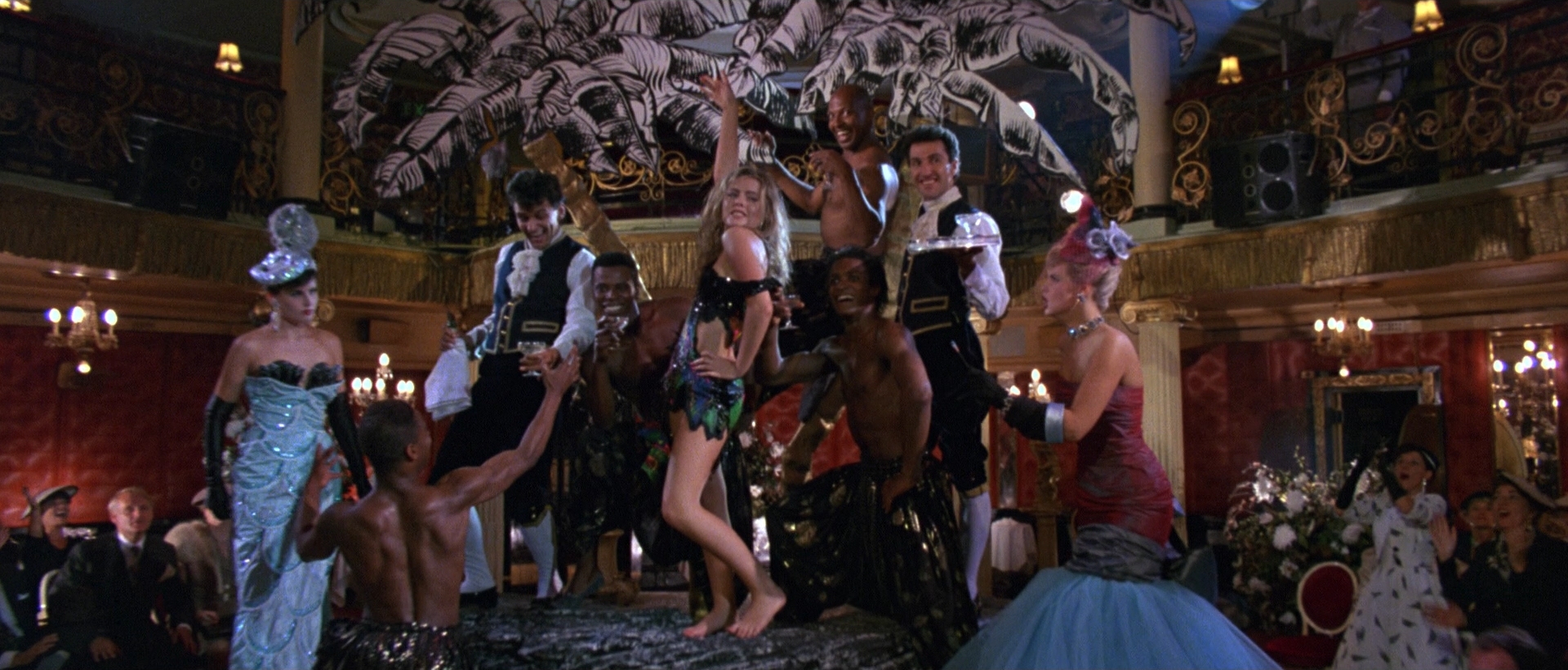
How does one describe a movie like Absolute Beginners? That’s a question I’ve been pondering since first watching it recently, a Blu-ray copy having sat on my shelf for just over a decade. I’m not sure it can be described. The best I’ve come up with is that the film feels like it exists in an alternate timeline or parallel universe where Wes Anderson and Federico Fellini somehow joined forces and decided to remake West Side Story, Antonioni’s Blow-Up, and Do the Right Thing all into one movie. Even that hardly does it justice. This thing is bonkers.
Absolute Beginners is a work of expansive and often confounding ambition. It wants to be a fizzy musical romance, a teen rebellion melodrama, a career rise and fall story, and eventually a statement piece about 1950s racial tensions. I think it’s fair to say that the movie doesn’t do any of those things fully successfully. Critics and audiences of 1986 certainly didn’t think so, and mostly wrote it off entirely. Yet every scene in the film is fascinating to look at or listen to. It’s a technical and artistic design marvel, and something about it is infectious. I think I loved it, but I also think I may need a lot more viewings to process it.
| Title: | Absolute Beginners |
| Year of Release: | 1986 |
| Director: | Julien Temple |
| Watched On: | Blu-ray |
| Also Available On: | DVD |
I’m sure like a fair number of people, the only reason I knew Absolute Beginners exists at all is due to a passing reference in Robert Altman’s The Player, where it’s enthusiastically name-checked during the famous one-take tracking shot in which characters discuss other movies with famous one-take tracking shots. Indeed, if not necessarily the very first shot in the movie, the opening scene has a truly amazing oner, perhaps the best I’ve ever seen.
Yes, sure, other movies may have done longer takes, and a few like Birdman or The Revenant have used seamless editing to fool audiences into believing the entire movie is just one long take, but this one is three-and-a-half minutes of pure amazement, a full-blown musical extravaganza with a ton of important characters moving and dancing all over the place around a city block white the camera dodges and weaves down streets and through buildings. And this isn’t one of those shots (like in Goodfellas) where the camera merely trails behind a character who leads it along. No, the camera here is a character unto itself, changing perspectives, drifting away from the lead and back again trying to take in all the controlled chaos happening around it. The choreography of thing thing is jaw-dropping. I can’t believe I’d waited so long to watch it.
Most of the film is similarly dazzling on at least visual terms. Every frame is cluttered with something of interest, sometimes off to the side or in the deep background. One particular set-piece set in a multi-level tenement house is shot from a slice-out view, like a doll house missing a wall so we can see multiple characters roam from room to room, up and down stairs as if in an elaborate stage play. I feel confident that this must have been a significant influence on Wes Anderson’s live-action diorama visual style.
Unfortunately, the narrative is mostly a confused (and confusing) mess. Based on a novel by author Colin MacInnes that I have to imagine was told with more coherency, the story is set in West London during the late 1950s, a vibrant period of rebirth bridging the end of World War II and the upcoming Swinging Sixties. Jazz is in the air and the youth of the day stay out ’til dawn at nightclubs and seedy strip joints, dancing, romancing, and a little of everything in between.
Our lead character is a boy also named Colin (though apparently not so in the original book), a young photographer trying to make a name for himself by shooting all the colorful people in his neighborhood. Musicians and prostitutes, white or Black, whether conventionally attractive or not, he finds all these subjects worthy of being glamorized on celluloid. Colin is in love with a seamstress and aspiring designer named Suzette (Patsy Kensit), who gets inadvertently plunged into the spotlight and rapidly becomes a major star in the fashion world.
As Suzette’s career skyrockets, Colin is likewise lured away from his friends into the conformity of the well-paying corporate world. The young couple’s relationship frays and Suzette is pressured into marrying and acting as beard for a stodgy fashion mogul from the prior generation (James Fox), with whom she has nothing in common. Colin, meanwhile, just becomes a bigger and bigger jerk who complains endlessly about Suzette ruining their relationship when it was mostly his own doing.

So far, this may sound like a straightforward rags-to-riches tale with themes about the dangers of selling out. One of the songs is actually called “Selling Out” to hammer that point home.
But the movie is also crammed full of subplots about gentrification forcing away everything good about the characters’ neighborhood, an invasion of white supremacists backed by powerful wealthy interests, and eventually a full-blown race war that threatens to burn down a still-recovering nation. The two halves feel forced together and should have remained in separate movies.
The film’s problems are twofold. First, and very detrimentally, is Colin himself. As played by actor Eddie O’Connell, he’s a very bland and uninteresting hero for this story, and in most scenes feels like he’s just tagging along for the ride when we’d rather be watching other characters instead. Not just an observer to history, he’s a wet blanket over the entire affair, not particularly likeable enough for anyone to care about his corruption-to-redemption arc or his love story with Suzette. A total prick in some scenes while begging for sympathy in others, his behavior swings back and forth with little motivation.
That issue in then tied directly into the other. The movie is so bursting at the seams with hundreds of ideas and themes that it can’t possibly hold them all. The narrative is rushed at a breakneck pace, preventing the audience from keeping up with whatever’s happening or why. Characters who seem to be good in one scene are bad in the next. None of these thoughts are explored with depth or subtlety or even sufficient explanation. Ultimately, the story is so incoherent that, despite its heavy subject matter, it feels inconsequential. What does this have to do with most of the musical numbers, that are otherwise so terrific? Any why is any of this about Colin?
Still, despite its flaws, the movie is really quite something to take in and absorb. I haven’t even mentioned the fact that David Bowie inexplicably both sings the theme song and plays one of the main villains, nor that pop songstress Sade shows up for one scene about three-quarters into the picture and steals the whole movie out from under everyone else.
I don’t really know what to make of Absolute Beginners as a whole, but I definitely think I want to experience it again in some hope of figuring that out.

The Blu-ray
Absolute Beginners has been released on Blu-ray twice, first by the Twilight Time video label (now defunct) in 2015 and later by Sandpiper Pictures in 2023, both under license from MGM. I have the Twilight Time disc. I can’t find much information about the Sandpiper release, but I’d expect it to be nearly the same as this one, as I don’t see MGM striking a new video master for such a small outfit or for such a deep-cut catalog title.
The Twilight Time disc isn’t perfect by any means. The 2.35:1 image is soft in general (worst during the opening titles and other opticals) and has some periodic speckling and minor film damage. Grain also tends to be noisy. Nevertheless, it’s a respectable enough presentation for the movie in high-definition. I’ve seen a lot of MGM catalog product that has been treated much worse.
This is a very colorful movie, with plenty of neon and other solid primaries. Most of them are treated well, but could use more depth and vibrancy. The disc leaves room for improvement in the unlikely event this film should ever be remastered for 4K and HDR. Because I don’t foresee that happening anytime soon, I can make do with the Blu-ray in the meantime.

Twilight Time prioritizes a DTS-HD Master Audio 5.1 track as the default audio setting, but also offers a DTS-HD MA 2.0 option for purists who prefer the original Dolby Stereo mix. I sampled both and found them more similar than not. The 2.0 perhaps has a little hiss that’s been reduced in the 5.1, but it’s not severe, nor is the filtering.
The movie’s soundtrack is a bit all over the place in terms of quality. The music and songs sound great for the most part, with a nice spread around the room and a satisfying amount of bass strumming. However, the dialogue has big volume swings, some lines barely intelligible and others way too loud. The difference between the live-recorded parts and the ADR are extremely obvious. I also find it very annoying the way dialogue and/or voiceover so often intrude into the middle of music or songs, especially during the opening scene.
The only on-disc bonus feature on the Twilight Time Blu-ray is an isolated score track. I don’t usually pay much attention to such things, but I really see the appeal here when it removes all the dialogue and voiceover from the musical numbers. Sadly, the audio quality is much thinner and weaker, and the music still sometimes (not always) fades out in places where dialogue would have been inserted. The Twilight Time copy also includes a booklet with an essay from the label’s Julie Kirgo.
From what I can tell, the Sandpiper re-release drops the 2.0 and isolated score tracks, as well as the booklet, making the Twilight Time edition at least somewhat preferred for fans. The Twilight Time case also has much nicer cover art.
Related
- Film from Z to A Article Index
- David Bowie


If you’re looking for a movie done in one shot, I heard Boiling Point is supposed to be pretty engrossing (I haven’t seen it). I guess it’s like 80-some minutes, so I can’t imagine the movie overstays its welcome.
On a different topic, have your boys seen the original Superman from 1978? I would be curious to see how they react to a slower type of pacing and the older practical effects.
LikeLike
Thomas was not a fan of Superman, sadly.
https://videofileblog.com/film-at-11-podcast-superman-1978-review/
He liked it even less when we did a best-and-worst discussion later.
https://videofileblog.com/film-at-11-podcast-year-1-retrospective-2026/
LikeLike