
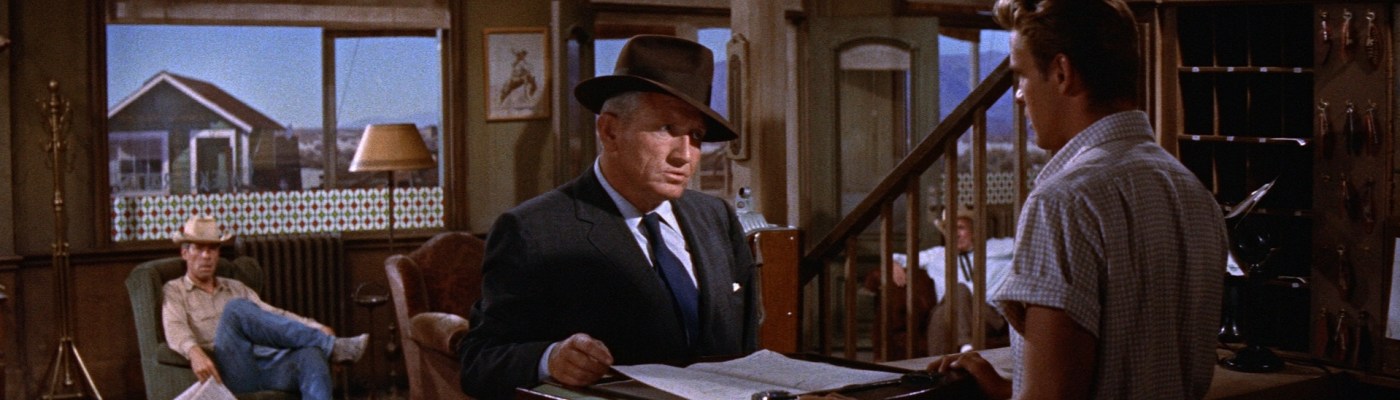
Part Western, part noir, and mostly a bunch of tough guys glaring at one another for 80 minutes, Bad Day at Black Rock was a collision of B-movie and prestige picture when it was made in 1955. Headlined by a couple major stars, one veteran character actor, and some other notable talent on the rise, the film was quickly hailed as a masterpiece upon its release. Maybe it is. I’m not sure that I’m entirely convinced of that, but the movie is strangely compelling. Its tight runtime feels like it’s packed with drama even though, objectively, almost nothing happens in it.
The film was also a box office hit that has largely retained its reputation as a classic over the years. Among its many accolades were three Oscar nominations, including one for Best Screenplay, which is pretty interesting considering that, to be completely frank about it, the entire plot portion of the writing could be wrapped up in about five minutes without losing much of significance.
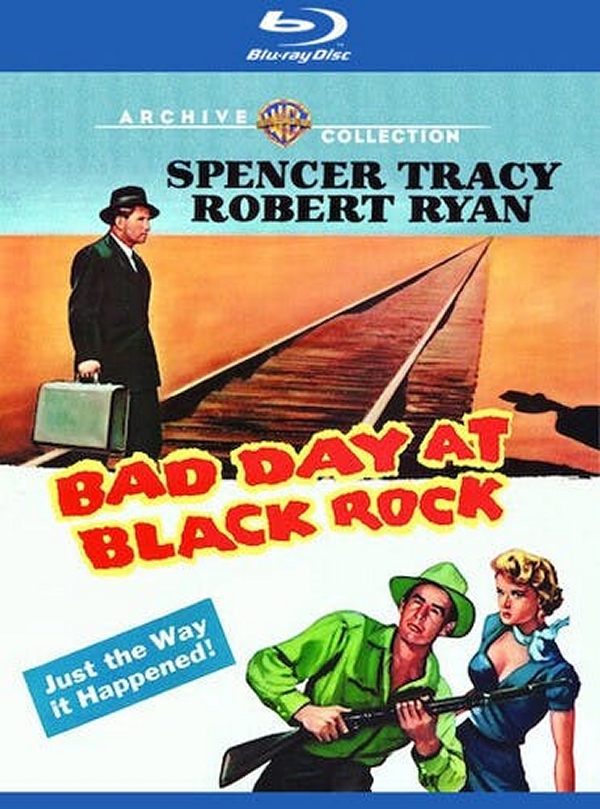
| Title: | Bad Day at Black Rock |
| Year of Release: | 1955 |
| Director: | John Sturges |
| Watched On: | Blu-ray |
| Also Available On: | Hoopla Various VOD rental and purchase platforms |
Unlike many early CinemaScope productions, Bad Day at Black Rock wasn’t conceived as any sort of epic spectacular. This is a very small-scale drama with only a handful of characters (certainly no “cast of thousands”) in basically one location. As far as being a showcase for the then relatively new widescreen format, the photography makes good use of a barren desert backdrop, and frequently frames its cast to fill the width of the screen. Audiences of the day must have eaten that up.
The picture opens energetically with a train racing through an expanse of the California desert, as if to signal right off the bat that this movie means business. As it slows down to stop at the title location, a tiny town (if you could even call it that) in the middle of nowhere with about a half-dozen buildings and hardly any more of a population, all the locals, every single one of them, eyes it with apprehension. The train hasn’t made a stop there in years, and why should it now? No one expects, or wants, a visitor.
One man steps off, clad in a black business suit and tie. He carries a briefcase in this right hand while his left is always in his pocket, later made clear that a war injury has crippled or taken that arm. He says his name is Macreedy (Spencer Tracy) and asks for a room at the town’s only hotel. When initially rebuffed with the obviously untrue excuse that the place is booked-up, he insists and claims a room anyway.
Macreedy is a no-nonsense kind of guy. He’s polite and makes no move to antagonize anybody, but also won’t be intimidated by people who don’t want him there, which would be nearly everyone. He undoubtedly experienced the horrors of war and no longer fears much. He says little about why he’s come to town, only that he wants to go to a place called Adobe Flat and find a man named Komoko. That alone seems to worry everybody, for reasons none will say out loud.
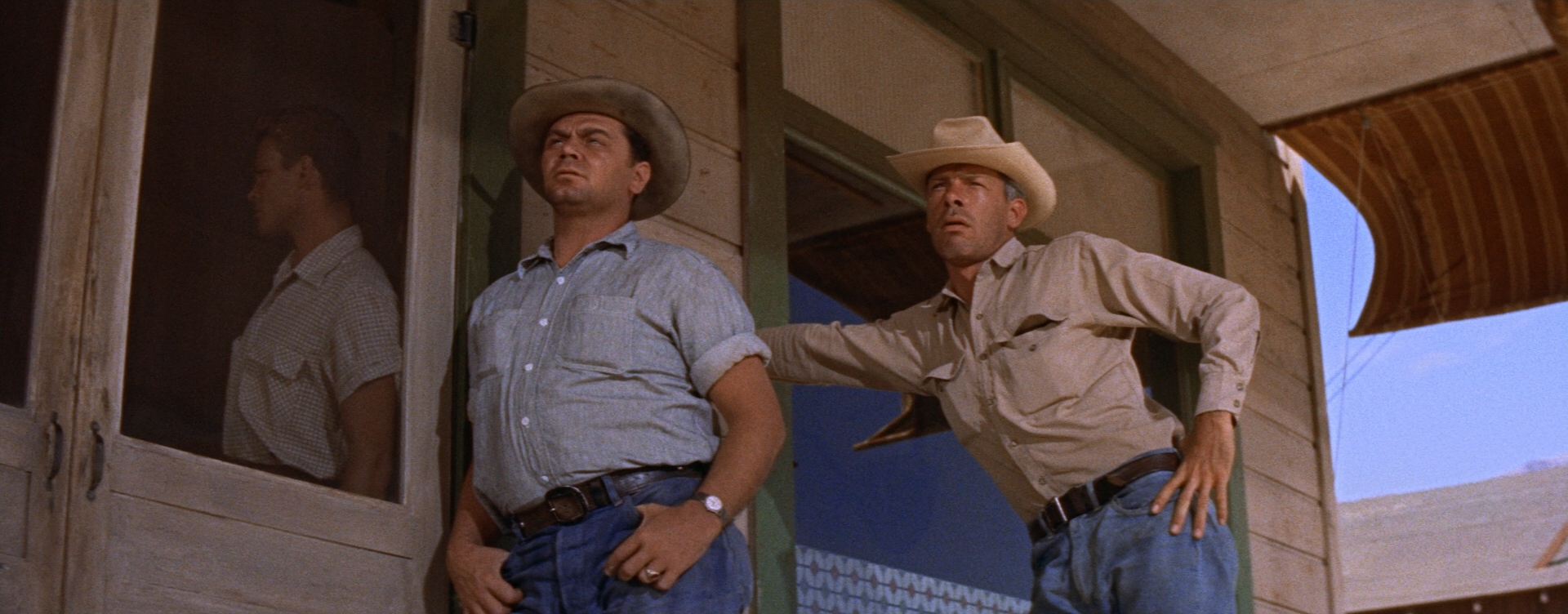
The town is run by a man named Smith (Robert Ryan), who’s far from subtle in his hints that the stranger isn’t welcome and should leave on the next train in the morning, if not sooner. At his beck and call are gruff cowboy Hector (Lee Marvin in an early breakout role) and the arrogant but dim-witted bully Coley (Ernest Borgnine, in a wildly different performance than his Oscar-winning turn in Marty the same year). As hard as they try to run him out of town, Macreedy won’t be dissuaded from his task, whatever it should be. The longer he stays, the more agitated everyone else gets, panicked about what he’s doing or what he might find.
About the only sympathetic faces Macreedy encounters are a washed-up doctor (Walter Brennan) and a perpetually drunk sheriff (Dean Jagger), neither of whom can do a damn thing to help. The town’s only female resident (Anne Francis) is elusive in her loyalties.
The mystery in this story isn’t much of a mystery at all. Macreedy wants to find Komoko, and everyone else doesn’t want him to. The possibilities for what might have happened here are pretty limited, and Macreedy surely knows it. Nevertheless, he calmly yet firmly presses on anyway until he can get to the truth, even if he can do almost nothing when he finds it.
Directed by John Sturgess (The Great Escape, The Magnificent Seven), Bad Day at Black Rock is a tale of strong-willed men pushing against one another, none willing to cede their ground. The film has very little action, and most of it is pretty ridiculous, to be honest. As mentioned, the plotting is thin, even strained. Although Smith makes numerous threats to kill Macreedy, for some reason he doesn’t go through with them, even though he’d face no repercussions if he did. He owns the only law in town and has ample resources (and locations!) to bury a body. When he finally sets his mind to it, Smith feels some inexplicable need to wait until dark and lure Macreedy into a trap outside town. If he’d just ordered Hector or Coley to shoot the damn guy in the street earlier in the day, the movie would’ve been over right then and there.
On the other hand, the film is an object lesson in how to build tension and suspense out of nothing. The silences and waiting between confrontations carry a lot of weight. While directed with little pretension of great depth or meaning, the movie burbles quietly with subtext about social divisions (the big city man vs. rural folk), abuse of power by the wealthy, and racism toward a faceless, arbitrary victim. Perhaps it has more going on beneath the surface than can be seen at first glance.
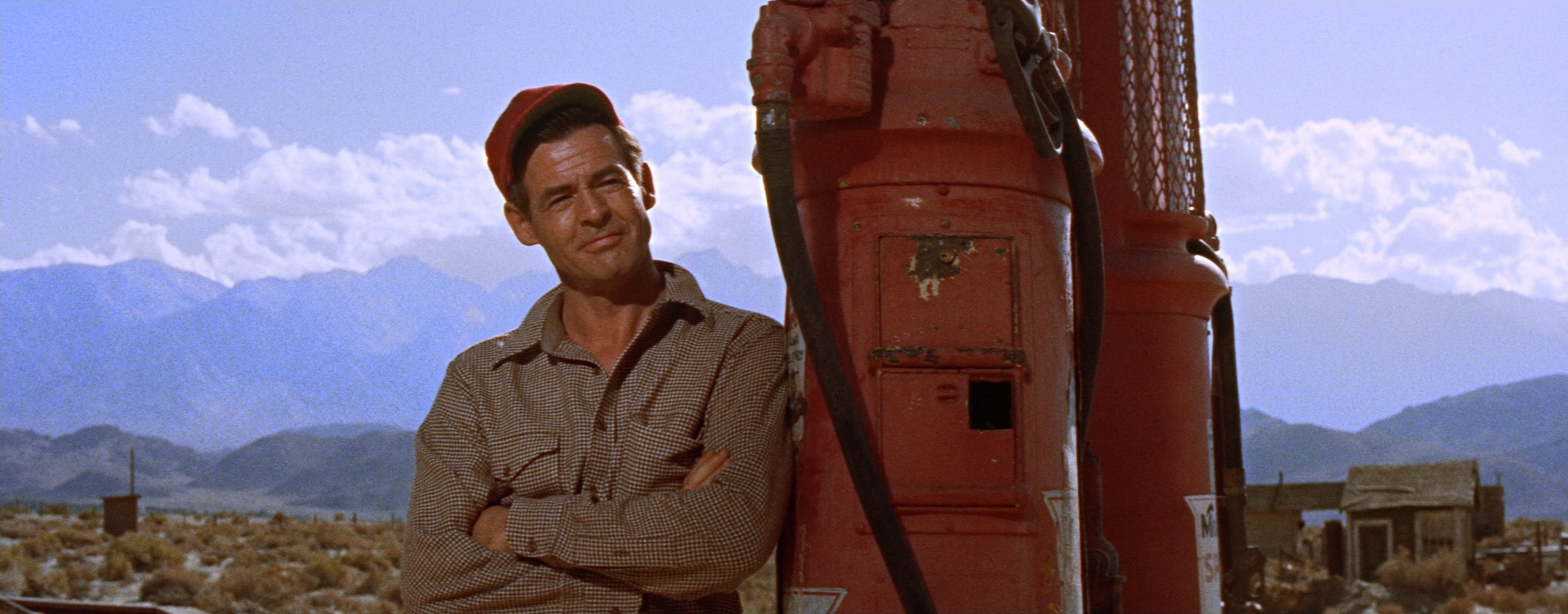
The Blu-ray
Bad Day at Black Rock arrived on Blu-ray in 2017 from the Warner Archive Collection. No 4K upgrade has been indicated at this time.
The CinemaScope process, especially in its early days, was renowned for the breadth and grandeur of its imagery, but not so much for its sharpness. The anamorphic camera lenses sometimes had focal issues, and occasional fisheye effect during panning motions. On top of that, this movie has optical composites during the opening credits and later dissolves that look very soft and dupey. Grain is often prominent.
Transferred at is full, original 2.55:1 aspect ratio, the image feels palpably wider than the later 2.35:1 standard. Detail is better in some shots than others. I tend to doubt the video master was scanned from the camera negative, which might yield at least a little improvement.
Color is decent enough, but the Eastmancolor film stocks were rarely very vibrant.
Several shots, mostly outdoors, have what looks like a blue halo around the characters. I assume this was an optical issue, as it doesn’t look like an electronic edge sharpening artifact to me.
CinemaScope was typically accompanied by 4-track stereo audio, consisting of three channels across the front and a mono surround. That’s been encoded on disc in matrixed DTS-HD Master Audio 2.0 format and should be decoded with an upmixer such as Dolby Surround or DTS Neural:X. The track is a little thin and has no bass or dynamic range of note. Sounds in general are sparse except for dialogue and music. Surround use is mild, mainly music bleed expanding a little beyond the front speakers.
Bonus features are limited to an audio commentary by USC film professor Dana Polan and a trailer.
Related
- Film from Z to A Article Index
- Robert Ryan
- Ernest Borgnine

