
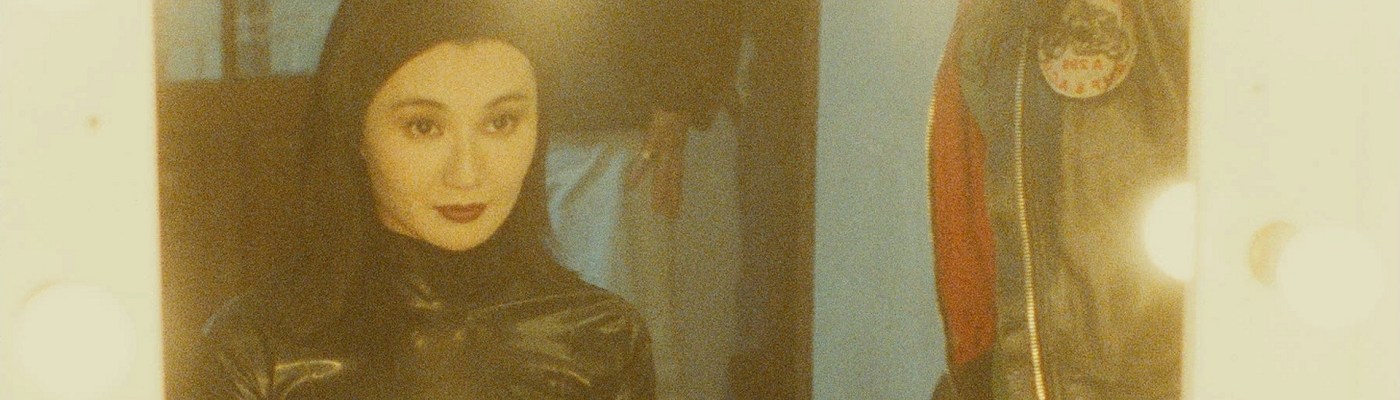
Like countless fictional films about the making of other fictional films (Day for Night, The Player, etc.), French director Olivier Assayas’ 1996 comedy (?) Irma Vep attempts to blur some sort of line between fantasy and reality. However, this one begs a particularly frustrating question: Can a movie really be a satire of pretentious French cinema when it is itself a piece of pretentious French cinema made by one of France’s most pretentious of modern filmmakers? I’m afraid I’m left feeling that it can’t. This puts me somewhat at odds with critical consensus for the movie, which is much higher than I’d rate it.
I first watched Irma Vep on DVD in the late 1990s or early 2000s and didn’t especially like it at that time. Nevertheless, I later purchased it on Blu-ray when it entered the Criterion Collection, hoping to re-evaluate that opinion in light of the effusive glowing praise many other reviewers have lauded on the film. I put off doing that, even entirely ignoring Assayas’ own cable miniseries remake in 2022. For some reason, I pulled the original off the shelf now, only to find that my previous assessment holds firm. Perhaps I’ve just missed the boat on this one, but if so, I’m happy to stay on the dock.
| Title: | Irma Vep |
| Year of Release: | 1996 |
| Director: | Olivier Assayas |
| Watched On: | Blu-ray |
| Also Available On: | The Criterion Channel HBO Max |
I wouldn’t necessarily say I hate Irma Vep. I like a few things in the movie. No, honestly, I like precisely two things in the movie. The first, and most important, is the presence of delightful Hong Kong star Maggie Cheung. The actress is in every scene and holds them all together, even as the film actively works against itself to fray apart at the seams. The other is the song “Bonnie and Clyde” covered by French alt-rock band Luna over the end credits. That’s about it.
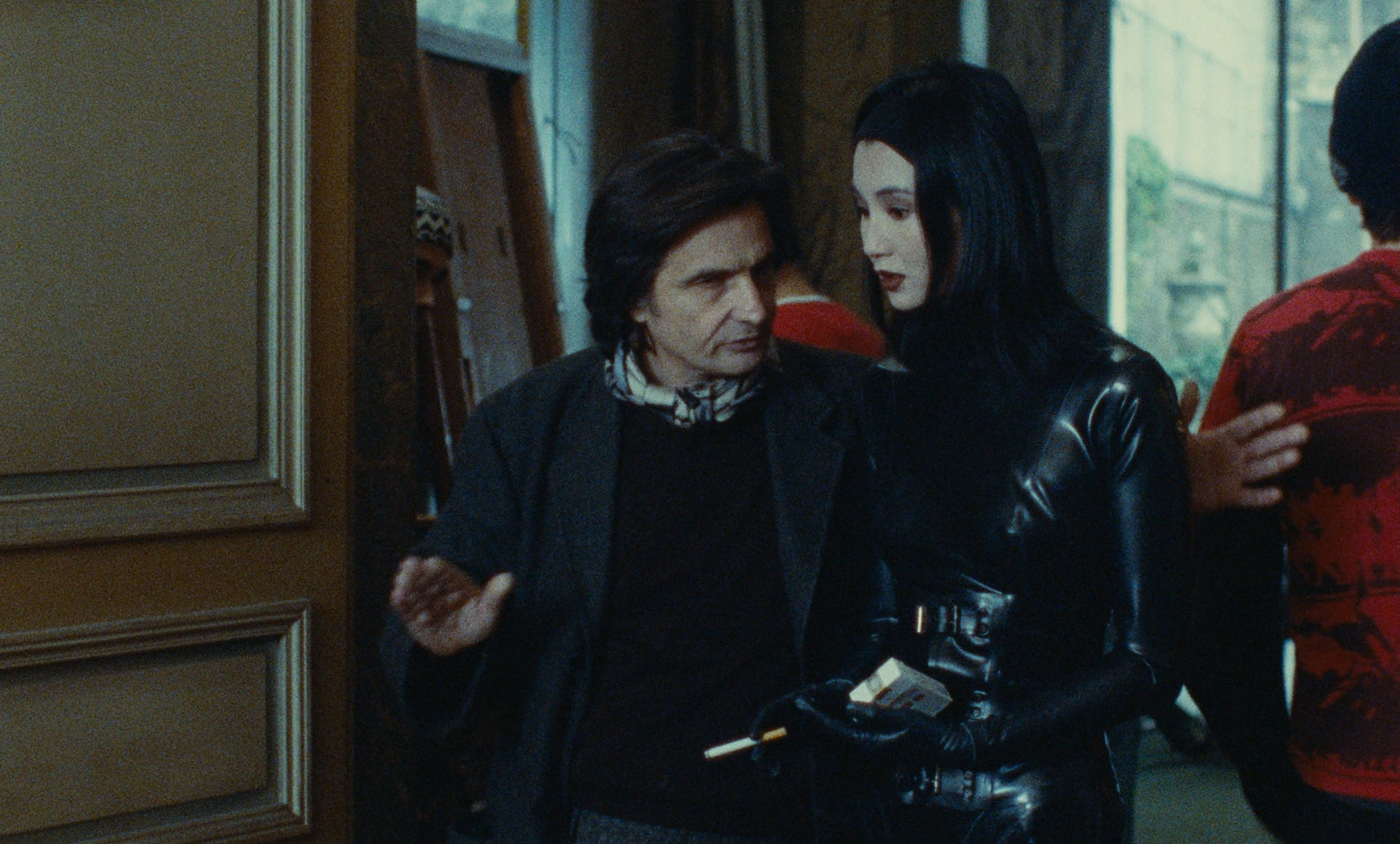
Cheung plays… well, she plays Maggie Cheung, a fictionalized version of herself as a Hong Kong action star who comes to France at the behest of a director named René Vidal (Jean-Pierre Léaud) to play the lead in his new remake of a famous silent film series from 1915 called Les Vampires. Cheung knows very little about French cinema, because few French movies have played in Hong Kong, but she holds a fantasized idea of it being very artistic and intellectual, and she wants to do something new and challenging in her career for a change. Those plans don’t work out too well.
Despite its title, the original serial Les Vampires is not actually about vampires, but rather about a mysterious criminal organization based in Paris. The Irma Vep of the title (her name a simplistic anagram for “Vampire”) is a cat burglar clad all in black who skulks through the city at night, across building rooftops, to break into homes or apartments and steal their valuables.
René, once a respected artist in the French film community, has fallen into a state of decline in recent years and needs a success, hence directing a more commercial project than usual. Just about the whole crew, especially costume seamstress Zoé (Nathalie Richard), think René is washed-up and have great skepticism about the film he’s making, if not outright contempt for both him and it. René earns their loathing when his behavior becomes abusive and he suffers a nervous breakdown after watching his own footage, abandoning the set without notice.
Maggie, who speaks almost no French, can only communicate with her director or other members of the crew in English, which a few of them speak in very thick accents and, like many Parisians, find to be a crude and distasteful language they’d rather not use. That’s when they bother trying to communicate with her at all. Most of the movie consists of Maggie standing around bewildered or being rushed from place to place with little instruction while those around her have seemingly never-ending conversations and/or arguments (it’s often difficult to tell the difference) she doesn’t understand. Many of these are about Maggie herself, standing in the room oblivious to what they’re saying.
Through all this, Maggie tries to maintain a positive attitude and acts like she’s happy to be there despite the chaos of her situation. The film looks to be a total disaster even its director hates. The crew do their jobs because that’s what they’re paid to do, but have no interest at all in the project and no respect for their director. Most of them don’t even like French cinema in general, even while they’re making it. At times, it feels like no one in France actually likes French cinema. When Maggie sits down for a puff-piece interview with an entertainment journalist, the man goes on and on about how bad French movies have become, and how much more enthusiasm he has for those by John Woo (with whom Maggie has never worked). As much as she tries to defend the role she’s playing, nobody else cares.
Assayas shoots all this in a fly-on-the-wall, vérité fashion that drops viewers directly into the middle of the story with no setup. What passes for plot is entirely aimless and rambling. None of the characters are worth caring about, beyond Maggie and the seamstress Zoé. Their quick friendship becomes very awkward when Zoé makes the mistake of confiding with another friend that she may have romantic intentions toward Maggie, and that friend immediately goes to Maggie to tell her about it just to create some drama between them. Maggie has no idea how to process this information.
I suppose the listlessness of the story, when contrasted against the frantic and chaotic manner in which it’s told, is meant to capture the “Hurry up and wait” nature of real film production. Unfortunately, if that concept sounds at all interesting or amusing, the actual execution by Assayas left me cold. I get what the movie is doing; I just don’t find it as clever as Assayas does. I can think of plenty of other movies-about-making-movies that have done the same thing better.
All that said, the only fun scene in the movie comes when Maggie, having nothing else to do while the production scrambles to go on without René, puts on her latex costume and sneaks around through her hotel, even slipping into a random room to burgle a meaningless piece of jewelry, just to experience what her character may be like. Later, when we finally get to see the footage René shot, and what he’s done to it, the result is predictably awful, but in a fascinating way very different than expectations may lead. Rather than a boring and generic crime caper, the man has turned his partial movie into an insane document of his own mental breakdown captured on celluloid.
I guess I also liked those parts, though not enough to sit through any of Assayas’ own TV remake.
The Blu-ray
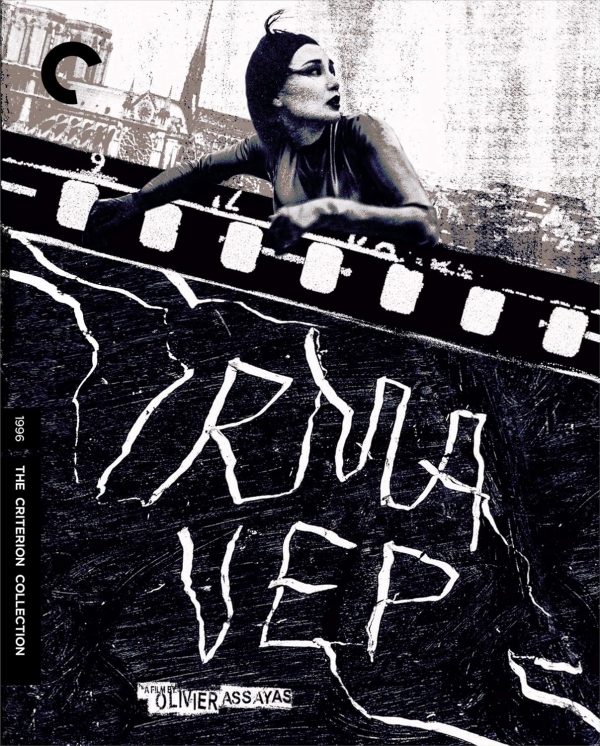
Irma Vep joined the Criterion Collection in 2021 as spine #1074. The Blu-ray edition came as a two-disc set loaded with bonus features, not all of which are specific to this particular movie.
A card before the opening titles states that the film was “restored by Éclair Group and L.E. Diapason.” Why a movie from 1996 would need to be restored and boasted about in such a fashion, I cannot fathom. Perhaps that’s meant to be a joke lost to English speakers? Criterion also abuses the term (as is not unusual) in the accompanying booklet, which claims a 2K digital restoration approved by director Olivier Assayas. At this time, no 4K version has been announced, and I can’t imagine one would ever be needed.
Irma Vep was photographed mostly on 16mm film in a style meant to look improvised on the spot. The camerawork is handheld, the focus soft, the lighting from natural sources with the camera’s iris opened al the way, and the film stock grainy as hell. The mildly pillarboxed 1.66:1 image has very flat contrast, and frankly just plain weird and washed-out colors. All of this is completely intentional, and for what it is, 4K and HDR would never do a thing for it.
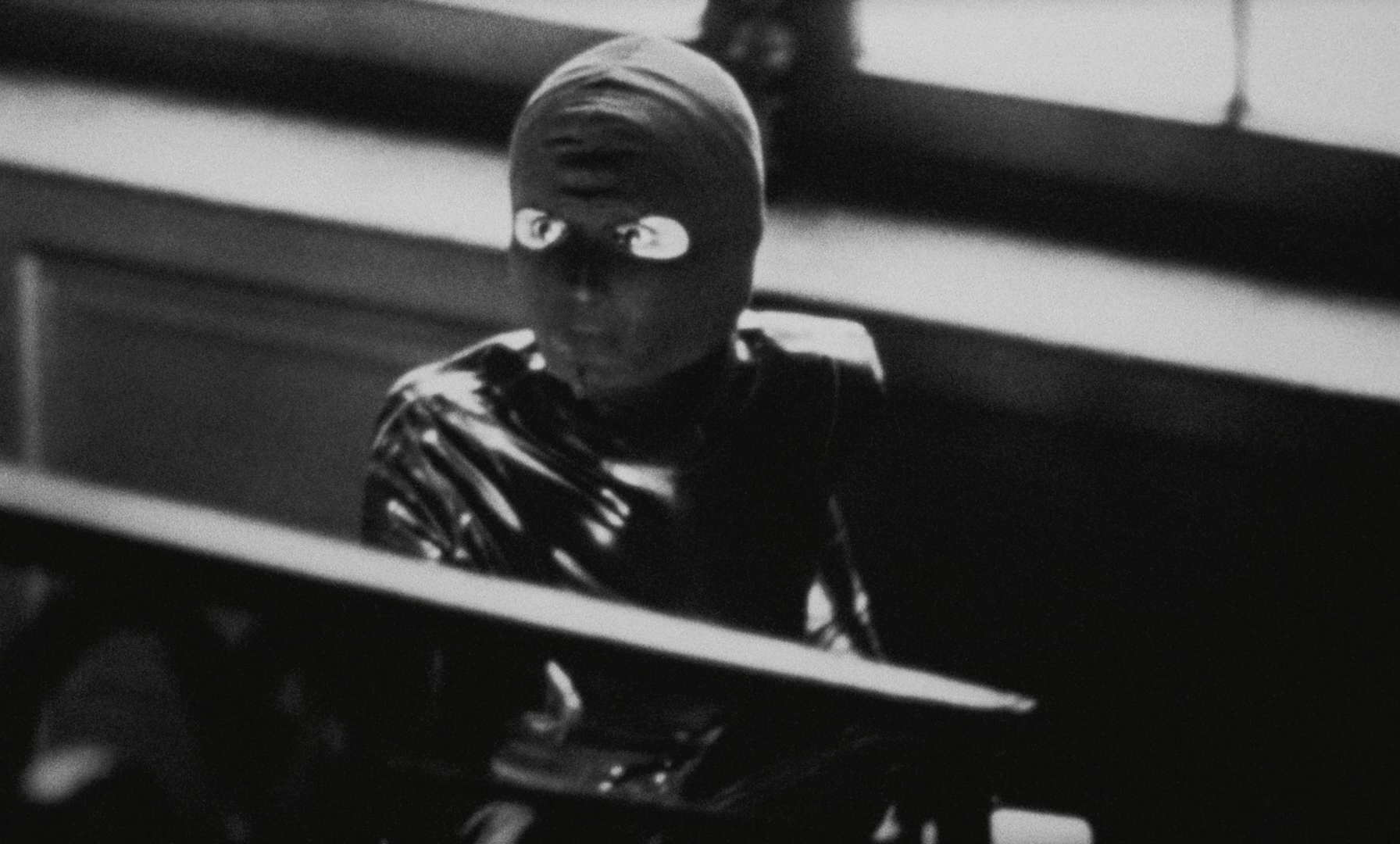
The movie also has black-and-white segments to represent the film-within-the-film. Those look even softer, but the camerwork is more stable, as if it were made by professionals.
The disc has a DTS-HD Master Audio 5.1 soundtrack with dialogue in a mix of French (with default subtitles) and English. For 5.1, the mix has almost nothing going on in the surround channels, which from my seated position sounded mostly if not completely inactive. The movie is extremely dialogue-driven, and is clear enough in that regard with nothing notable about it. A couple scenes have music that’s a little more energetic, but nothing that will tax any viewer’s sound system.
Extras start on Disc 1 with a then-new (2021) interview with Olivier Assays, followed by two older interviews from 2003. In one, Assays and critic Charles Tesson recount visiting Hong Kong. In the much more interesting one, actresses Maggie Cheung and Nathalie Richard discuss their collaboration and experiences, and we learn that Cheung in fact speaks quite fluent French. After these are a half-hour of vintage behind-the-scenes footage.
Disc 2 offers a hour-long episode of the 1915 Les Vampires serial, plus a documentary about its star, an actress named Musidora. Assayas then delivers a lecture about the state of cinema in 2020 as he saw it.
A so-called “Portrait of Maggie Cheung” is a silent short film Assays directed with the actress. Even at just five minutes, it’s insufferably pretentious. About half that time is spent watching Cheung apply moisturizer to her face.
The disc ends with a few minutes of black-and-white “rushes” from the film-within-the-film.
The accompanying booket contains a lengthy essay defending the movie by writer/film programmer Aliza Ma.
Related
- Film from Z to A Article Index
- Maggie Cheung


Wow…just reading your recap makes me want to throw something.
Thank you for helping me avoid this one…
LikeLike
Keep in mind that I seem to be in a minority with this opinion. Most other reviews are much more positive. It just struck a nerve with me that made me find it nearly insufferable.
LikeLike
Well my interest has been piqued. Might have to check this out. Can’t be as bad as Josh says it is… or can it?
LikeLike
I hope you enjoy it, Chief.
There’s nothing worse than suffering through a movie you’re trying give a chance to when you could be watching something you actually enjoy.
LikeLike
I forced myself to read the booklet essay that came with this Criterion disc and, dear lord, it’s somehow even more pretentious than the movie. I hardly thought that possible. Here’s an excerpt of one sentence (and yes, this is all a single sentence):
“But Irma Vep retains a critical and speculative distance from its collage of different subjectivities, reference points, and diegetic realities, and positions its audience in the middle of all these enlivened scenes and discussions – prompting us to question the stability of our own individual aesthetic, ideological, and political identities and assumptions – rather than making any grand judgments or proclamations about the present or future state of cinema, its form and main subject.”
Christ in a can, woman, put down your thesaurus! It’s a very long essay and every sentence in it reads like this. It’s simply torturous.
The whole point the writer is trying to make could be more easily (and clearly!) expressed in about two paragraphs if she’d just cut out all the annoying critical buzzwords and stream-of-consciousness BS, and actually said what she means.
“In the wake of the tumultuous events that led up to May 1968, the lettrists and situationalists cautioned against a future in which social relations between people would be supplanted by the passive fetishization of commodities and spectacle for spectacle’s sake – a warning that probably warrants repeating today.”
I’m exhausted just trying to read that.
LikeLike