
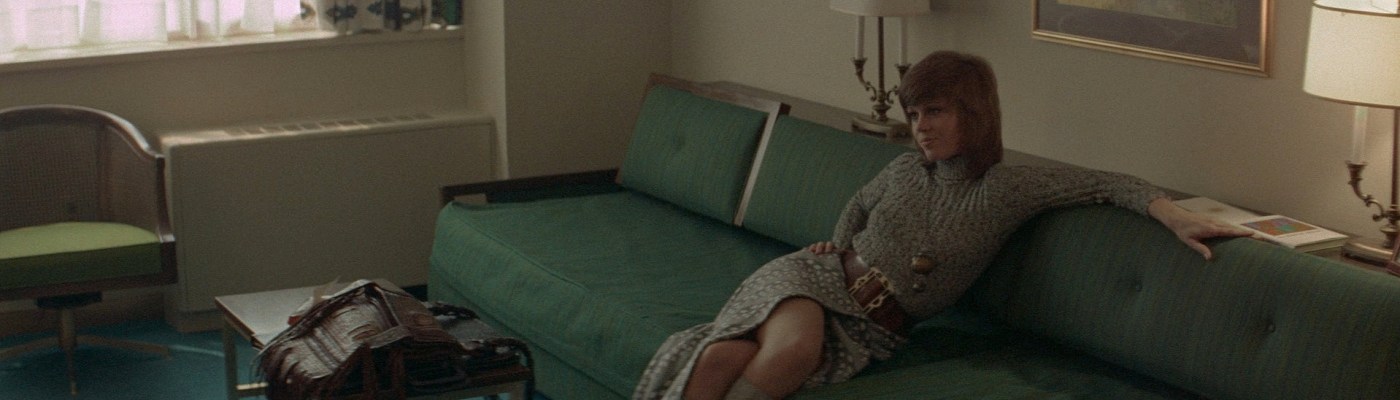
The movie that won Jane Fonda her first acting Oscar, Klute deserves equal credit for director Alan J. Pakula, master of the 1970s paranoid conspiracy thriller. If not a conspiracy story, per se (though a little bit so), Klute is certainly rife with paranoia, and Pakula subverts the thriller genre in unexpected and remarkably effective ways.
Fonda, of course, shines here as well. Following the notorious sci-fi dud Barbarella in 1968, Fonda’s career rebounded quickly with an Oscar nomination for the period drama They Shoot Horses, Don’t They? the next year and then a win for this, proving that her early success in Barefoot in the Park was no fluke, and that the actress was as compelling in heavy dramatic roles as in romantic comedy.
| Title: | Klute |
| Year of Release: | 1971 |
| Director: | Alan J. Pakula |
| Watched On: | Blu-ray |
| Also Available On: | Kanopy Various VOD rental and purchase platforms |
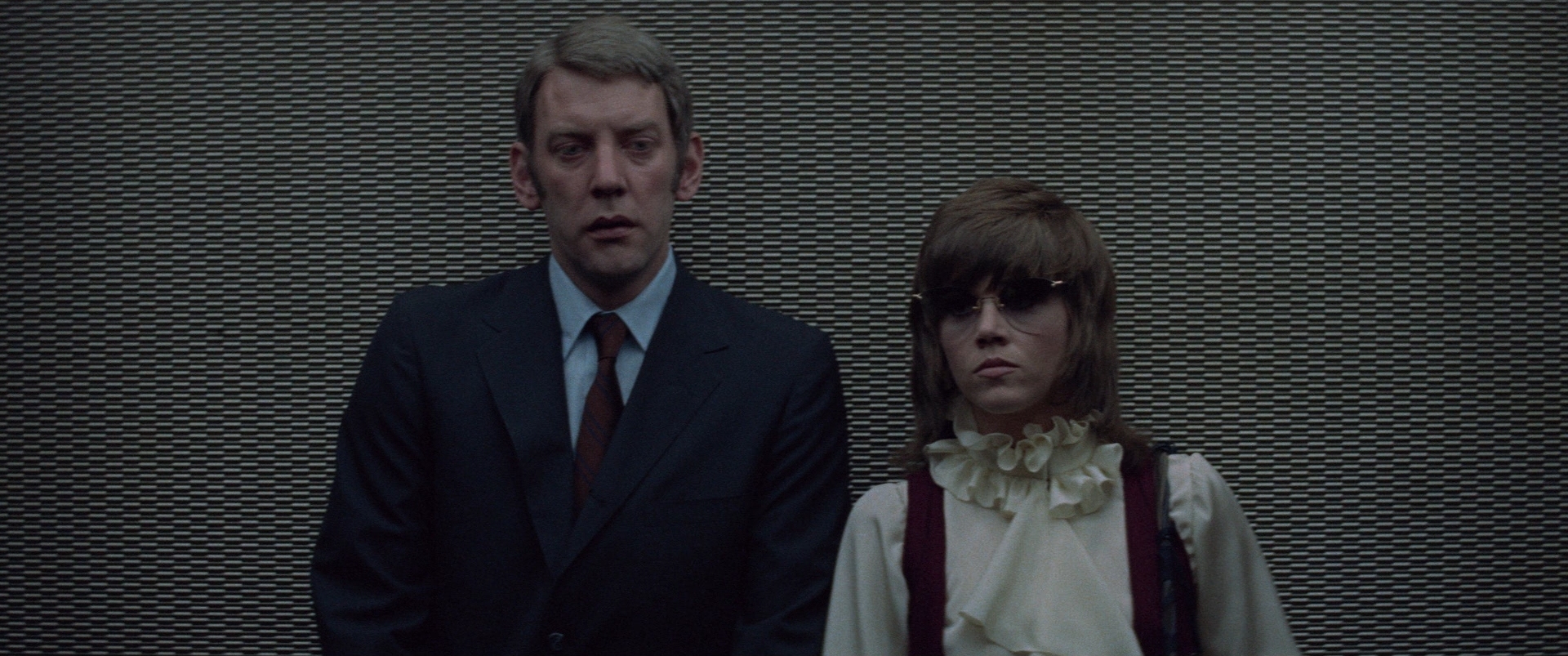
On its surface, Klute is a detective thriller, in which a police officer steps away from his job to work a private investigation involving the disappearance of a friend. Despite John Klute (Donald Sutherland) having no prior experience with missing-persons cases, the subject’s wife and boss both feel that he has a personal attachment and would be best able to find his friend, named Tom Gruneman.
While the wife insists they had a happy marriage and her husband was faithful, evidence points to Gruneman having repeated affairs, and what seems to be an unhealthy obsession with New York City call girl Bree Daniels (Fonda). Klute neither believes nor disbelieves that, and finds either possibility plausible. For her part, Bree is very busy and successful at her work, has many regular clients, and claims to barely remember the man. However, she’s been receiving a lot of troubling heavy-breathing phone calls and often feels like she’s being watched. All signs add up to the conclusion that Gruneman has abandoned his family, gone off the deep end, and is stalking his favorite prostitute. The reality, naturally, turns out to be a little more complicated.
More than just a straightforward thriller, the film is really a character study of two very different personalities. As detective, Klute is stoic and seemingly emotionless. He analyzes any situation he’s put into with a dispassionate and cold logic, that only slowly starts to crack as he becomes more invested in the outcome of the case and in Bree, but even so, never fully breaks.
Meanwhile, Bree herself is something of a contradiction, both strong-willed and self-assured yet also vulnerable. She feels no shame or guilt about her current work. Sex is just a tool for her, one she uses to assert some form of control onto her life, which is otherwise a mess. Even with all the tricks she turns, money is running short, and her attempts to make her way into a more legitimate profession such as modeling or acting have gone nowhere. Sex will no longer bring her real pleasure, but it allows Bree to take charge over the type of men who would normally look down on her. Men pay her to come to them, and beg for her talents and services. Still, she can’t help but fear that eventually a man will harm or kill her, especially after exactly that happens to some of her friends.
Even coming out of the Swinging Sixties and the very recent end of the Hays Code, cinema was still, for the most part, extremely conservative in the late 1960s and early 1970s. Midnight Cowboy winning Best Picture the year before seemed to open the door for another a mainstream movie distributed by a major Hollywood studio to take a frank look at sex work, perhaps even more so. Klute was definitely a beneficiary of what felt like a growing sea change in the industry. The film casts no moral judgment on Bree or her work. It, and John Klute as a character, accept her for what she is. Jane Fonda is terrific in the role, displaying a full range of emotions. She earned that Oscar.
Donald Sutherland is compelling in different ways. His stillness is eerie, sometimes uncomfortable for those around him. He barely speaks, and only with words necessary to convey his meaning. Somehow, we understand exactly what he’s thinking and how he feels regardless.
Roy Scheider also has a fun turn as Bree’s pimp, who fancies himself a successful businessman with menacing undertones. The character is a big divergence from his performance in The French Connection the same year.
Orchestrating all this is Pakula, a studio producer (of To Kill a Mockingbird, among other things) in only his second time sitting in the director’s chair. The filmmaker places these characters into a thriller plot that eschews traditional action or jump-scare beats. The movie is disconcertingly quiet in almost every scene, with dialogue spoken in low tones and the music minimal. When watched in a proper setting, in a movie theater at the time or at home now with the lights off and no other sounds to distract you, these techniques build incredible tension and suspense. Even the subtlest of sounds could mean that something terrible is about to happen.
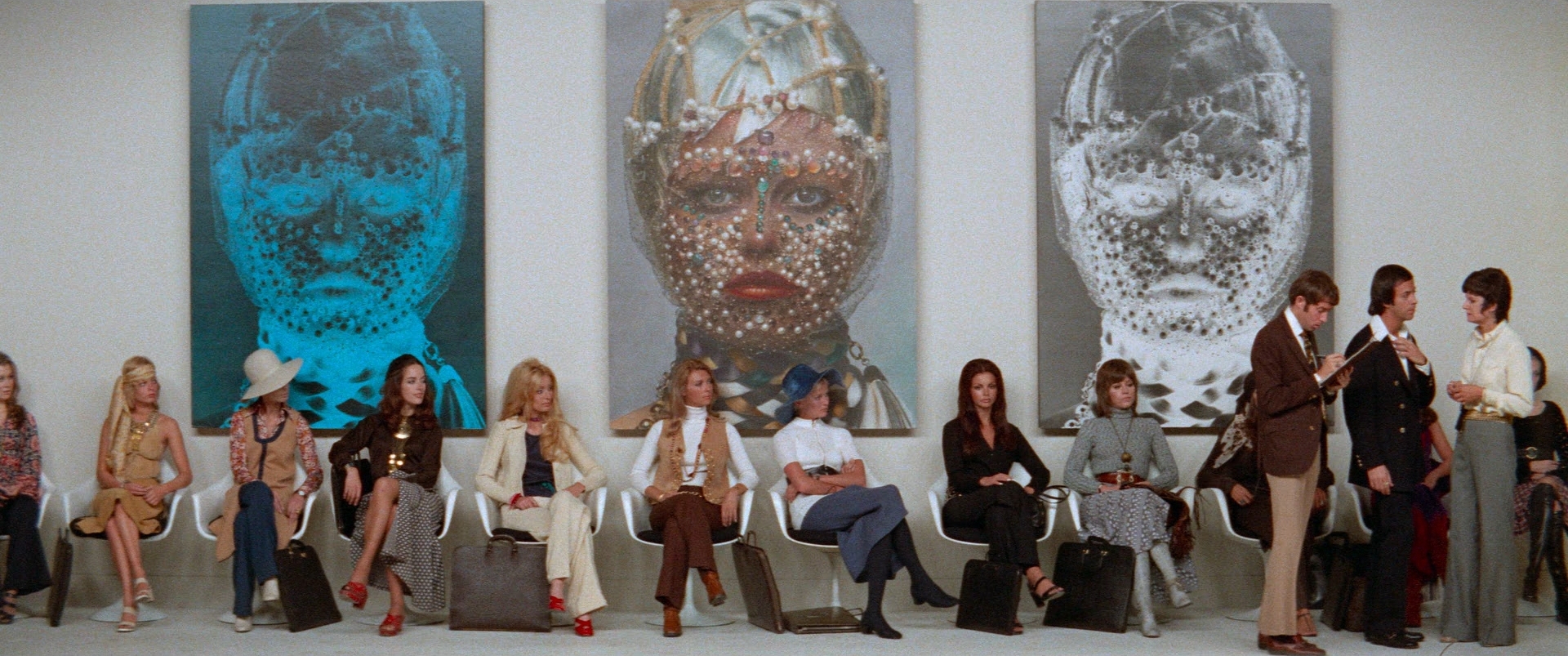
The film is also a very stylish piece of work, set in a period mid-transition from the wild flamboyance of the 1960s into the sterile blandness of the mid-’70s, before Disco took over. The fashions and production design are fascinating, a time capsule from an era both familiar and strange to viewers from my generation, who grew up just after it.
Klute is more than just a footnote in Oscar history. It’s still a terrific movie in every respect.
The Blu-ray
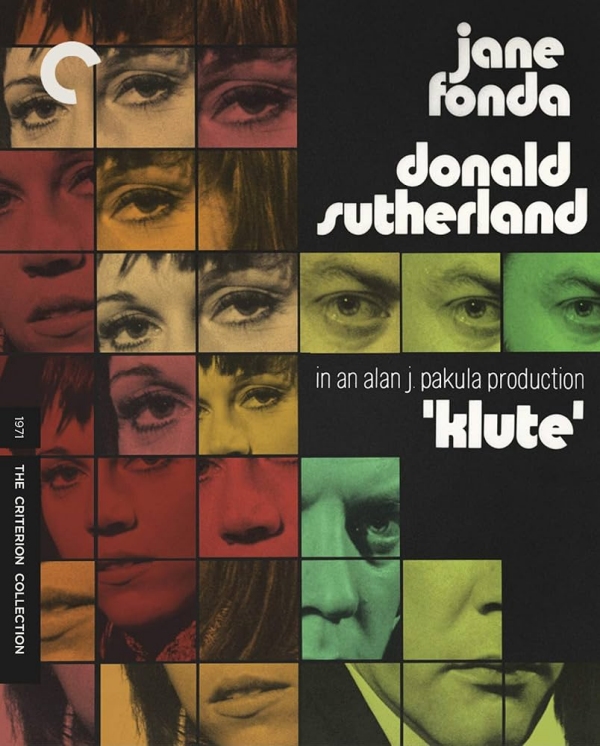
Klute joined the Criterion Collection in 2019 as spine #987, available simultaneously on DVD and Blu-ray. As of this writing, no 4K upgrade has been announced.
The Blu-ray is credited in the accompanying booklet as being sourced from a 4K scan of the camera negative. Because both director Alan J. Pakula and Director of Photography Gordon Willis were deceased by that point, the transfer was supervised by camera operator Michael Chapman, an accomplished cinematographer in his own right. (Chapman also passed away about a year after this disc was released.)
The first thing most viewers will notice about the Blu-ray, perhaps discomfortingly, is the grain, which comes thick and heavy right from the opening scene. Klute is an extremely grainy movie, and I’m not convinced that Pixelogic (Criterion’s authoring house of choice) has encoded it well. The film grain looks very noisy and exaggerated.
In other respects, the 2.39:1 image looks quite nice, keeping in mind that Gordon Willis (known as the “prince of darkness”) liked to shoot in low light. The photography is often dark and shadowy, and requires viewing in a darkened room. It doesn’t look dim, but it also doesn’t have a lot of dynamic range in the contrast. Black levels appear slightly elevated, which may be intentional. I don’t have any specific technical details about the photography, but low-contrast film stocks and lens filters were very popular at the time.
To that end, the movie is the product of many stylistic trends of the 1970s, hence the grain and the abundance of brown in the color palette. Other colors are sometimes striking, though soft.
I’m left unsure how much 4K and HDR would do for this movie. They might improve the contrast, especially highlights, or may exaggerate them beyond what Willis intended. They’d probably also make the grain look even worse. Blu-ray may hit a sweet spot for this movie. I just wish the grain had been encoded better.
The soundtrack is available only in PCM mono format. Fidelity is strong for mono, in ways that may not immediately impress viewers expecting loud and dynamic audio. The sound design for Klute is notable for its use of silence. Music is dialed way down in volume and used sparingly. Most of the movie is talking, but during the quiet suspense sequences, the clarity of every subtle sound effect is important.
Bonus features consist of an excerpt from a documentary about director Pakula, a 36-minute piece in which Jane Fonda is interviewed by actress Illeana Douglas, a 25-minute featurette about the film’s costumes and production design, plus some vintage television interviews and a short promo.
The enclosed booklet contains an essay by film historian Mark Harris and a 1972 print interview with Pakula conducted for Sight and Sound magazine.
Related
- Film from Z to A Article Index
- Alan J. Pakula (director)
- Jane Fonda
- Donald Sutherland
- Roy Scheider


Excellent review, Josh. Fonda’s performance in this remains the best I’ve ever seen from an actress. Have often wondered what the 4K treatment might do for this movie but very pleased with Criterion’s disc of one of my very favorite ’70s flicks. Really overdue for a rewatch and might just do so this weekend.
LikeLiked by 2 people
This title has been on my “must see” list for forever. I need to see this flick! Thanks for the review.
LikeLiked by 1 person
Same!! I really wanna see this one. Great Zyber review!
LikeLiked by 1 person
I wonder if the increased resolution and a higher bit rate may resolve the grain better and make it more palatable…
LikeLike
Possibly. Maybe even probably.
A lot of people on the various home theater forums and Facebook groups regularly complain about Pixelogic and berate Criterion for using them. I don’t usually pay this much attention, because most of those people are fanboys for Fidelity in Motion and will blindly complain about anything else. (The fact that a home video authoring house could have fanboys is a phenomenon I find utterly bizarre.) But in this case, I do think the encoding is a problem. If you pause the frame on any of the grainy scenes, the grain looks blocky, which ideally it shouldn’t.
LikeLike
It doesn’t surprise me what people fight about anymore…the lack of perspective and debate is depressing all because no one can concede anything.
From what I understand about the new 4K release of Moneyball is it was mastered in SDR (purposefully by the director) but is a true 4K DI. I would think that might be the way to go for a 4K release of this one.
LikeLike
This disc has some highlight clipping I think could genuinely be improved with HDR. I’m not sure what Gordon Willis felt about the black level being slightly elevated. That may or may not be intentional, or an inherent characteristic of the film stock used.
The problem is that remastering with HDR often encourages those doing the work to make more eye-catching changes so it will stand out more against the Blu-ray. That’s exactly what happened to the Godfather films on 4K. Robert Harris (who worked directly with Willis on the earlier Blu-ray masters) is very adamant that the 4Ks are wrong and disgraceful.
LikeLike
I can see that. It’s a shame HDR is being utilized in such a way as to really alter the look of a movie instead of enhancing it.
With the 4K release of The Black Phone, the HDR grade is supposedly so oppressive, it crushes the highlights easily seen on the BD. It’s a dark movie to be sure, but you can still make things out with the SDR grade whereas the HDR grade has the shadows smothering the details of the image.
LikeLike