
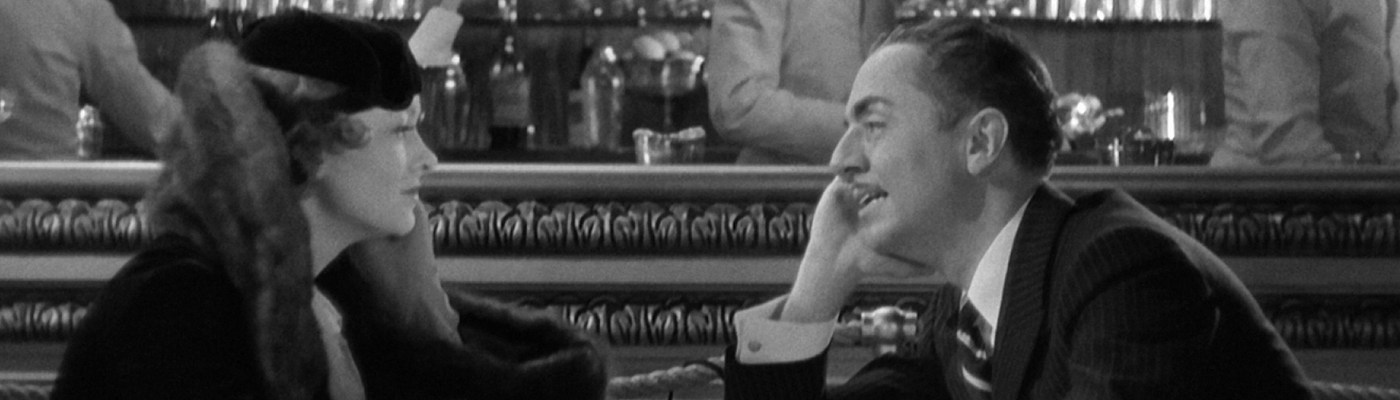
In real life, the prospect of investigating a murder is a grim business that should be conducted with the utmost seriousness and fastidious attention to detail. Yet movies and TV frequently present the job as being so much fun, the type of thing a clever person or team can do in their spare time for a lark. That’s been the case since even the early days of cinema. If not necessarily the first example, the classic 1934 detective mystery The Thin Man perfected the formula and set a template that countless imitators continue to follow close to a century later.
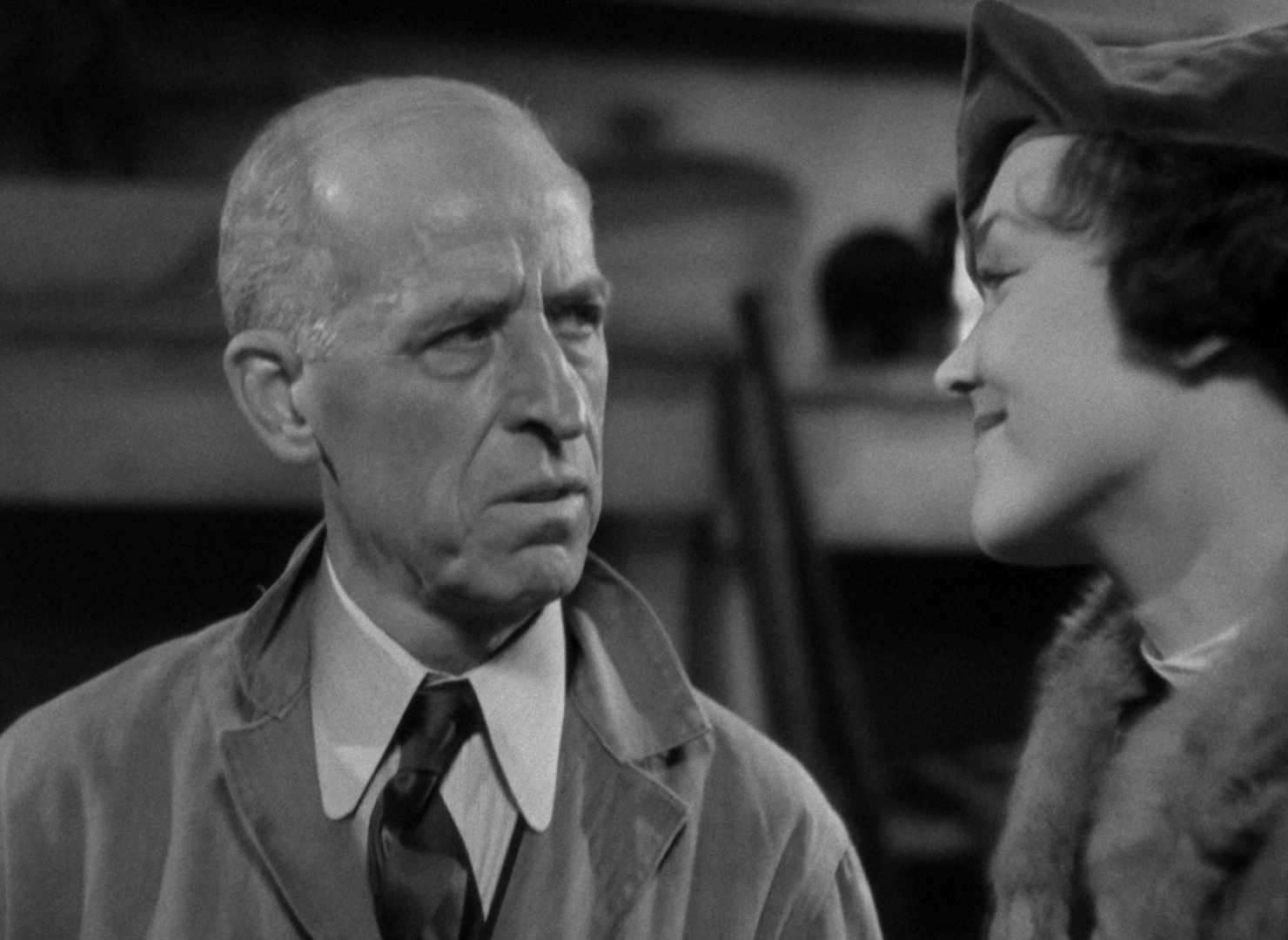
Amusingly, neither of the lead characters in the original film is the “thin man” of the title. That description actually belongs to a supporting character who would not recur again (for obvious reasons). This fact became a problem when the movie turned out to be such a hit the studio insisted on turning it into a franchise with no less than five sequels (plus a later TV series), all of which strained to justify keeping the phrase in their titles for brand recognition.
| Title: | The Thin Man |
| Year of Release: | 1934 |
| Director: | W.S. Van Dyke |
| Watched On: | Blu-ray |
| Also Available On: | Tubi Various VOD rental and purchase platforms |
Based on the final novel by famed mystery author Dashiell Hammett (The Maltese Falcon), optioned for movie rights before it had even finished publishing in installments within issues of Redbook magazine the prior year, The Thin Man follows the exploits of Nick and Nora Charles, a socialite couple from San Francisco visiting New York City over the Christmas holiday. Nick (William Powell) was formerly a private detective of some renown, but happily gave up the job after marrying Nora (Myrna Loy), a wealthy heiress whose fortune can more than keep them living in luxury and well stocked with plentiful supplies of liquor, of which Nick can hardly go without.
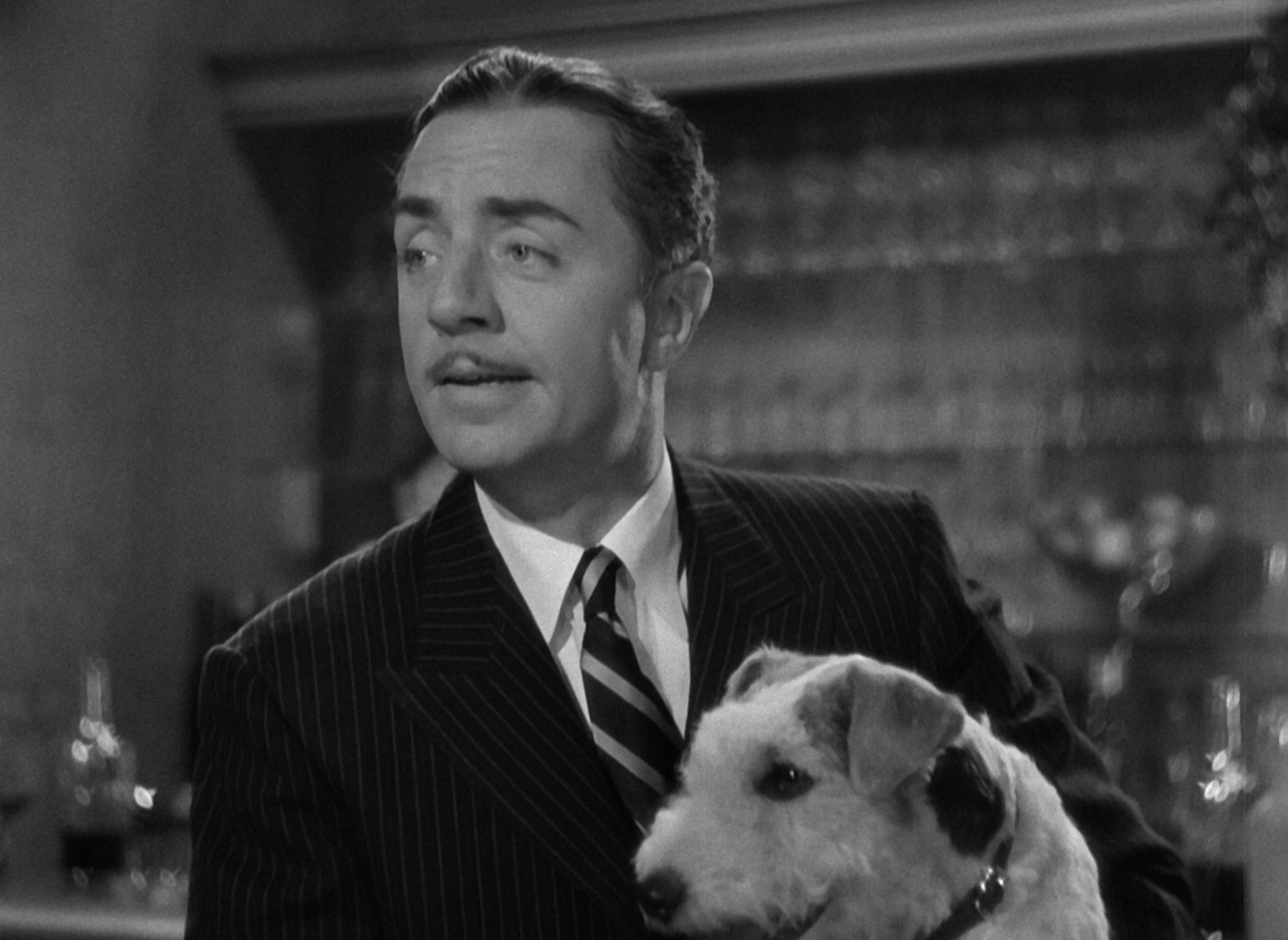
Nick and Nora are a fashionable couple, dapper in attire and capable of mixing with a sprawling social circle that spans both the city’s elite as well as lower-tier criminal elements that Nick used to investigate. Both of them charming, sophisticated, and endlessly resourceful, they (along with an adorable terrier named Asta) find themselves inadvertently entangled in a mystery involving a missing inventor (the thin man of the title) accused of murdering his secretary. who’d stolen a large chunk of money from him. The man’s daughter (Maureen O’Sullivan) worries for her father and believes him innocent. She begs Nick to help her find and exonerate him. Nick has no interest in going back to work at first, until egged on by the adventure-loving Nora, who finds the scandalous affair too exciting to resist. Nick, in turn, can’t resist his wife’s enthusiasm.
The cast of suspects mounts quickly, from the inventor’s ex-wife and other children, to his accountant, employees, and even some mobsters. While the police continue to believe the inventor is guilty of the crime, Nick figures out all too quickly why that can’t be true. The specific details of the plot are both very complicated and, ultimately, not terribly important. When it’s finally revealed, the identity of the real killer is almost incidental and could have easily been anyone else instead. Even the “thin man” himself is not notably thin as a distinguishing characteristic (you’d never look at him and exclaim, “Wow, that guy sure is skinny!”), except for the benefit of a plot twist late in the story.
The real joy of The Thin Man, both this first installment and the rest of the series, is the interplay of Nick and Nora themselves. In that famous 1930s screwball fashion, the characters machine-gun out witty repartee almost faster than viewers can keep up with it. Real human beings may have rarely ever spoken to one another this way but, after watching a movie like this, surely wish they could.
Released in mid-1934, just as the United States was beginning to pull itself out of the Great Depression, The Thin Man is an aspirational tale of the leisure-class wealthy elite, presented as carefree layabouts for whom nothing should be taken seriously, not even murder. In retrospect, the politics of that approach may seem a little suspect, but audiences of the day needed some escapism, and movies like this were just the ticket.
Notably, The Thin Man also arrived only shortly after the repeal of Prohibition, and wastes no time extolling the joys of alcohol, as if it had never been forbidden or illicit. A shameless and enthusiastic drunk, Nick is never without a drink in his hand, from morning to night. The film plays this for laughs, with no concern for the reality of alcoholism.
Reality wasn’t on anyone’s agenda with movies like this, and probably doesn’t need to be. Nine decades and counting since its creation, The Thin Man holds up marvelously as a frothy piece of lighthearted entertainment.
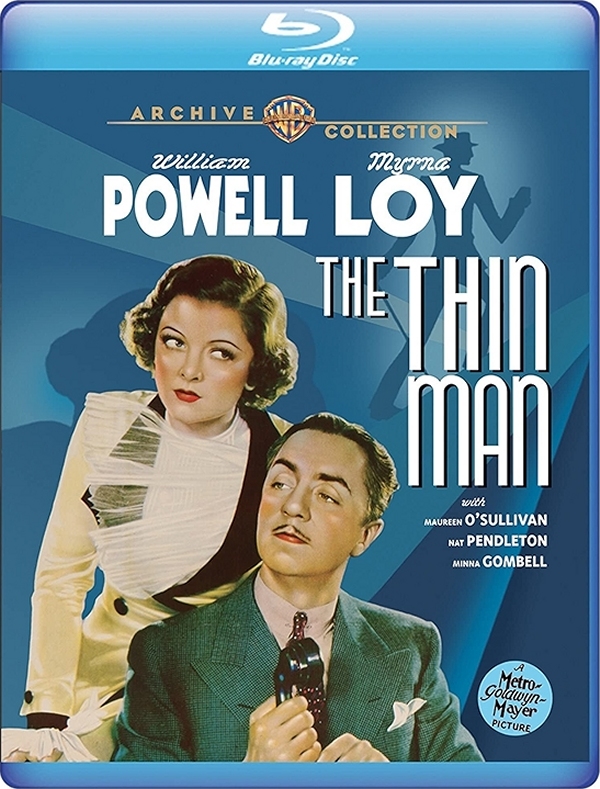
The Blu-ray
The Thin Man first arrived on Blu-ray in 2019 as part of the Warner Archive Collection. That was followed in late 2024 by a six-film set called The Complete Thin Man Collection. I only own the standalone disc for the original movie, which as far as I’m aware should be identical to the one in the box set.
In many ways, The Thin Man is lucky to still exist in any watchable fashion at all. The film’s original nitrate negative is long-since lost or destroyed, and the remaining fine-grain preservation copies are reportedly in poor condition. Prior home video editions of the movie were swamped in heavy grain, with extensive dirt and damage. For its Blu-ray debut, the Warner Archive spent considerable time and effort restoring the film, and digitally cleansing and repairing its many issues. The results are very impressive, though I still have some nits to pick, because it’s my job to do so.
For the most part, the 1.37:1 image is remarkably free of any signs of disrepair. A few faint errant scratches are barely noticeable and easily forgivable. No dirt, drop-outs, or other physical artifacts are apparent any longer. The black & white photography’s grayscale sparkles nicely, and grain is kept to a manageable level. This is certainly the best The Thin Man has looked since its first theatrical run in 1934.
Getting the movie to that point required quite a bit of massaging, needless to say. That it would look soft should be no surprise. Even if the original negative survived, a lot of the picture was photographed in soft focus in the first place, especially the dinner party climax. However, the amount of digital scrubbing has also taken a toll. To my eye, it looks like the film was put through extensive grain removal and then had a light layer of artificial grain added back on top. This leaves the picture with an uncanny appearance of looking both sharp and soft simultaneously. Surfaces and facial features have little textural detail aside from the (fake?) grain. Meanwhile, edge halos and other signs of electronic sharpening are sporadically noticeable.
Honestly, that description probably sounds more serious than it actually is. The alternative, to show the current condition of the film elements without the clean-up, would be far more distracting. I think this was the right decision and I’m happy it looks as good as it does.
The mono soundtrack (authored in DTS-HD Master Audio format) also has its own age-related issues, notably a somewhat bright character and a persistent faint hiss. Neither is worth quibbling about. Movies from 1934 didn’t exactly have elaborate sound design. The film is almost entirely dialogue with a small amount of music and a few sound effects. To that end, the dialogue is all clear and intelligible, which is as much as you can ask for.
Bonus features on the disc include an audio-only 1936 Lux Radio Theater broadcast featuring William Powell and Myrna Loy reprising their characters, an episode of the 1957 Thin Man TV series spinoff starring Peter Lawford, and a trailer.
Related
- Dashiell Hammett (writer)


Nick and Nora, eh? I wonder if the movie ‘Nick and Norah’s Infinite Playlist’ is a shout-out to ‘The Thin Man’.
LikeLike
Undoubtedly.
LikeLike
This is my wife’s favorite movie (and she was introduced to it from Warner Archive’s BD release as well). None of the sequels rival the original, and a couple are actively bad, but there’s still enough charm to keep ’em afloat.
LikeLiked by 1 person
I haven’t seen this film but I have seen Hart vs. Hart and I’m guessing this was the inspiration for that 50-years-removed TV show? I’ve heard for years how good The Thin Man is so at some point I will check it out. Thanks for the review.
LikeLike
This was definitely an inspiration for that show.
LikeLike