
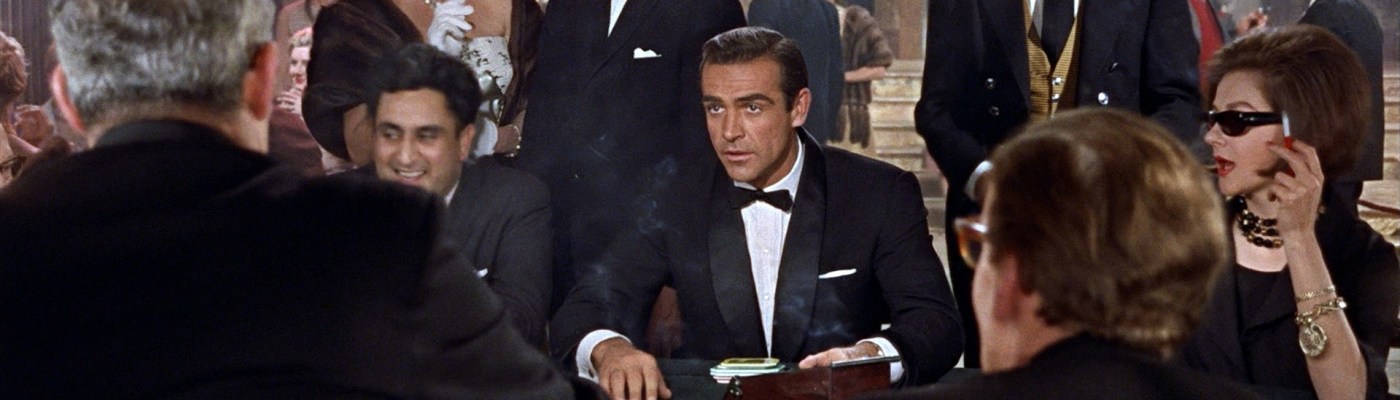
Made on a budget barely equivalent to $1 million USD at the time, the film adaptation of Ian Fleming’s spy thriller Dr. No was very modest even by 1962 standards. Although producers Harry Saltzman and Albert “Cubby” Broccoli surely had high hopes for it, I doubt even the most optimistic of projections could have foreseen that they were about to kick off a global phenomenon that would quickly grow to become one of the most popular and longest-running movie franchises of all time. James Bond, British special agent 007, had arrived on screen, fully ready from the onset to take the world by storm.
Dr. No will forever hold the distinction of being the first James Bond theatrical feature film, which alone earns it a very special place in cinema history. I’m not sure if many fans would really rank it as the best Bond movie, however. The film is rather small in scope or ambition compared to its successors, and a little rough around the edges at times. Nevertheless, it’s still a very entertaining movie in its own right, and many of the hallmarks of what would become the Bond formula originate here.
| Title: | Dr. No |
| Year of Release: | 1962 |
| Director: | Terence Young |
| Watched On: | 4K Ultra HD Blu-ray |
| Also Available On: | Blu-ray Various VOD rental and purchase platforms |
To get technical about it, Dr. No wasn’t actually the first screen appearance for Fleming’s James Bond character. In 1954, Fleming’s novel Casino Royale had been adapted into a one-hour episode of the television mystery anthology series Climax! The plot of that novel was heavily condensed and altered, not just for time, but also to Americanize the character – an idea which seems almost sacrilegious in retrospect.
Nor was Dr. No even based on the first of Fleming’s novels about the British secret agent. (Casino Royale had been.) Dr. No was actually the sixth book in the series. Right from the start, the producers showed little concern for translating the source novels directly from page to screen as originally written. The books were adapted completely out of order from how they’d been published, and in most cases, merely served as loose inspirations for the films that bore their names. Questions of narrative canon or continuity were mostly shrugged-off as irrelevant to the purpose of making successful movies.
With that noted, the Dr. No film may be one of the more faithful Bond adaptations, and follows the plot of the Fleming novel in at least broad terms. (Compare that to the later Moonraker, which took Fleming’s title and a couple character names, and little else.) As published in 1958, Dr. No was always intended to be a smaller-scale adventure for James Bond, a “holiday assignment” the agent undertakes to ease back into duty after recovering from a serious injury in the previous book. While that bit of connective backstory is excised from the movie, the relatively small number of locations worked out very conveniently for the first film, which couldn’t afford to send the character jet-setting around the globe.
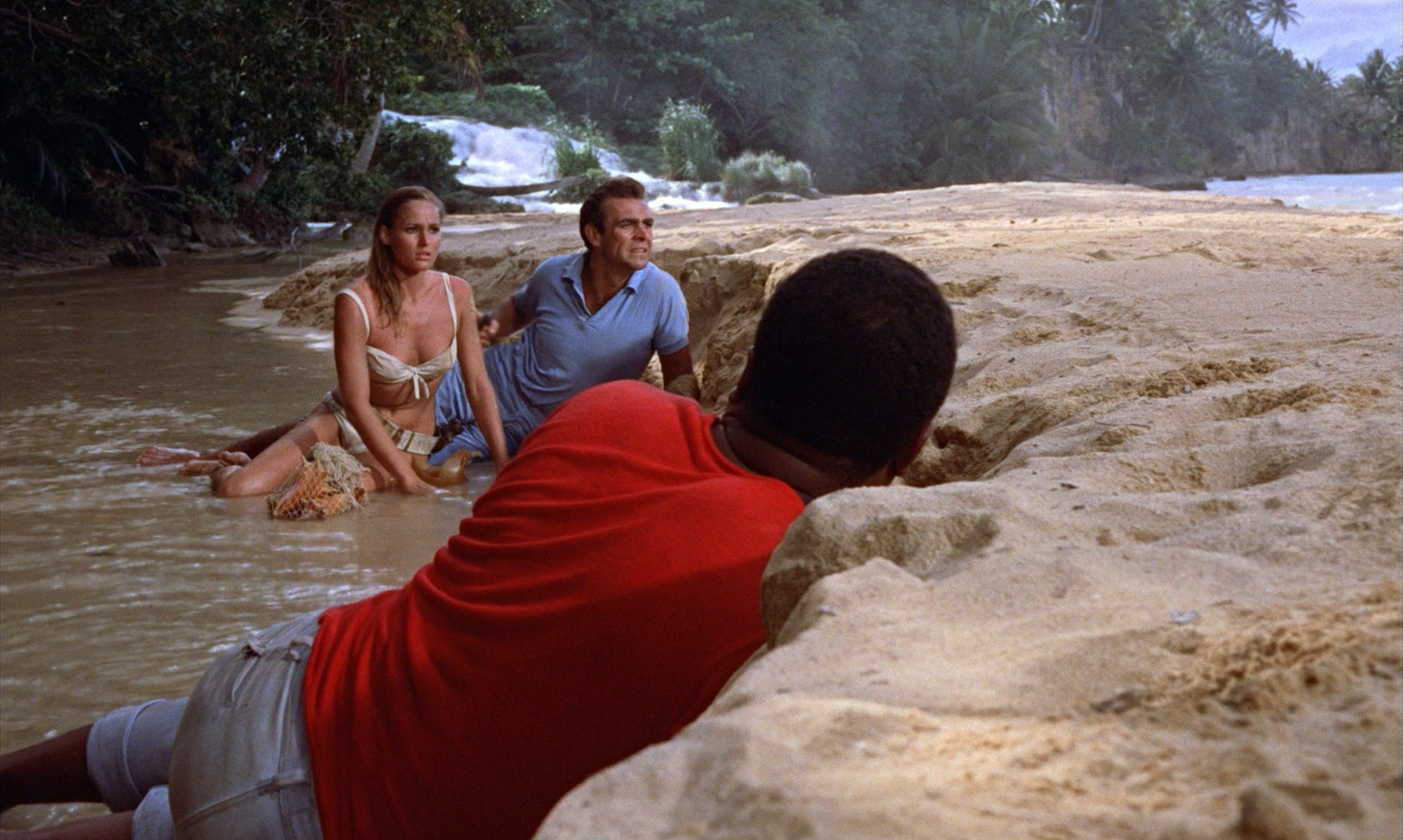
Specific details may vary from the book here or there, but the gist of the plot sends Bond to Jamaica to investigate the death of a British intelligence asset murdered by the title villain, Dr. Julius No, a half-Chinese/half-German scientist (played by Canadian actor Joseph Wiseman) working to disrupt the American space program by using a nuclear-powered radio interference weapon of his own design. To foil this scheme, Bond must snoop around on Dr. No’s private Caribbean island and infiltrate his secret high-tech lair. In the process of all this, he’ll also encounter a voluptuous conch shell collector named Honey Ryder (Swiss model Ursula Andress), the sight of whom rising out of the ocean in a white bikini will become one of the most iconic images not just of this film series, but of all cinema.
In comparison to the many sequels that would follow it, the plotting in Dr. No is fairly simple and the film is rather light on action. In those regards, it can feel like a formative work for a franchise that would go on to much bigger thrills. In its favor, it still has plenty of intrigue and exotic color to keep fans engaged. Most importantly, Sean Connery steps into the role of James Bond overflowing with charisma and confidence from his very first frame. He’s magnetic enough to hold the entire movie together around him through sheer force of personality.
Ironically, Ian Fleming himself didn’t care much for Sean Connery at first, and expressed his own preference for David Niven to play the debonair gentleman spy he’d written. Audiences, meanwhile, responded to Connery with such enthusiasm the actor shot to immediate superstardom. Even Fleming eventually came around on the matter, and wrote some of his later books to more closely align with Connery’s portrayal.
A theoretical version of Dr. No starring David Niven would probably still have been successful in its day, but I tend to doubt it would have launched quite the same string of stratospheric blockbusters this version did. Sean Connery elevated the character and the material beyond even what the author had envisioned of them, and made James Bond a legend.

The 4K Ultra HD Blu-ray
MGM initially released Dr. No and a handful of other James Bond movies on Blu-ray in 2008, but did not complete the series at that time. Four years later, to mark the franchise’s fiftieth anniversary in 2012, the studio started over again with an impressive 22-film box set called Bond 50, which contained every installment up to that time from Dr. No through Quantum of Solace, with an empty slot reserved for the then-upcoming Skyfall. The copy of Dr. No in the box set was the same Blu-ray disc released in 2008.
I reviewed Dr. No on both occasions and rated the disc’s technical quality very highly both times, as did a majority of other home video critics and viewers. Indeed, even looking at it again now, I stand by my original assessment that the Blu-ray remains a very nice-looking disc overall. That said, with nearly another two decades having passed, the invasive digital remastering used on the movie (performed by a firm called Lowry Digital) stands out more now than it did at the time. Although I may not agree with the small but vocal segment of home theater fandom that has risen up to decry all the James Bond Blu-rays, I will concede that some room existed for refinement and possible improvement of the process.
Along those lines, under its new corporate ownership by Amazon, MGM started efforts a few years ago to remaster all the James Bond films yet again. In June of 2025, the first 4K Ultra HD Blu-ray editions arrived, in the form of a Sean Connery 6-Film Collection containing: Dr. No (1962), From Russia with Love (1963), Goldfinger (1964), Thunderball (1965), You Only Live Twice (1967), and Diamonds Are Forever (1971). Observant fans will note that the set skips over the George Lazenby entry On Her Majesty’s Secret Service (1969), which will hopefully be included in another package somewhere down the road. [For clarity, I have been informed that previously-released streaming copies of all the Connery titles were taken from the older Lowry Digital masters, in 4K resolution but only Standard Dynamic Range. These physical media editions with HDR come from all-new video masters.]
The Sean Connery 6-Film Collection is further offered in a choice of two packaging options, either an expensive Limited Edition set of six SteelBook cases inside a padded box, or a less costly basic keepcase with an admittedly weird and awkward montage of Japanese poster art on the cover. While the collector in me pines for the more attractive SteelBook set, I already have Blu-ray SteelBooks for all these movies. As such, I decided to save some money and shelf space by going with the slimmer alternative. I think I’ll take all the discs out of this and put them into the Blu-ray SteelBooks.
All six James Bond movies in this collection are provided only on 4K Ultra HD physical discs or Digital Copy codes (which at current redeem with the older masters). No 1080p Blu-rays are included.

The 4K remastering in the Sean Connery 6-Film Collection has already garnered quite a bit of praise among those fans who’d been critical of the Blu-rays. However, I suspect that most general viewers will likely be quite surprised to watch Dr. No and find the 4K picture decidedly softer and grainier than a Blu-ray from almost two decades earlier. The argument in its favor is that the new master looks more “film-like” or “analog” than the Blu-ray, and I would mostly agree with that, with a couple caveats.
Where the Blu-ray had been presented at an aspect ratio of 1.66:1, the 4K Ultra HD master is matted a slight bit more, down to about 1.75:1. Aside from a couple images in the opening credits that look a little cramped, the difference is minimal and either version is workable. Judged on its own, the 4K image is bright and acceptably sharp, with nice colors and contrast. I half-feared that the new HDR grade might wind up too exaggerated, but it actually looks very natural. Even scenes shot day-for-night look better than I’d ever seen them on any previous home video transfer.
As mentioned, when compared directly, the 4K picture is noticeably softer and grainier than the Blu-ray. Whether that grain is actually organic film grain from the original negative or just a (better) digital simulation of it, I can’t say for certain. Part of me suspects the latter. The image has a somewhat strange oily texture and occasional issues where motion looks weirdly smoothed over. This suggests to me that the master has still had a considerable amount of digital processing, just a different type of digital processing than the Blu-ray master did.
Nevertheless, the 4K disc looks very nice, and I would side with it being the best available version of Dr. No. Even so, I was never especially disappointed with the Blu-ray and still find that disc quite watchable as well.
One area where the 4K Ultra HD decisively wins out over the Blu-ray is audio – though not because of the inclusion of a brand-new Dolby Atmos soundtrack. I actually don’t like the Atmos track much at all. It’s been heavily noise-reduced and rolled-off, and sounds very dull. Nor does Dr. No offer any particular reason to need Dolby Atmos in the first place, other than for a marketing bullet-point on the packaging. The film has exactly one shot of a Pan Am jet landing in the distance, and barely uses the overheard speakers anywhere else, at least not noticeably so. Other surround activity is mostly duplicated from the annoyingly gimmicky 5.1 remix that previously appeared on DVD and Blu-ray.
In more compelling news, the 4K Ultra HD also offers the movie’s original mono soundtrack in lossless DTS-HD Master Audio 2.0 format, which is a big improvement over the heavily-compressed Dolby Digital mono track on the Blu-ray. The mono may be a little strident at times and has some unfiltered hiss, but it also has tremendously more life and vibrancy than the deadened Atmos remix.
Bonus features are all recycled from prior home video editions. These include an audio commentary assembled from interviews with director Terence Young and other members of the cast and crew, a handful of featurettes about various aspects of the franchise, and some vintage trailers, TV spots, and radio ads.
Related
- Dr. No
- Other James Bond Movies
- James Bond Books
- James Bond Parody
- Terence Young (director)
- Ursula Andress
Note: All screenshots on this page were taken from the standard Blu-ray edition of the film and are used for illustration purposes only.
 The Video File Blog
We started watching this last night and I’m really happy with the PQ. I chose the remastered audio so when we finish the film I may try the original mono. It’s been ages since I’ve seen this one but it’s still a really fun little proto-Bond film.
LikeLiked by 1 person
To be honest, I don’t think I’ve ever heard an Atmos remix of a movie that was originally mono that didn’t sound worse than the original (and damn few “upgraded” from stereo that were any better either). With that said, I don’t appear to be a lone voice of dissent here. I’m seeing widely-held agreement on social media and various online forums that the Atmos mixes of these Bond movies are decidedly worse than the mono tracks.
The problem is that these Atmos tracks are built off the prior 5.1 remixes from DVD and Blu-ray, which had already been heavily noise-reduced. When remixing them again for Atmos, the tracks were put through yet another round of noise reduction, which compounds the filtering and sucks all the life out of the audio.
Unfortunately, with movies this old, it’s probably unlikely that any of the original recording elements or audio stems still exist, or are at least readily available. So, you wind up with a new track that’s been over-processed, based on some prior copy that was already over-processed the last time around.
LikeLike
Same with the ‘Indiana Jones’ Atmos mixes. Pure horror!
LikeLike
Same with the ‘Indiana Jones’ Atmos mixes. Pure horror!
LikeLike
I guess I should listen with a more critical ear to the both of these!
LikeLike
Watched a bit more of Dr. No with the original soundtrack and I found it to be a bit bright – but I’m super-sensitive to some upper frequencies. Switched back to the remastered audio for the rest of the film.
This flick is so cute in how it handles the radioactivity exposure, then just blows up the reactor at the end. No big deal, right?
LikeLike
I agree that the mono is a little bright, but I still find it preferable to the Atmos, which is super-filtered and rolled-off.
LikeLike
I started listening to the audio books recently in order that Flemming produced them in. His original books definitely had the character having a lot more ‘depth’ then the movies portrayed, more interacting with a team of spies rather than a isolationist.Sorry I’ve joined the modern era of not ‘reading’ anymore the books, and more just getting the audio books.
LikeLike