
I wrote a lot of obituary posts at the last blog I ran. It got to be depressing, and I gave up doing it after a while. Everyone dies eventually, even icons. I didn’t always have the most knowledge about or emotional investment in the subjects I had to memorialize, and doing so became a burden. When I started this site, I decided I wouldn’t do that anymore. However, David Lynch died this week, and that requires some recognition here.
Lynch was 78-years-old and had a decades-long history as a heavy chain-smoker. Last year, he revealed that he was suffering from emphysema that had left him homebound. His death now is not much of a surprise. Nonetheless, the news hit me pretty hard when I first heard it. David Lynch has been my favorite director since just about the time I first understood what a movie director was. His work means something to me on a very personal level.
I’ve noted before that Lynch’s 1984 adaptation of Dune is my favorite movie, despite its notorious box office failure and the tremendous derision it has received over the years. Even in the wake of the director’s death, my social media feed has been filled with snarky comments calling the movie “cheesy” and comparing it disparagingly to Denis Villeneuve’s more popular and successful remake. I have little tolerance for that right now.
Dune was an anomaly in David Lynch’s career. He’d never made a movie like it before and never would again. Even I wouldn’t call it his best movie. However, his experience on that production forged him into the uncompromising filmmaker he’d become. Because he was so distressed at having his vision and work taken away from him by meddling producers and studio executives, and because he never had a chance to properly finish the movie the way he wanted, Lynch determined that he couldn’t work as a director-for-hire again. He didn’t want to be a studio hack churning out projects that other people assigned to him. He demanded and negotiated for the right of Final Cut (a privilege few filmmakers receive) on everything he made afterward, and would never again make anything he didn’t feel some personal investment in.
Without Dune, there would be no Blue Velvet or Twin Peaks or Mulholland Drive as we know them. If the movie had been more successful, I have no idea what Lynch’s career might have looked like, but it would certainly have been something very different from the path he actually took.
Dune was not my introduction to David Lynch. Nor was it immediately my favorite of his movies the first time I watched it. In the spring of 1990, I’d never heard David Lynch’s name until buzz started building for a new TV series about to premiere on the ABC network. A murder mystery set in an otherwise seemingly sleepy small town, Twin Peaks was decidedly unlike any of the police and detective procedurals I’d watched before. At 16-years-old, I’d never seen anything like it, on television or in movies. The show’s two-hour pilot episode, which mixed drama, suspense, comedy, horror, and melodrama in equal measures, each weaving seamlessly into and out of the others, was a startling revelation to me. It was one of the first pieces of media content to make me think about filmmaking as more than just passive entertainment, but a serious art form that could be made by an individual with a unique voice and something to say. Before that first episode was over, I knew that I needed to find out more about the guy who made it and watch absolutely everything he’d done.
Like most of America, I became deeply obsessed with Twin Peaks during its first season on the air. Unlike most of America, I didn’t give up on the show during the second season when the mystery of “Who Killed Laura Palmer?” wasn’t resolved right away. I loved every episode, even the ones I’d later learn other fans heavily debated. (In those pre-internet days, I didn’t have much sense of how individual episodes were received by other viewers, beyond what I’d heard on shows like Entertainment Tonight or read in the Arts & Leisure section of my local newspaper.) When the show was canceled without resolution to the story, I was heartbroken.
As promised, I sought out anything else I could find by David Lynch. At that time, the only of his movies easily accessible on VHS were his highly-respected historical drama The Elephant Man, and his less well-regarded science fiction flop Dune. I liked the former right away, but took a number more viewings to sort out my feelings on the latter. Eventually, I came across a copy of Blue Velvet, and recognized its clear connections to Twin Peaks in style, tone, and content. I was blown away.
David Lynch became my gateway into a lifelong obsession with film. Once my eyes were opened to their possibilities, I devoured movies en masse, of all types, new and old. I started noting the people who made them, developing lists of my favorite directors (Martin Scorsese! Stanley Kubrick! Ridley Scott!), and working my way through their catalogs of work as best I was able based on what was available to me. By the time I left high school, I’d decided I wanted to become a filmmaker myself. I applied and was accepted to film school, where I proudly tacked posters for Blue Velvet and Twin Peaks to my dorm room wall.
My college years coincided with the early days of the internet. Not only could I finally talk about movies in depth with other film students at school who were totally into all the same things I was, an online community of others opened up around the world. I spent countless hours chatting about David Lynch in the alt.tv.twin-peaks USENET newsgroup, and still have friends from that time I keep contact with today.
Moving to a big city for college also broadened my access to films I couldn’t get back home, and to new media formats on which to watch them. I finally got to watch Lynch’s debut feature, the Surrealist cult oddity Eraserhead (then not available on home video in the U.S.) via an import Laserdisc from Japan, in widescreen letterboxed format no less! That in turn became an impetus that spurred my passion for home theater.

My years in film school taught me that I enjoyed watching and talking about movies a lot more than I liked actually trying to make them. My dreams of becoming a famous director petered out pretty quickly. However, I discovered that I did have some talent for writing about film. Developing that led to my own career as a movie and home video reviewer, which has gone on pretty well for a few decades now.
Over the years, I’ve watched and written about almost everything David Lynch has made, from his first short film in 1967 called Six Men Getting Sick to his belated return to Twin Peaks for a revival season on the Showtime cable network in 2017. I own multiple copies of every movie and TV show he’s made, across several video formats.
I don’t hold any pretense that everything David Lynch made was a masterpiece. Cannes Film Festival win or not, for years I cited Wild at Heart (1990) as Lynch’s messiest and weakest movie. I’ve come around a little on that, only to find his last theatrical feature, 2006’s Inland Empire, virtually unwatchable. (I’ve sat through that one a couple times and don’t know if I can do it again.) Most of the video shorts and music videos he made for his personal web site in later years were, let’s be frank about this, kind of abysmal. To the fury of some of his other devoted fans, I must even admit to having mixed feelings about his widely-acclaimed Mulholland Drive and that return season of Twin Peaks.
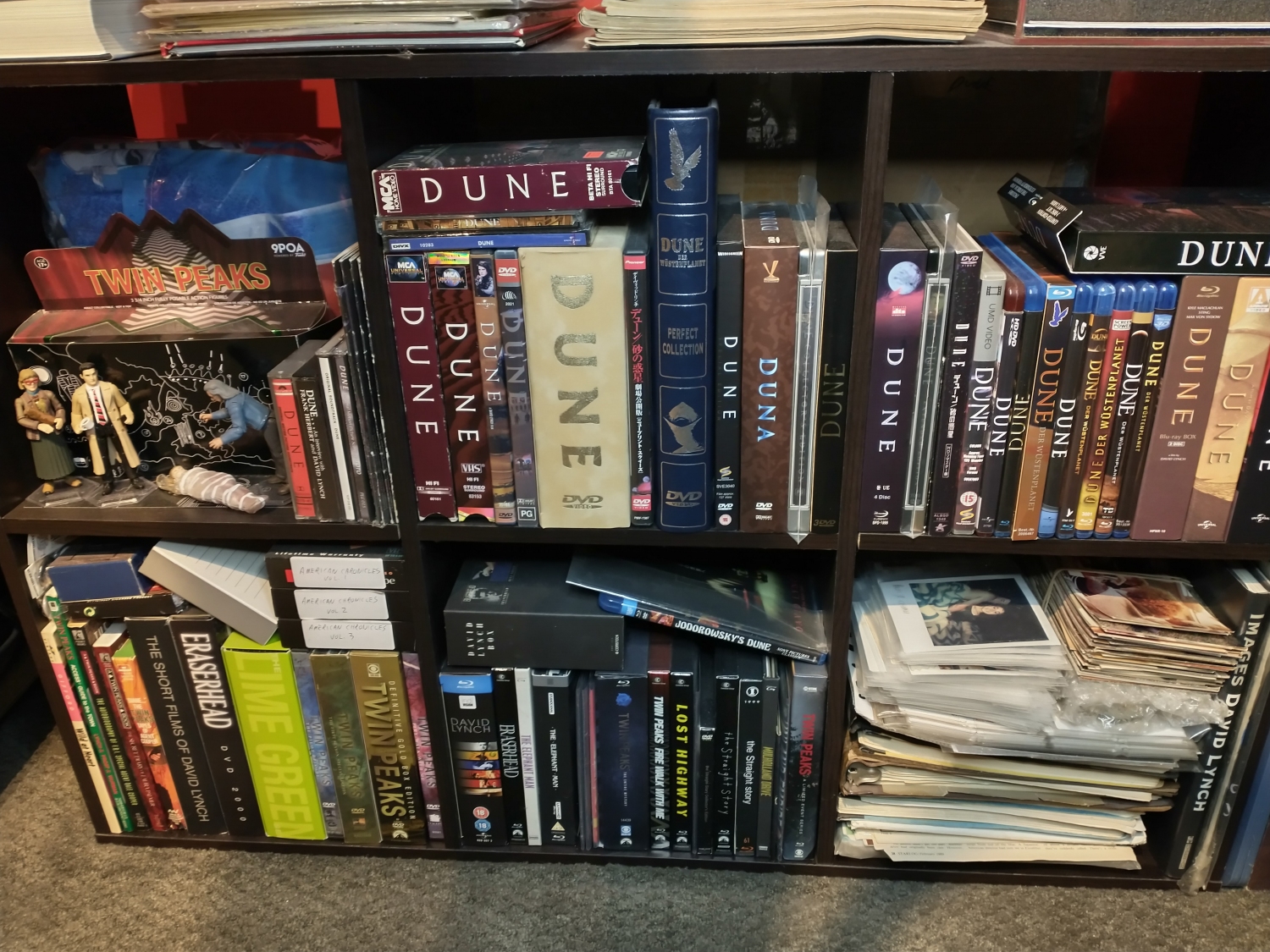
Even that being the case, David Lynch remains very meaningful to me. Through all his career highs and lows, his work is a foundational part of my own identity as a film lover and critic. A major section of my current home theater room is devoted to my collection of David Lynch movies and Dune memorabilia. Although his output in recent years may have declined in both volume and quality, the landscape of cinema is a much lesser place without him around.
Further Reading
Across my time at multiple publications, I’ve written extensively about most of David Lynch’s film and TV work. The following is a sampling of some of that effort, here and elsewhere:
- Dune
- Lynch’s Other Films & TV
- The Short Films of David Lynch (1967-1995)
- Eraserhead (1977)
- The Elephant Man (1980)
- Blue Velvet (1986)
- Wild at Heart (1990)
- Industrial Symphony No. 1: The Dream of the Brokenhearted (1990)
- American Chronicles (1990)
- Twin Peaks (1990-1991)
- Twin Peaks: Fire Walk with Me (1992)
- On the Air (1992)
- Hotel Room (1993)
- Nadja (1994)
- Lost Highway (1997)
- The Straight Story (1999)
- Mulholland Drive (2001)
- Inland Empire (2006)
- Crazy Clown Time (2012)
- Twin Peaks: The Return (2017)
- Reading & Misc.
- David Lynch: Images (1994) book review
- The Secret Diary of Laura Palmer (1990) book review
- Diane… The Twin Peaks Tapes (1990)
- The Autobiography of F.B.I. Special Agent Dale Cooper (1991) book review
- Pretty as a Picture: The Art of David Lynch (1997) documentary
- David Lynch: The Art Life (2016) documentary
- Room to Dream (2018) book review
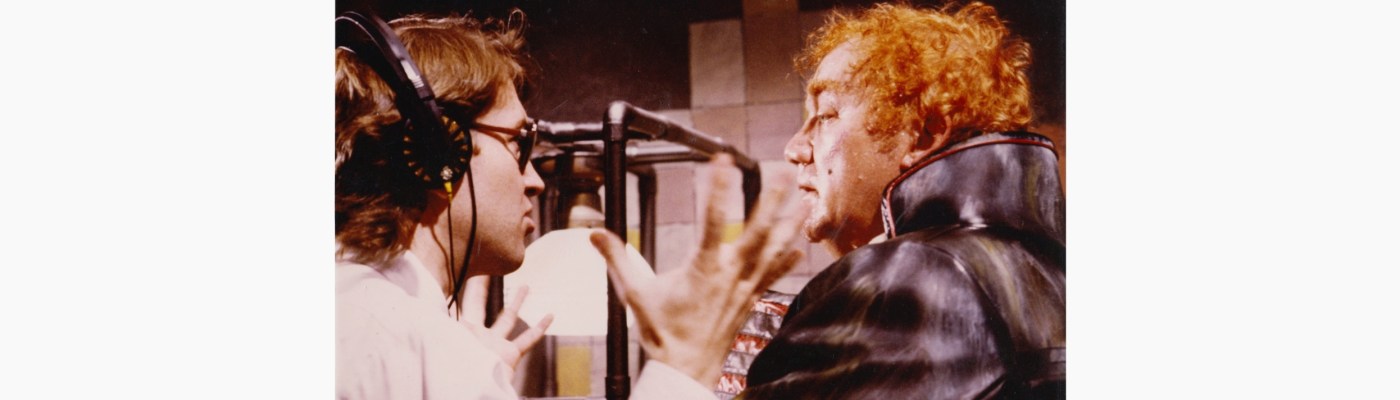
[Photo of David Lynch directing Kenneth McMillan in Dune (1984). Credit: Ron Miller.]
 The Video File Blog
I’m sorry Lynch passed; I know how much you enjoyed his work and eccentricities.
While I’m not the biggest fan of his work, I can appreciate someone wanting to “color outside the lines” instead of doing “paint by numbers”.
I’m with you on Mulholland Drive…I remember the credits rolling and thinking to myself, “Okay?” Needless to say, I guess I’m not smart enough to understand it.
LikeLike
Thank you for this !! Well written . Many of his films that I have not seen that you brought to light .I will be exploring them in the future! I will miss the mans surreal ,sometimes Avant-Garde even ? Style of film making !
LikeLiked by 1 person
Terrific recollection and the powerful inspiration Lynch had on you, Josh. Truly lots to learn. Awesome of you to share.
LikeLiked by 1 person
Not many out there who admit to liking Dune. It’s one of those films people just love to hate on, and is by no means as bad as everyone says. I was a young man just reading Dune for the first time when it came out, and I liked it just fine. Haven’t seen the new one, as new movies just don’t hit me the same way. I thought it was an elegant depiction of a very complicated story. And it’s fantasy, people! I still listen to the soundtrack all the time. Best thing Toto ever did.
LikeLiked by 1 person