
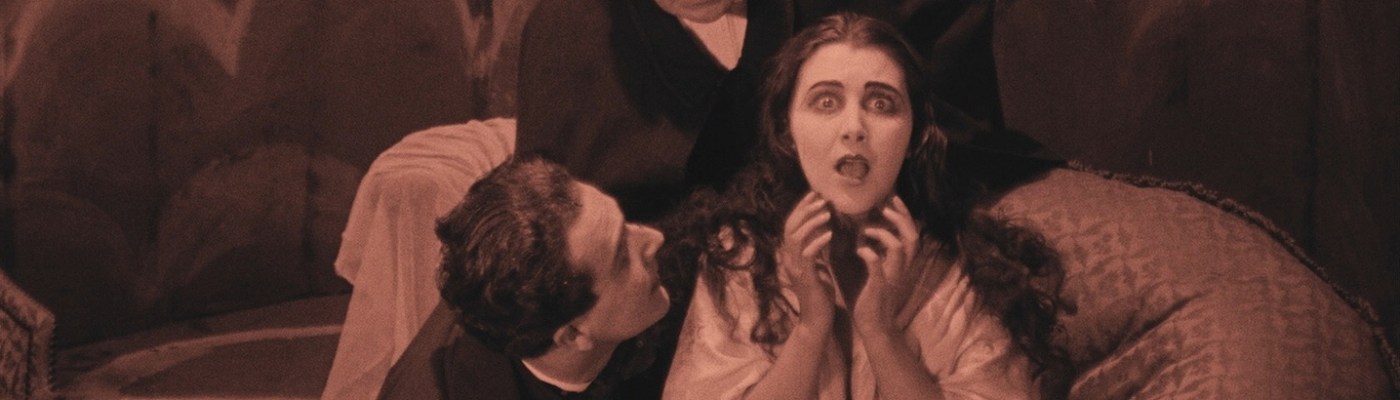
If not the first horror movie ever made, The Cabinet of Dr. Caligari was an early feature film to explore the macabre side of cinema. While exact records of its critical and financial reception back in 1920 are somewhat unreliable and often contradictory, the film proved highly influential on the development of the horror genre, and has survived more than a century as one of the most important landmarks of the silent era.
Of course, any discussion of The Cabinet of Dr. Caligari will also note it as a key work of the German Expressionism art movement. Its deliberately distorted and artificial sets and backgrounds dazzled and disoriented viewers of the day. These techniques, though they may seem a little crude in execution a century later, were incredibly advanced and innovative for a time when cinema itself was still coming into its own as an art form.
| Title: | The Cabinet of Dr. Caligari (a.k.a. Das Cabinet des Dr. Caligari) |
| Year of Release: | 1920 |
| Director: | Robert Wiene |
| Watched On: | 4K Ultra HD Blu-ray |
| Available On: | Blu-ray AMC+ FuboTV Hoopla Kanopy Various VOD purchase and rental platforms |
In the first of its ambitious ideas, Caligari tells its story in a flashback structure, rather than a simple linear flow. We may take devices like that for granted today, but viewers in 1920 likely found it a novel approach, even a little confusing.
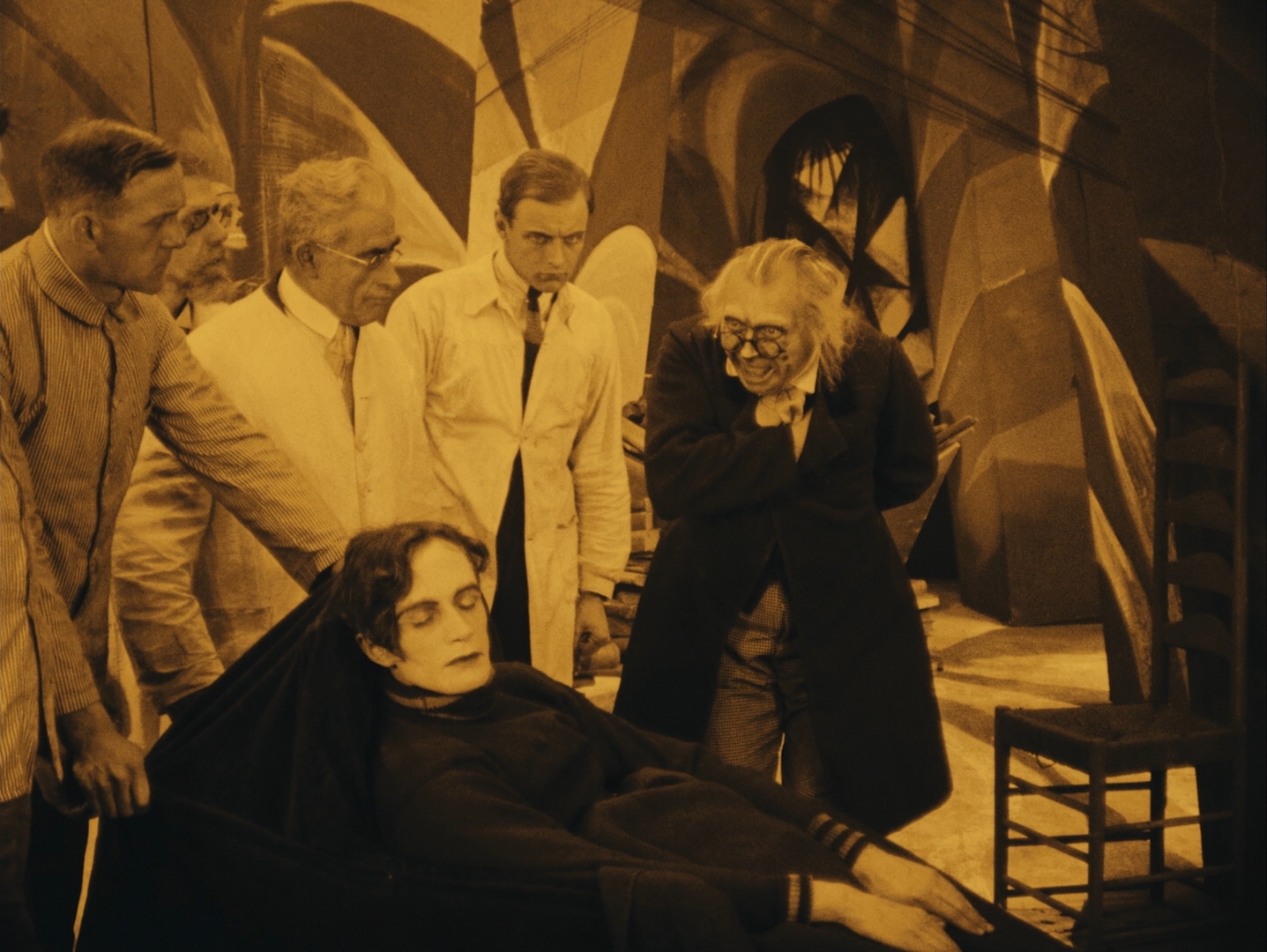
The film opens with a framing story in which a distraught young man named Francis (Friedrich Feher) meets an older acquaintance in the park and recounts the tale of his fateful encounter with the title character, a creepy carnival barker calling himself Dr. Caligari (Werner Krauss). The movie then flashes back to depict those events. At the town fair in Francis’ small home village, Caligari draws a crowd to see a so-called somnambulist, a catatonic man that Caligari claims has been asleep for twenty-three years, but can be made to walk and even talk upon his command. Once animated, Cesare (Conrad Veidt) delivers ominous fortunes to the spectators, such as the prediction that Francis’ friend Alan (Hans Heinrich von Twardowski) will die before the next morning. It doesn’t seem like much of a show, but I suppose entertainment options in those days were probably limited.
Sure enough, Alan is murdered that night, at the hands of Cesare himself. Investigating his friend’s death, Francis discovers that Caligari is the director of a nearby mental asylum, and having gone mad himself, learned to control his patient to commit terrible crimes in his sleep.
The details of this story are rather simplistic. The exact reasons why Caligari would want Cesare to murder random villagers are vague, and the movie wraps up with a twist ending that doesn’t quite make sense. Anyone looking for a coherent narrative or well-drawn characters should temper expectations. The broad pantomime performances are also exaggerated in typical silent film fashion.
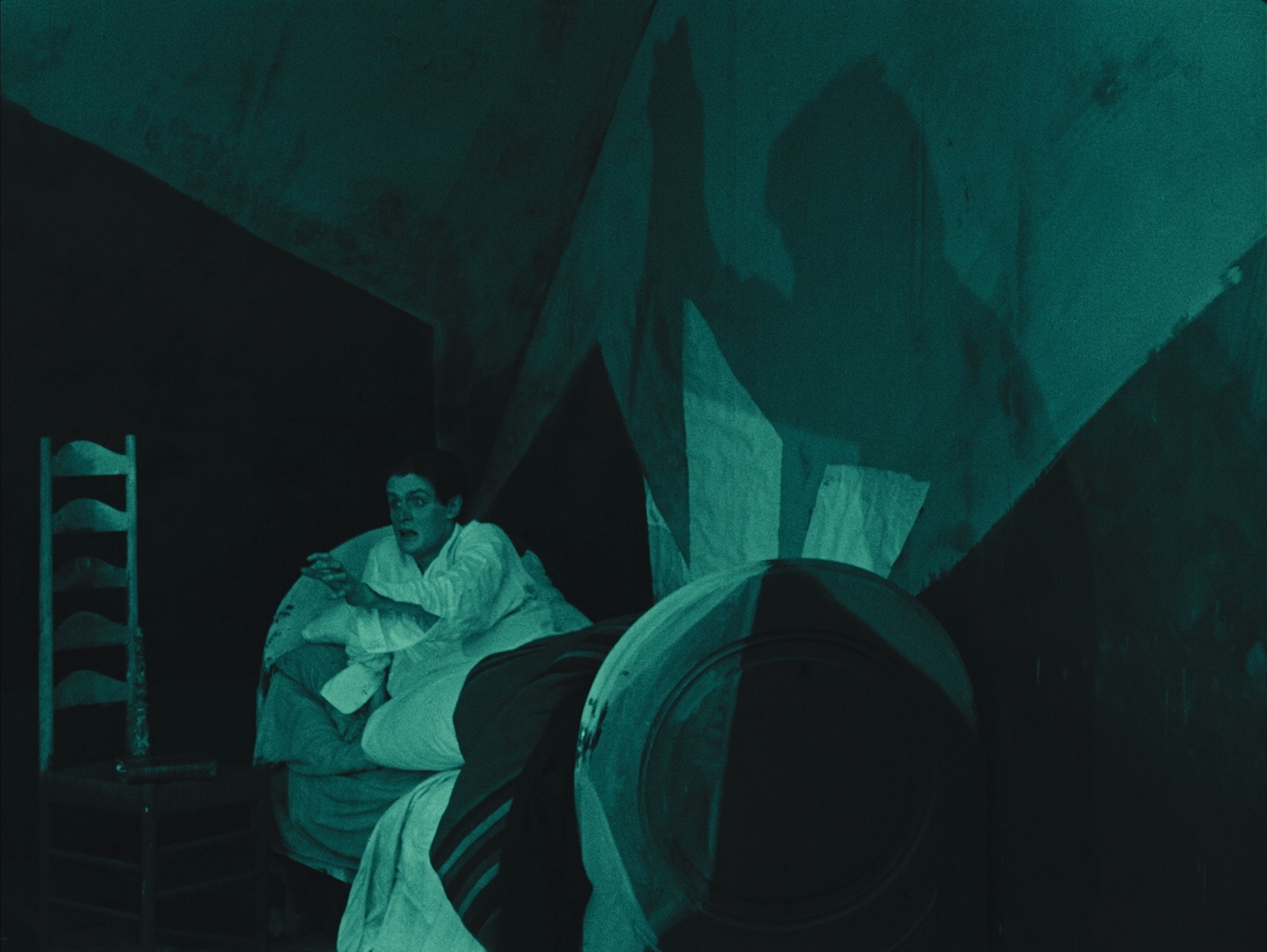
The manner in which the story is depicted on screen is more interesting than the story itself. Filmed on stages with crazy painted backdrops, bizarre-looking misshapen props, and expressive lighting and shadows, the movie eschews any pretense of realism in favor of highly-stylized imagery to reflect the emotional state of its characters, and to evoke similar feelings in the audience.
I’ll be honest that, like many modern viewers, I have a hard time fully embracing most silent films. I find them more fascinating from an intellectual perspective as artifacts from a distant era, than as compelling entertainment I might feel myself invested in watching. This holds true even for The Cabinet of Dr. Caligari. I can admire its artistry, without quite getting caught up in its story or caring about its characters. As such, I have no idea how to rate films like this in comparison to movies from even just a decade later, when the entire filmmaking industry rapidly transitioned to sound.
Nevertheless, on those terms, The Cabinet of Dr. Caligari remains a vital piece of art worth studying for the creativity it expressed and the ingenuity required to make it.
The 4K Ultra HD Blu-ray
Like many silent films from the early days of cinema, The Cabinet of Dr. Caligari suffered significant amounts of damage and deterioration in the decades after it was made. As such an important work, Caligari has also undergone several attempts at restoration over the years, the most recent undertaken by the F.W. Murnau Foundation in Germany and L’Immagine Ritrovata in Italy. Those efforts were released on Blu-ray in 2014 by Kino Lorber in the United States and by the Masters of Cinema label in the UK. Masters of Cinema later released a 4K Ultra HD edition in 2022. Now, two years later, Kino Lorber follows suit with its own 4K Ultra HD Blu-ray for the American market. Both 4K discs are based on the same restoration and should be of comparable video quality, differing in the choice of musical scores and bonus features offered.
Remarkably for a film from 1920, the majority of Caligari‘s Original Camera Negative still survives, albeit in rough condition. However, the negative no longer contains the first act of the movie, which had to be reconstructed from other surviving elements, as did various missing frames from throughout the feature. Even after restoration, many frames are still missing, resulting in noticeable jump cuts. While dirt and damage were repaired as much as possible using both physical and digital means, plenty still remains visible. The first act in particular (though not exclusively) is coated in a layer of fine vertical scratches. Any viewer even remotely familiar with silent film in general, or this movie specifically, should understand and expect these issues.
With all that in mind, the restoration teams have done a remarkable job of bringing The Cabinet of Dr. Caligari back to life in a vivid and watchable form. The 1.33:1 image (photographed in black-and-white but tinted into shades of sepia, green, or pinkish-red from scene to scene) contains sometimes extraordinary amounts of detail, such that you can practically feel the palpable textures of the makeup on the actors’ faces, even in the first act sourced from dupe prints.
The running speed has also been adjusted to something that (largely) feels like natural movement or motion, with only a small amount of speed-up noticeable from time to time. (Cameras of the day did not always have consistent frame rates as the film moved past the lens gate.)
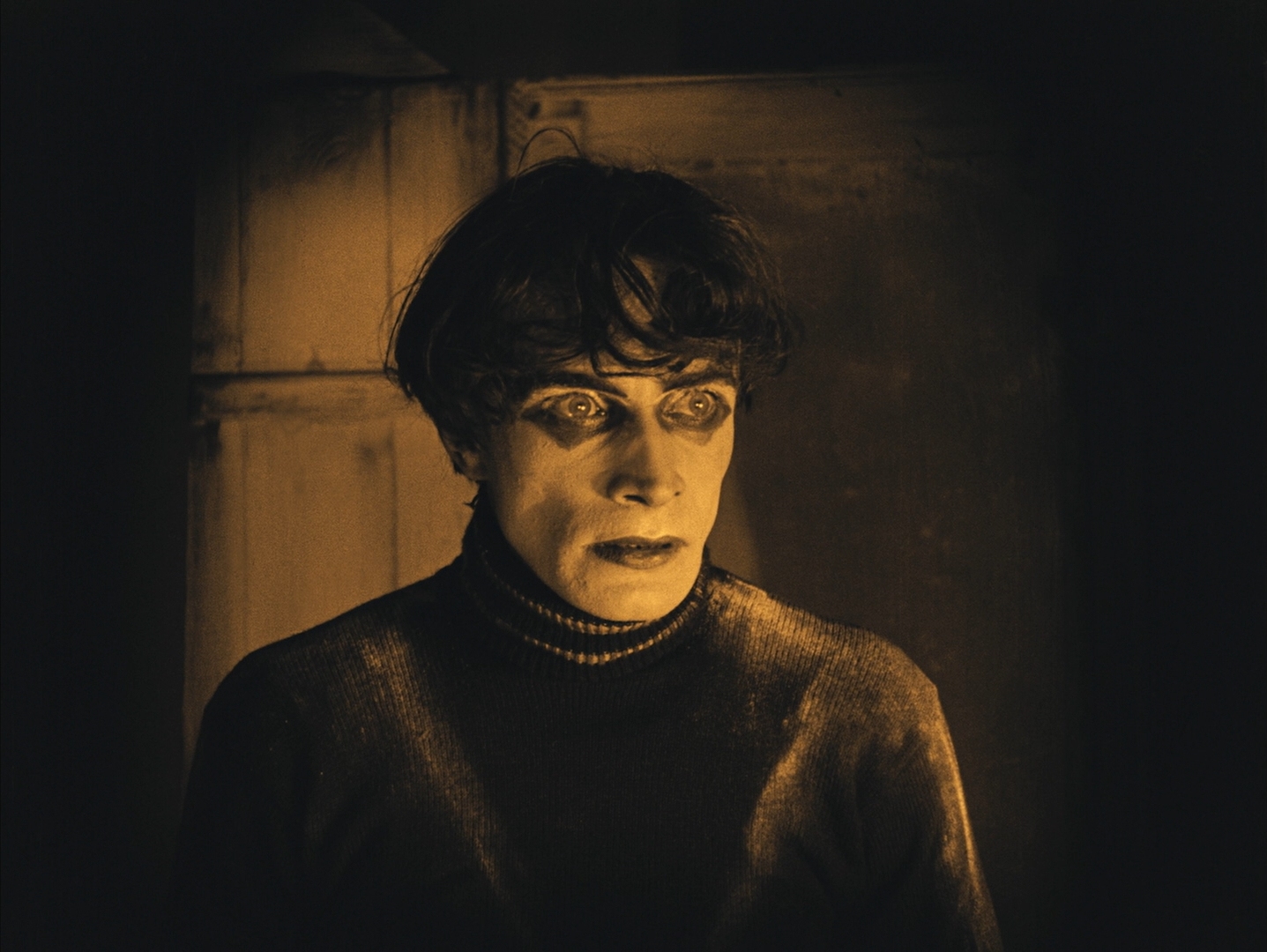
I’ll admit to approaching this disc with some skepticism about whether the hundred-year-old film elements had anything close to 4K resolution, but at least on my projection screen, the 4K disc in the set does feel a little crisper than the accompanying Blu-ray.
That said, I’m a little troubled by the lack of grain it exhibits. Perhaps this is my own ignorance about vintage film stocks, but I expected a movie of this age to have considerably more grain than is present here. The image doesn’t look smeary or appear to suffer the traditional symptoms of too much Digital Noise Reduction, but I’m left to wonder if advanced digital tools (such as those pioneered by Lowry Digital a few years before this restoration was performed) might have been employed to remove grain without affecting the underlying detail.
I’ll also be frank that the L’Immagine Ritrovata credit in the restoration notes screen that annoyingly plays at the start of the movie gave me a little pause. Ritrovata is notorious for adding a yellow color bias to just about everything restored there. Although that might not seem to apply to a silent movie from 1920, I can’t help questioning the accuracy of the color tints. Is the sepia too yellow? Should the red be a deeper shade? Without a reliable reference to compare against, I don’t have answers to those questions.
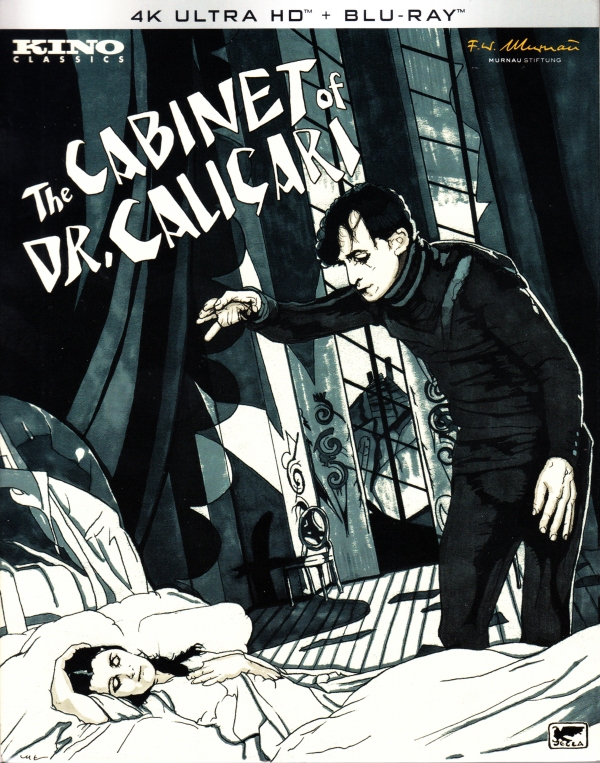
The packaging for Kino Lorber’s 4K Ultra HD release proudly trumpets a new 2024 musical score by Emmy-winning composer Jeff Beal (Netflix’s House of Cards). Honestly, I hated it and could barely get through the first act of the movie. His jazzy score is way too contemporary and, to my ears, feels ridiculously mismatched to the tone of the visuals on screen. I greatly prefer the alternate 2014 orchestral score by Hochschule für Musik Freiburg (Freiburg Conservatory of Music).
The Blu-ray in the case has a third option not present on the 4K disc, an electronic score by Paul D. Miller, a.k.a. DJ Spooky. I kind of like this track on its own but, again, am not a fan of playing too-modern music over a silent film. In my opinion, the music distracts too much from the movie.
The Jeff Beal score is available in both DTS-HD Master Audio 5.1 or 2.0 formats. The other two scores are both DTS-HD MA 2.0 only. Fidelity on all of these soundtracks is very good no matter which you choose.
Bonus features on the 4K disc are limited to an audio commentary by Jeff Beal (who has intelligent things to say, even if I don’t care for his music) and an Audio Descriptive Track for the visually impaired. Found on the Blu-ray disc are an excellent hour-long German documentary that places Caligari into context of the political era in Germany between two World Wars, and two brief restoration demonstrations.
I don’t own a copy myself, but the UK Masters of Cinema 4K release has two different score options and several more supplements (that sound fairly substantive) than Kino offers.
Note: All screenshots on this page were taken from the standard Blu-ray edition of the film and are used for illustration purposes only.
 The Video File Blog
I have the Eureka UHD from 2022. I haven’t watched all of it but I did like what I saw. Seeing such detail on something so old was pretty impressive. I always wondered if musical scores accompanied these old movies or is it something that was added in later to enhance the experience.
LikeLike
From the beginning, silent films were almost always accompanied by live music. Depending on the size of the venue, it might have been a single pianist or organist, up to a full orchestra. Sometimes official scores were distributed on sheet music to be played along with the movie. Other times, the local musicians may have written or improvised their own music. Unfortunately, records for most of those scores were lost to time.
Nowadays, there’s a niche industry of musicians who compose new scores for silent films. One of my favorites here in New England was the Alloy Orchestra. I saw a live screening of Metropolis some years back with them performing and it was fantastic. I believe one of the members later left the band and the others reformed a new ensemble called the Anvil Orchestra.
LikeLike