

As the world celebrated Denis Villeneuve’s Dune: Part One as if it were the greatest science fiction masterpiece in the entirety of cinema history back in 2021, I was among the rare outliers who didn’t care for the movie. I found it a bore, and yes, I’m one of those weirdoes who prefers the David Lynch adaptation from 1984 – the one everybody else so helpfully and incessantly informs me “totally sucks” and is “super cheesy” and has “bad graphics” (an actual complaint I’ve really heard someone lob against it recently). In any case, when Villeneuve’s Dune: Part Two arrived earlier this year, I made no effort to see it in the theater, despite being assured that my life would have literally no meaning if I didn’t experience it in the majesty of IMAX.
In fact, as the hype train for Dune: Part Two built and built, critics piled on top of one another to laud it with accolades, and the fanboys orgasmically proclaimed it a hundred and fifty billion times better than even the first part in a spice orgy delirium, I decided that I found the whole thing insufferable and wanted nothing to do with it. I doubted that I’d even bother watching it when it came to a streaming platform I already subscribe to.
Little by little, that resistance started to break down after I joined a Dune Facebook group. No, not because the members there convinced me of the film’s merits. Quite the opposite, it turns out that the fans of Frank Herbert’s original novel absolutely LOATHED Dune: Part Two with an intensity even I found shocking, and for the most petty, ill-considered, and even flagrantly misogynistic reasons. Listening to their whining, I found myself quite unexpectedly wanting to come to Villeneuve’s defense over a movie I hadn’t yet seen that was a sequel to one I didn’t even like.
| Title: | Dune: Part Two |
| Year of Release: | 2024 |
| Director: | Denis Villeneuve |
| Watched On: | 4K Ultra HD Blu-ray |
| Also Available On: | Blu-ray Max (May 21, 2024) Various VOD rental and purchase platforms |
Technically, I suppose Dune: Part Two isn’t necessarily a sequel to Part One, but rather the second half of the story that the first one didn’t finish telling. In adapting Frank Herbert’s award-winning 1965 science fiction epic, Villeneuve and his screenwriters split the book in half. The first part just stopped after a random scene, with no narrative closure or even so much as a cliffhanger. Somehow, that didn’t seem to bother anyone but me.
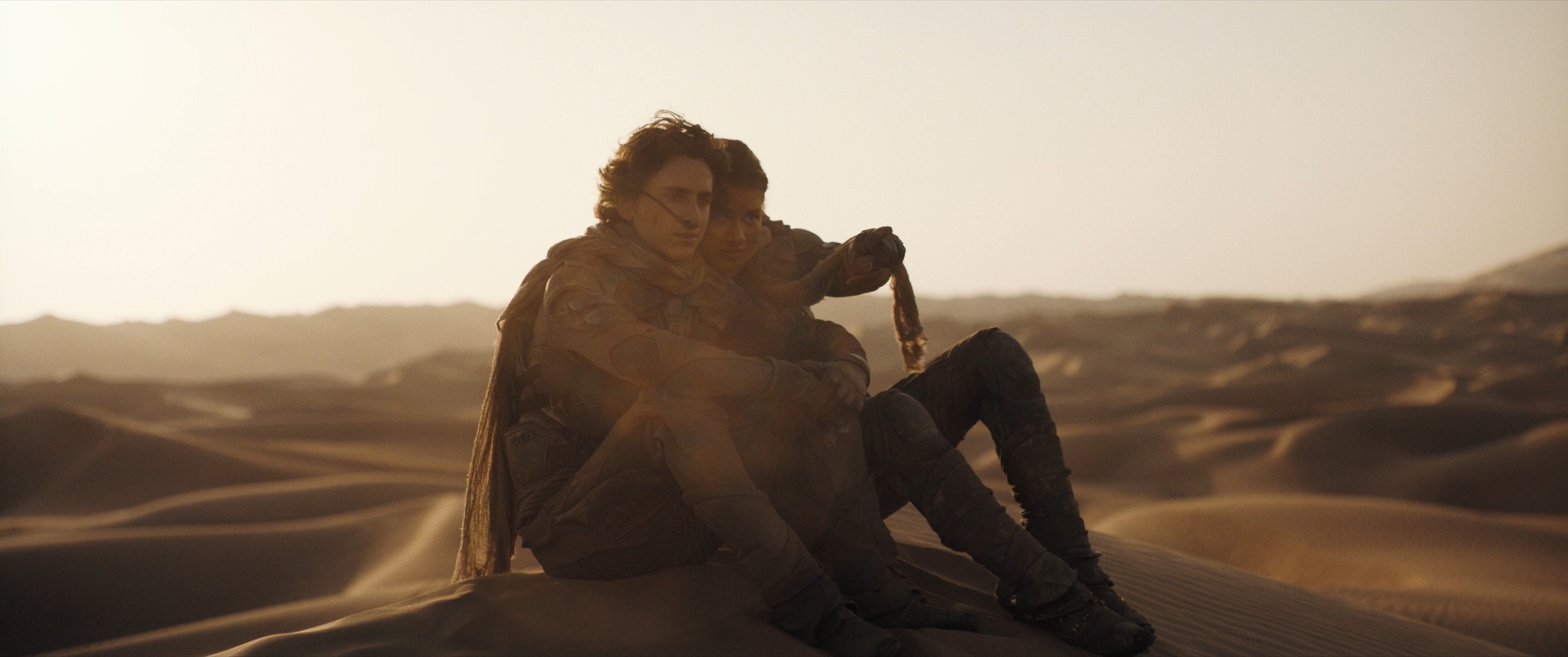
Part Two picks up after the evil Harkonnens have taken control of planet Arrakis and its precious supply of psychoactive spice. Young Paul Atreides (Timothée Chalamet) and his mother Jessica (Rebecca Ferguson) fled to the desert and into the protection of the planet’s native population of Fremen, who have been carefully manipulated by Jessica’s religious order for centuries to believe a nonsense prophecy that one day a young white boy would arrive to save them from their oppressors. In this telling, leader Stilgar (Javier Bardem) in particular is very quick to buy fully into this legend, to the point that his fawning adulation of Paul as the “Lisan al-Gaib” becomes a comic relief gag throughout the rest of the movie.
After proving their worth and joining the tribe, Jessica takes over as the Fremen’s new Reverend Mother and Paul leads them on a campaign to wage a war against the Harkonnens. In the midst of all this, Paul falls in love with Fremen warrior Chani (Zendaya), but also has spice-driven visions of a terrible future that his actions will instigate, and feels conflicted about his role in setting that chain of events into motion.

Both versions having been adapted from the same novel, the broad strokes of this story are of course the same as the 1984 film by David Lynch. The main difference between them, obviously, is that Lynch was required by his producers and the studio to cram the entire plot of the book into a 2 hr. 17 min. running time, while Denis Villeneuve has nearly five-and-a-half hours to spread it across in greater detail between his two movies.
Writing as someone who still considers the Lynch film his favorite movie, I have mixed feelings about this. As much as I love it, I’ll be the first to concede that narrative coherency is a weakness of the Lynch film – especially in the second half, during which many important storylines wound up either eliminated or condensed into perfunctory montages. The central love story, for example, is summarized in its entirety by a single line of voiceover narration stating, “Paul and Chani’s love grew.” Villeneuve has a lot more time to flesh out that story, and the romance is at least slightly more convincing in this version (if still a little rushed).
In fact, Dune: Part Two on its own runs almost three hours, to adapt the last 200 or so pages from the novel that Lynch was forced to compress into just 45 minutes. The extra time allows Villeneuve to tell the story with a lot more clarity than Lynch could. For viewers who prioritize plot as the most important aspect of their movie experience, I can understand why this adaptation would seem preferable. Admittedly, this version makes more sense in that regard. I get that.
Part Two also belatedly introduces key characters who were left out of Part One, including the Emperor of the Known Universe (Christopher Walken), Princess Irulan (Florence Pugh), and the psychotic Feyd-Rautha Harkonnen (Austin Butler). However, even with the additional breathing room, Villeneuve leaves out other significant portions of the book, including the importance of the Spacing Guild and the political pressure it exerts onto the Emperor. Even Lynch managed to fit that in with a very memorable sequence at the beginning of his movie.
A detail like that, I expect most viewers would consider an acceptable compromise of the adaptation process. The film’ s box office success would certainly seem to bear that out. The most dogmatic of Frank Herbert book fans, on the other hand – even those who were rapturous in their praise of Part One – suddenly decided they could not tolerate even one omission or variance from their beloved text, and lashed out at Villeneuve and his movie for ruining their favorite novel. Other changes they couldn’t stand included Christopher Walken’s portrayal of the Emperor as weak and ineffectual, and the decision to have Jessica remain pregnant for the duration of the story rather than have daughter Alia be born prematurely. (The latter also results in a pretty major alteration to the film’s climax.)

What really drove the book purists nuts, though, was the way Dune: Part Two rewrites the Chani character. In the novel, Chani was a fairly subservient and submissive love interest to Paul, and supported him even as he moved toward fulfilling the prophecy of leading her people into an apocalyptic holy war to cleanse the universe of anyone who opposed him. Villeneuve, meanwhile, gives Chani a little more personal agency. In this version, she loses faith in Paul and turns away from him when the course he’s setting becomes clear. For this, the most toxic factions of the fandom have accused the director of going “woke” and allegedly missing the point of the book, and have further directed their outrage at actress Zendaya for frowning too much in her performance, as if the character should be more cheerful about finding out her boyfriend plans to commit genocide on an unimaginable scale.
Personally, I don’t object to what Villeneuve did here. I understand that his intention is to align the end of this story with his plans to adapt the second novel, Dune Messiah, which Frank Herbert explicitly wrote as a corrective for readers who missed his warning about the danger of charismatic leaders, including Paul. I will also fully acknowledge that, love the Lynch adaptation though I do, the happy ending that the studio and producers foisted onto it was ridiculous. This version is more logical and fits the story better.
Even not having liked Villeneuve’s Dune: Part One very much, I found Part Two more engaging. The film held my interest throughout its nearly three-hour length, and the director provides a number of moments of impressive big-budget action spectacle. From a narrative standpoint, even I can’t deny that it tells the story better than the comparable portion of the David Lynch adaptation. In that respect, I see its value. Watching it may even put the first part into a better light and make me consider revisiting that as well at some point.
Still, the Lynch version remains my preference. The biggest problem I have with the Villeneuve version of Dune is that his adaptation is so focused on plot and spectacle that it otherwise completely misses the flavor of Frank Herbert’s writing and the personality the author infused into the book. Both Parts One and Two strip away the majority of Herbert’s original dialogue and simplify what remains. Characters are pared back to the barest essentials of their defining traits. As I argued in my review of Part One, I don’t feel that the Minimalist visual aesthetic the director has imposed, where every planet has essentially the same architecture and production design as every other planet, is appropriate for this universe. The Dune books are filled with a lot of just plain weirdness (the author was reportedly an avid fan of psychedelic drugs), and Villeneuve cut just about any trace of that out of his movies. They play like a Cliff’s Notes version of Dune, providing a very clear summary of the plot, but missing most of the details that give the story life.
For all its faults, the David Lynch adaptation goes in the other direction. It may have bungled the plot aspect, but the movie at least feels like it takes place in Frank Herbert’s Dune universe. I can’t say that for Villeneuve. The 1984 film was a work of real ambition by a genuine artist attempting to bring his own sensibilities to material written by another. I respond to that much more strongly than I do to this new version, which (though I liked Part Two more than Part One) still feels more mundane in comparison.

The 4K Ultra HD Blu-ray
In contrast to the first movie, which premiered in theaters and on streaming simultaneously in 2021, Dune: Part Two was a theatrical exclusive event earlier this year. At the time of this writing, its impressive $700 million box office tally makes it the highest-grossing film of 2024 so far, even if it fell well short of reaching the rarified $1 Billion Club. Just two months later, home video releases now follow, with physical media on DVD, Blu-ray, and 4K Ultra HD. As far as I’m aware, no 3D conversion was ever made for Part Two, which will no doubt leave fans with the 3D edition of Part One on their shelves feeling unfulfilled.
Even though I could have just waited another week for the movie to begin its streaming run on Max, my collector and completist impulses won out and I purchased the Limited Edition 4K SteelBook edition of the film to go on my shelf next to Part One. The SteelBook has nice art, though the front cover of my copy already suffered ugly scratches right through the shrinkwrap by the time it arrived on my doorstep. Thanks a lot for that, Amazon.
Consistent with the first film, the home video transfer for Dune: Part Two is presented entirely at an aspect ratio of 2.39:1, as it played on the majority of screens theatrically. Once again, a decision has been made (whether by director Denis Villeneuve or by some other party is unclear) to ignore the IMAX version of the movie, which in this case was a fully open-matte 1.90:1 presentation for the entirety of the film, exposing extra empty sky at the top of the frame and sand at the bottom. Some viewers will be more heartbroken about this than others.
I did not go back to rewatch Dune: Part One or make any comparisons when starting the sequel. Judged on its own, I didn’t find much to complain about in Part Two. The 4K image may not be the most exceptionally sharp I’ve seen, but it’s pleasingly detailed and textured. The HDR grading has nice dark-to-bright contrast, with the caveat noted that some of the bright desert scenes have an intentionally bleached appearance. The movie doesn’t have much color in it, beyond a lot of drab browns, grays, and the occasional splash of orange. In fact, the most striking sequence in the entire picture occurs when the photography switches to supposed “infrared” (which effectively looks black & white) on planet Giedi Prime and strips out almost all color entirely.
For some reason, the last half hour of the movie exhibits a slight video-ish appearance, as if shot with different cameras or at a different frame rate than earlier scenes. I have no information on the production to account for that. The issue is subtle enough that most viewers probably won’t notice it, or will assume I’ve imagined it, but I found it a little distracting.

The Dolby Atmos soundtrack is a real stunner that hits hard with deep, powerful bass right from the opening and has many big dynamic range swings throughout. While so many Hollywood sound mixes today have gotten tepid with true low-end activity, this is the type of track that can really wake up your subwoofers and rock your house to its foundation. The mix is also tremendously immersive with surround activity, including sandstorms swirling and ornithopters buzzing overhead.
The weakest part of the disc, unfortunately, is its selection of extras. The eight short featurettes are light on content. Even the packaging can barely hype them up as amounting to, “Over an hour of bonus features.”
Related
- Dune: Part One (2021)
- Dune (1984) Koch Films Ultimate Edition 4K Ultra HD
- Dune (1984) ViaVision Limited Edition Blu-ray
- A Visual History of Dune (1984) on Home Video
- A Masterpiece in Disarray: David Lynch’s Dune (2023) Book Review
- The Spice Must Flow: The Story of Dune, From Cult Novels to Visionary Sci-Fi Movies (2023) Book Review
Note: All screenshots on this page were taken from the standard Blu-ray edition of the film and are used for illustration purposes only.
 The Video File Blog
Ha, the review I had been waiting for! Not because I’m a big Dune connoisseur; fell asleep during part one and haven’t seen part two, BUT because you’re the biggest DUNE fan I know. Great write-up. Even though you clearly still favour the Lynch version (which you should, favourite movie and all), you don’t get choked up in blind fanboy rage and allow Villeneuve’s version to have its day. Great stuff. A classic Zyber review.
LikeLike