
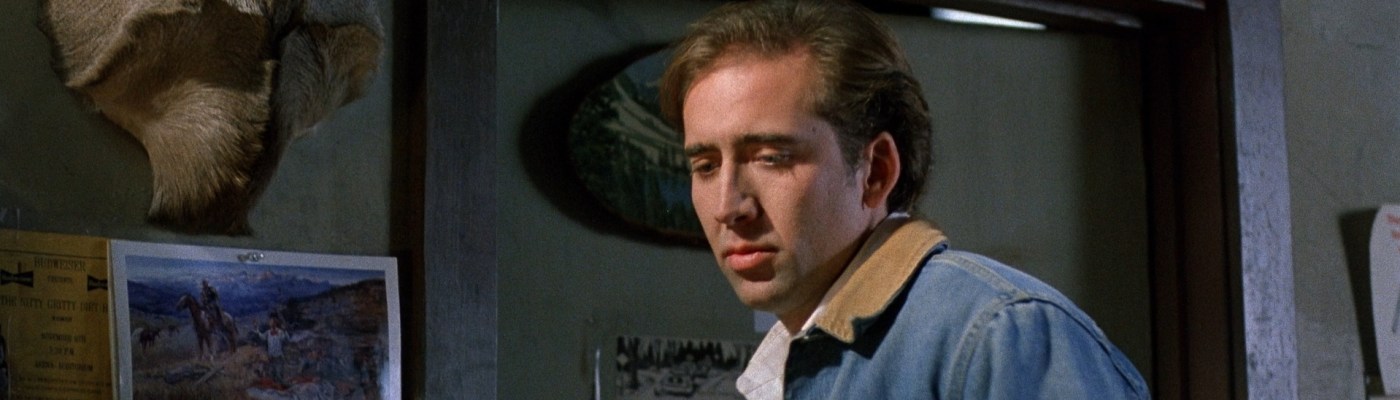
Even though David Lynch may not have had anything to do with making it, the 1993 noir thriller Red Rock West features an interesting convergence of actors who had recently worked with the director, albeit not at the same time. With Nicolas Cage (Wild at Heart), Dennis Hopper (Blue Velvet), and Lara Flynn Boyle (Twin Peaks) headlining the cast, the film could almost have been mistaken for a new Lynch production. At least, that’s how it felt to a young Lynch fan at the time.
Of course, rationally, three actors who had worked for the same filmmaker in the past appearing in a new movie together isn’t all that remarkable a coincidence. Hollywood’s a small community, and their agents were probably pursuing similar projects for all of them. Nor is Red Rock West particularly Lynchian, in the sense of the surreal weirdness people usually associate with the director. However, the picture clearly shares many of the same classic film noir influences that weighed heavily upon Blue Velvet, Twin Peaks, and (later) Mulholland Drive.
Not to belabor these admittedly tenuous connections too much, but Red Rock West is a relatively obscure movie that had next to no theatrical release and limited exposure even on home video over the years. To call it a cult film would suggest a more significant cult audience than it has ever found. I discovered it in 1993 by way of my David Lynch fandom, specifically because all those actors were in it together. In those days, rabid Twin Peaks groupies like myself followed every cast member’s latest work in lively discussions on Usenet. If not for that, I might not have known this movie existed, or wish to revisit it three decades later.

| Title: | Red Rock West |
| Year of Release: | 1993 |
| Director: | John Dahl |
| Watched On: | Blu-ray |
| Also Available On: | DVD |
By 1993, Nicolas Cage already had a considerable reputation as an eccentric actor known for his flamboyant performances in movies like Raising Arizona, Vampire’s Kiss, and Wild at Heart. Rarely has the star ever had much interest in playing a seemingly normal human being. In that regard, the first surprise twist that Red Rock West delivers is just how grounded and down-to-earth his character is, in a performance with no broad accent, actorly tics, or sudden outbursts of rage.
Michael (Cage) is a down-on-his-luck Marine Corps vet with a bad knee and barely five dollars to his name. After failing to land much-needed work on an oil-drilling crew, fate brings him to the dead end town of Red Rock, Wyoming. In the hopes of picking up an odd job for a few days, Michael stops at the local bar, only for the owner, Wayne (J.T. Walsh), to mistake him for a hitman he’d hired to murder his wife. Normally an honest man, but desperate, Michael plays along, planning only to take the cash payment and quickly head out of town. Unfortunately, his moral compass drives him to warn the wife (Boyle) before he leaves. Perhaps even more so than taking the money, that decision triggers an escalating spiral of terrible consequences that leave Michael unable to escape the town, trapped between the machinations of the equally duplicitous husband and wife, and eventually the real hitman (Hopper), who shows up late and isn’t happy about a stranger stealing his job from him.
Just as he had with his first feature, the 1989 box office flop Kill Me Again, director/co-writer John Dahl fashioned Red Rock West in direct homage to film noir classics from Hollywood’s Golden Age. The film is often labeled a “neo-noir,” but there’s nothing particularly “neo” about it, aside from the action taking place in the (then) modern day. The story follows the traditional noir rules and the characters are the traditional noir archetypes. To that end, it’s a perfectly satisfying throwback without feeling too retrograde. The plot is loaded with a practically never-ending string of twist after twist, delivered with skill by a filmmaker who’d studied the genre well and was smart enough crib the best parts.
By so uncharacteristically dialing down his performance, Cage channels the frustration he felt as an actor at not being able to unleash his wild side directly into the character. Throughout the movie, Michael struggles to do the right thing and is foiled at every turn, feelings that he keeps pent up inside him. Just 22-years-old at the time but with quite a lot of acting experience under her belt already, Lara Flynn Boyle makes a fine femme fatale. Meanwhile, Dennis Hopper plays pretty much the same villain role he’d played extensively in other movies; director Dahl actually wanted him for the Wayne character, but Hopper turned him down and insisted on doing the loony psycho. Perhaps that’s self-typecasting, but Hopper had some marquee value and he was good at that type of character, so how could any filmmaker refuse?
As a genre exercise, Red Rock West is clever, suspenseful, and very entertaining, but hardly breaks any new ground. I’m not sure that I’d call it a neglected masterpiece, but I enjoyed it in 1993 and still think it deserved better treatment than it received. Originally planned for release in 1992 (hence the copyright date of that year in the end credits), the film’s producers lost faith in its marketability and scrapped plans for a theatrical run in the United States. The movie wound up getting sold to HBO instead, where it premiered on cable broadcast the following year. A very limited theatrical release in a small handful of theaters didn’t occur until early 1994, after the movie had played on television, due to positive buzz from a few prominent critics including Caryn James at the New York Times and Roger Ebert. It made very little money and was quickly shuffled off to home video, where it got lost amongst a sea of countless other low-budget thrillers of the era.
Those who did manage to catch Red Rock West often remember it fondly, and with good reason. It’s a fun, underrated movie that should have served as a calling card for an up-and-coming filmmaker. Director Dahl built and improved upon everything he did well here with his follow-up in 1994, the even more wickedly entertaining The Last Seduction. Sadly, that film met a similar fate and once again premiered first on HBO before a belated theatrical release.
Dahl’s feature film work after that point was mostly uneven, with a couple of modest hits (Joy Ride, Rounders) and some big flops (Unforgettable, The Great Raid), before he eventually found his most success directing television on an extensive list of hit shows throughout the 21st Century.

The Blu-ray
Red Rock West is the second title (after 1980’s Little Darlings) to be released by Cinématographe Films, a new sub-label from boutique distributor Vinegar Syndrome. Unlike Little Darlings, or the forthcoming edition of Jack Nicholson’s 1978 Goin’ South, this film is only available on standard Blu-ray format, not 4K Ultra HD.
The Limited Edition box set (mine is #3,539 of 6,000) comes packaged in a Digibook with three printed essays, stored within a hard slipcover box. It’s unclear to me whether a less-expensive standard edition in a regular keepcase will follow at a later date. While that’s often the pattern for other Vinegar Syndrome titles, I’m not sure if Cinématographe will be treated differently.
Despite the lack of an Ultra HD edition, the Blu-ray’s 1080p image is very sharp with plenty of detail. The technical specs credit a “New 4K restoration from the 35mm Interpositive.” The 1.85:1 picture also has pretty nice color and contrast, though of course no HDR. One benefit of using the Interpositive rather than the camera negative is that it has the movie’s original photochemical color timing baked-in, leaving less room for revisionist teal-and-orange digital color grading, as you’ll find on many other new 4K remasters.
On the other hand, as seen in this transfer, the movie is heavily grainy at times, especially during daytime scenes in shots set against the sky as background. That grain can be very coarse and distracting in the highly-resolved image on this Blu-ray – more so than it would have looked on a 35mm release print back in the day, much less in the HBO broadcast. As much as I appreciate that Vinegar Syndrome didn’t try to smear the picture with Noise Reduction, I feel like something could have been done to help mitigate this issue. Some compromise must be possible in situations like this.

The DTS-HD Master Audio 2.0 soundtrack has decent fidelity, with mostly subtle surround envelopment. Dynamic range is modest and sound effects such as lightning and gunshots are a little weak. To be honest, the mix, especially the musical score (by William Olvis, known primarily for scoring all six seasons of Dr. Quinn, Medicine Woman) turns kind of dull and droning after about the first half hour.
All bonus features on the disc are brand new content, starting with an audio commentary by film noir historian Alain Silver and Nicolas Cage’s brother Christopher Coppola. I tried listening to some of this but think I might have liked it better with just Silver on his own. Following that are a 27-minute interview with writer/director John Dahl, a separate 17-minute interview with co-writer Rick Dahl (his brother), a 22-minute interview with editor Scott Chestnut, and two video essays (14 minutes and 9 minutes, respectively) offering further appreciation for the film.
Related
- John Dahl (director)
- Dennis Hopper
 The Video File Blog
“pop. 1523 elev. 7027”
‘pop’ = population, but what does ‘elev.’ stand for?
LikeLike
Elevation above sea level.
LikeLike
Thanks!
LikeLike
That’s what a Neo-Noir is, any Noir coming after the classic period between the 40’s and 60’s. Never heard of the movie but it sounds cool. Maybe there’s a rough version streaming somewhere I could track down.🤔
LikeLike
That’s how the term is typically abused, but if that were accurate, why don’t we have neo-Westerns, neo-musicals, neo-gangster dramas, or neo-screwball comedies? The prefix “neo-” is meant to imply some sort of revisionist take on the genre, but that’s not what this movie is at all.
LikeLike
We do have Neo-Westerns. No Country For Old Men and Hell or High Water are examples of this.
We don’t have Neo-Musicals because a musical is the form in how the story is being told as opposed to a noir which has specific narrative tropes. Not to mention the fact that they never stopped making musicals whereas when one refers to film noir it’s naturally assumed to be between the classic period.
Similar to Musicals, Gangster films have been made since the advent of the medium and have never stopped being made.
Nobody makes Screwball Comedies anymore so the term is really necessary, although I guess one could argue some of Wes Anderson’s output definitely has elements of screwball comedies.
Neo-Noir is just an efficient shorthand for “You know all those tropes from classic film noir? The femme fatale? The everyman character who gets in over his head? Hired goons? Double-crosses? Murder/kidnapping plots? First-person voiceover narration? This movie is like that but it’s set in modern day.”
LikeLike
I’ve never heard the phrase “Neo-Western” used. The “Neo-” prefix seems to be exclusively reserved for the noir genre, as if there’s something unique about it that requires you to differentiate older movies from newer ones that doesn’t apply to any other genre.
If you Google it, there’s even a ton of examples of people using the term “Neo-Noir” to refer to movies from the 1930s and ’40s, which is ludicrous.
Basically, it’s a meaningless term. Noir is noir, no matter when it’s made.
LikeLike
It’s not meaningless though lol, it is a way of categorizing noir into the two main types.
Much like Westerns, you have Class/Spaghetti/Revisionist etc. Rio Bravo, A Fistful of Dollars and Unforgiven are all technically Westerns but they’re different movies.
Just like how Double Indemnity and After Dark, My Sweet share the same DNA but are really different films.
LikeLike
Double Indemnity is a different type of film than The Maltese Falcon. Is Double Indemnity a Neo-Noir? 🙂
LikeLike
Well no, because they’re classic film noirs released within the same period. Neo-noirs tend to differ in both when they were released and the content, but they still have much in common with the classics.
LikeLike