

If the financial failure of Blade Runner in 1982 posed a serious setback for the director, his next feature project, Legend, was the film that broke Ridley Scott. Although his career would recover and he’d go on to be nominated for several Oscars over time (some of dubious merit, if you ask me), the film’s tumultuous production and terrible reception led Scott to make big changes to the way he’d make movies in the future, and seemed to drain the passion and fire out of most of his later work.
Many of Ridley Scott’s movies have messy production histories, but Legend may be the messiest of all. The period fantasy epic was reportedly an arduous shoot, capped off by a massive soundstage fire that burned down the main sets before filming had finished. Once finally completed, the movie was released in two different versions between Europe and America, both of which were panned by critics and flopped at the box office. Not until a longer Director’s Cut saw release on DVD a decade and a half later did Legend finally start to reclaim its reputation as perhaps something other than a disaster for all involved.
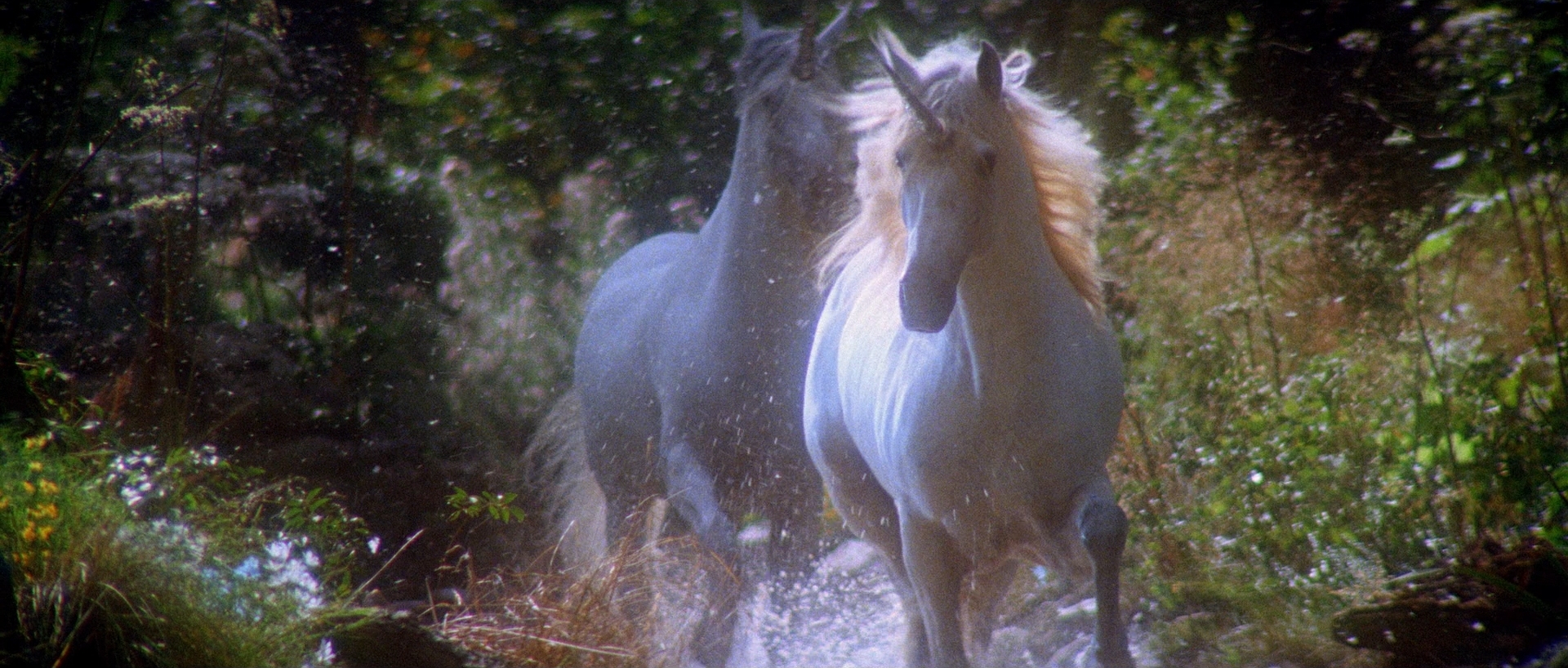
| Title: | Legend |
| Years of Release: | 1985 – Europe 1986 – United States 2002 – Director’s Cut (DVD) |
| Director: | Ridley Scott |
| Watched On: | Blu-ray |
| Also Available On: | DVD Various VOD rental and purchase platforms |
The two distinct phases of Ridley Scott’s career were clarified for me years ago by watching the bonus features on his middling and forgettable 2008 spy thriller Body of Lies. Whether it was in the audio commentary or one of the featurettes, I no longer remember, but at some point Scott explained how he prefers to shoot his movies quickly and efficiently, with all set-up completed well in advance so that he doesn’t have to waste too much of his actors’ time or cause any drama on set. Those were simply not the words of the same man who so infuriated Harrison Ford by spending hours art-directing the placement of props in the deep background of scenes on Blade Runner.
This opinion may not be widely shared among the director’s fans, but to my mind, Legend seems to be the last movie Ridley Scott really put his heart into making. His later films may still be well-constructed and visually striking, but most of them feel like technical exercises or cynical awards bait claptrap. The best of them might be fortunate enough to be paired with a halfway decent script Scott can apply his craftsmanship onto, but more often than not, he hardly bothers to care whether he’s working from a pretty good screenplay (Thelma & Louise, arguably) or a fetid pile of garbage (Prometheus). It’s all the same to Scott so long as he can work a cool set-piece or two into it.
That’s not to say that Legend is some unheralded masterpiece, or ever had the potential to be one. Even in its most complete version, the fairy tale drama has a thin story, an overly twee tone, and suffers the miscasting of a young Tom Cruise in a role that doesn’t suit him before he’d figured out what his movie star persona would be. For as ornate and elaborate a visual spectacle as it is (skills very much in Ridley Scott’s wheelhouse), the material also feels like it needs someone behind the scenes with a lighter touch and more facility for the goofy comedy bits. The movie came out just a few years after Terry Gilliam’s Time Bandits, and has some very obvious stylistic and tonal similarities with that film, but doesn’t work nearly as well.
On the other hand, Scott was clearly reaching for something with Legend. The film strives to be a pure visual representation of a classical European fairy story. Interiors and exteriors alike all constructed entirely on soundstages, the director creates a rich and detailed, hand-crafted dreamscape world. If the casting of Cruise doesn’t quite fit, Mia Sara is luminous as the female lead, and Tim Curry miraculously manages to deliver one of cinema’s most magnetic and charismatic villain performances under six tons of latex and prosthetic appliances as the demonic Darkness. These qualities resonate long after the details of the plot (some nonsense about needing to save unicorns from being killed by goblins so that the sun can rise again) are quickly forgotten.
As if shooting it weren’t difficult enough, by the time the film got to post-production, both the director and the studio panicked about its commercial prospects and began hacking away at it, cutting the length down dramatically. From an initial cut reportedly a little over two hours long, the movie was eventually distributed in two versions to different territories. European theaters played Legend first in late 1985 with a running time of 94 minutes. In the United States, the movie was held back until spring of 1986 with further cuts bringing it down to a mere 89 minutes. As mentioned, both received negative reviews and were box office bombs.
In addition to losing a few more minutes of footage, the most dramatic change between the two theatrical cuts of Legend was a completely different musical score. American viewers saw the movie with a score by synth rock band Tangerine Dream, while those in Europe saw it with a traditional orchestral score by Jerry Goldsmith. Each score has its merits, and fans passionate enough to defend it against the other.
For years, Legend was regarded as little more than a visually pretty but misguided dud. However, the success of the Blade Runner Director’s Cut in 1992, followed by the explosive success of the DVD format at the end of that decade, convinced the film’s producers and studio executives at Universal that maybe Legend might be worth another look. In 2002, Universal released a new Director’s Cut of Legend on DVD to more fanfare and success than the movie had during its original run.
With a new running time of 113 minutes and featuring the Jerry Goldsmith score, I would personally describe the Director’s Cut of Legend as less a revelation than a refinement or fine-tuning. The story is less jumpy and condensed, the romance between Jack and Lily (Cruise and Sara) is a little better fleshed-out, and the whole thing generally feels a bit more coherent and enjoyable overall. Even that being the case, the movie still never hits the heights of greatness. It’s still kind of a mess, just less of one. Also, I think I like the Tangerine Dream score better.

The Blu-rays
Legend first appeared on Blu-ray in the form of a so-called Ultimate Edition from Universal Studios that contained both the 89-minute American theatrical cut and the 113-minute Director’s Cut squeezed onto the same disc. Amusingly, playback of that disc was prefaced by a note from Ridley Scott apologizing for the quality of the Director’s Cut, which had to be sourced from a less-than-optimal answer print supposedly inferior to the “much more detailed and refined image” of the theatrical cut.
Looking back on it today, the Director’s Cut on that disc actually looks vastly better than Universal’s transfer for the theatrical cut, which is a ghastly edge enhancement nightmare unwatchable on any large home theater screen.
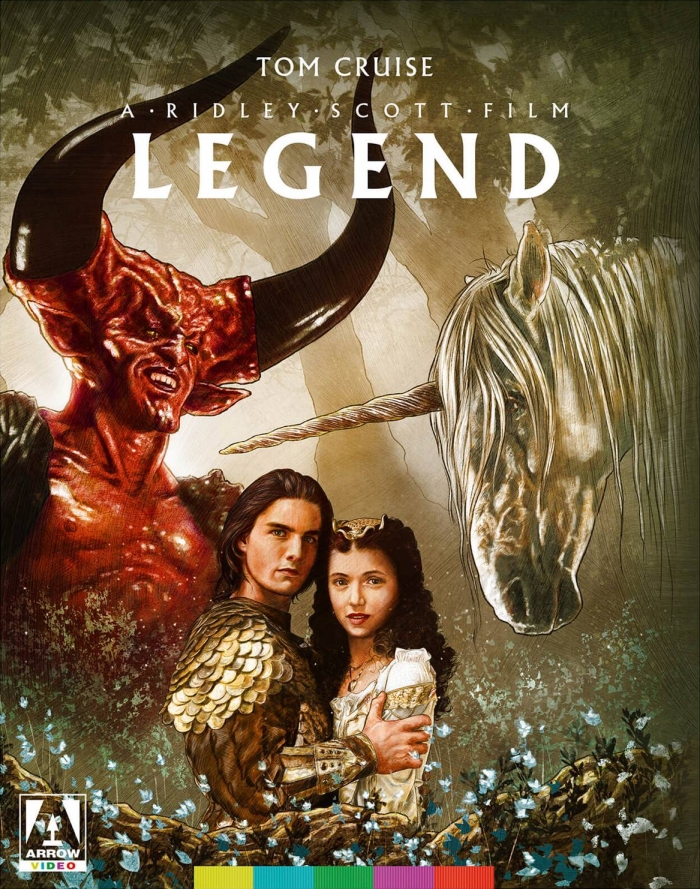
Jumping forward another decade, the rights to Legend were licensed by boutique label Arrow Video, which reissued the film in 2021 in the choice of a Collector’s Edition or a more elaborately packaged Limited Edition. Both included the American theatrical cut and the Director’s Cut on separate discs, along with a host of bonus features. The deluxe Limited Edition, which I bought, housed the contents in a fancy hard case and came with a folded poster, some art cards, copies of cast photos by Annie Leibovitz, and a booklet with several essays about the film.
Because Legend was originally a co-production between Universal Studios and 20th Century Fox, American distribution rights to the film went to Universal while international distribution rights went to Fox. As a result, ownership of the European theatrical cut has unfortunately resided with 20th Century Fox ever since. In recent years, this means all licensing rights to that version have been held hostage under Disney’s lockdown of the Fox catalog.
The Director’s Cut
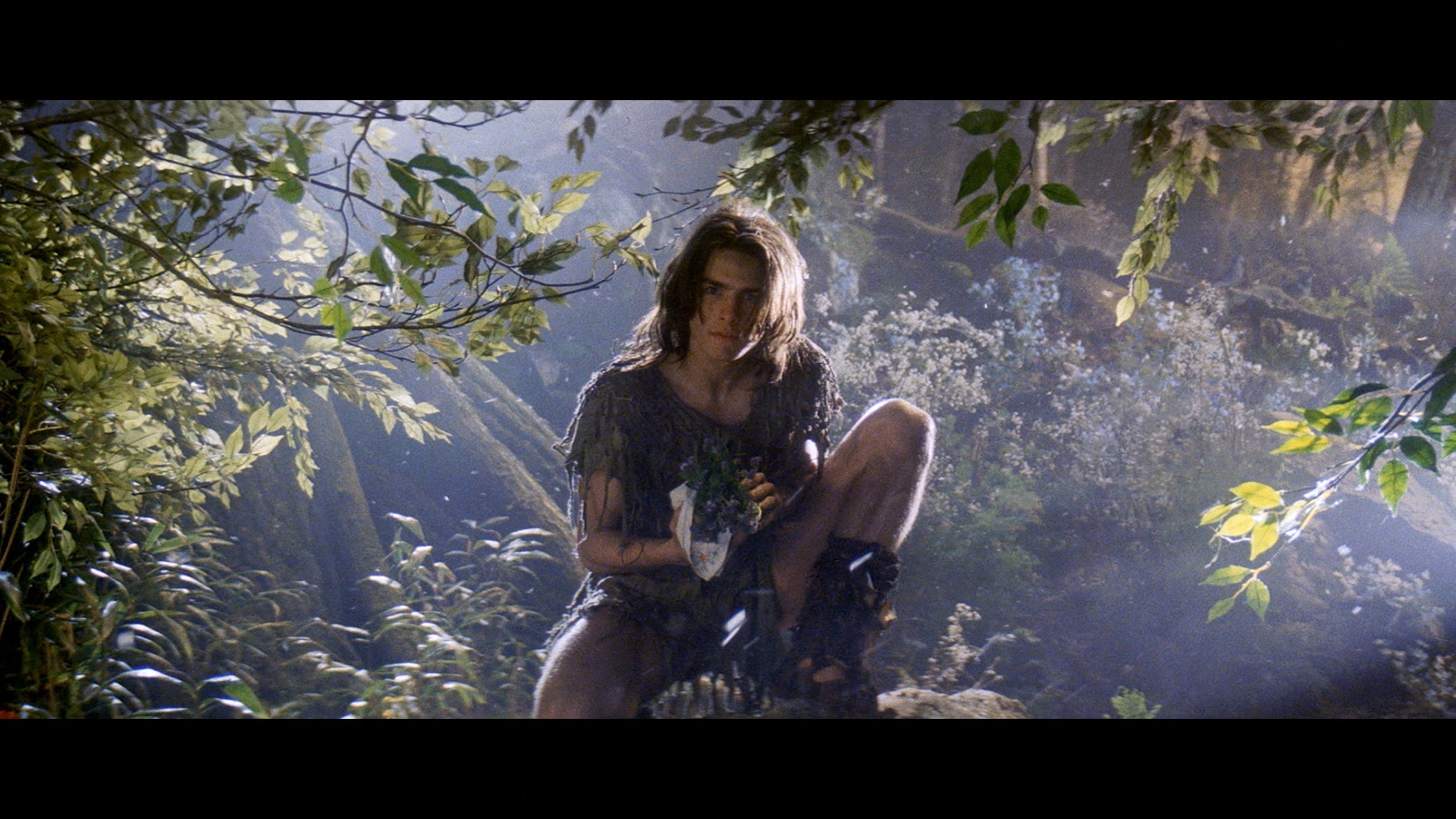
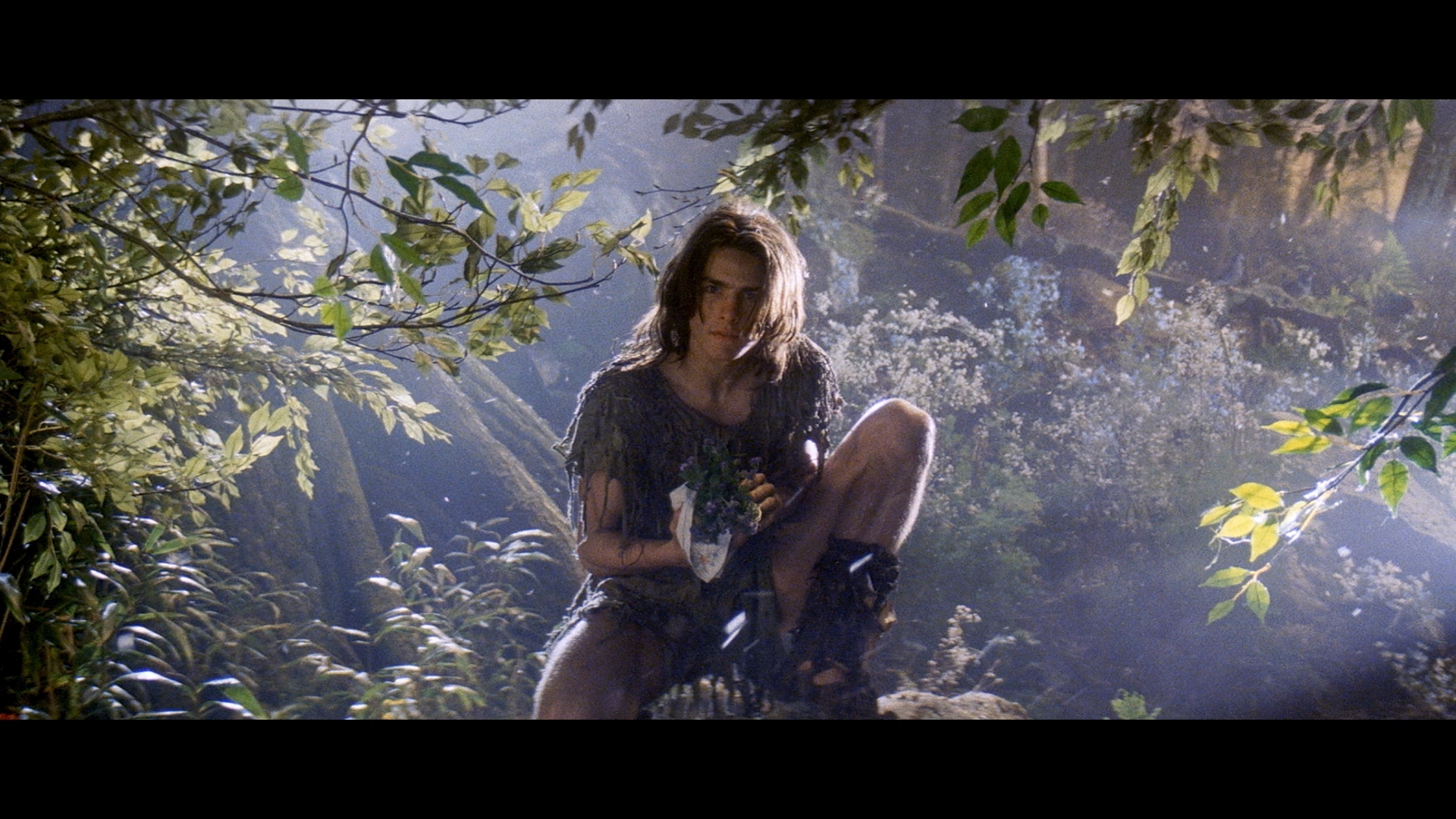
The video transfer notes in Arrow’s booklet state (again in an apologetic tone) that the Director’s Cut comes from the same 2011 HD master supplied by Universal. Indeed, the two copies of the Director’s Cut look very similar. Arrow perhaps has better compression and authoring, for slightly better resolved film grain and fine object detail in some scenes, but the difference is pretty subtle during playback. (If the slider comparisons below don’t display large enough, click the links in the captions for the full-size screencap images.)
Looking at the Director’s Cut first, the 2.35:1 image is rather soft. Some of that may be due to the answer print source, but I expect that a lot of it has to do with Scott’s photographic choices to shoot the film with diffusion filtering for a soft and warm glow. The picture’s also quite grainy, heavily so in many scenes. Colors look a little faded and contrast is flat. That said, the first 25 minutes tend to look the roughest. Video quality is generally a little bit sharper and less grainy after that point, with slightly better defined colors. Considering that only two complete prints of this Director’s Cut are known to exist in the world, it’s quite watchable.
Audio is offered in DTS-HD Master Audio 5.1 or 2.0 options, both provided by Universal. Per Arrow’s tendencies, the disc defaults to 2.0, which I suppose is meant to represent the film’s original stereo-surround mix. Comparing them, the 2.0 track on the Director’s Cut is louder and stronger than the 5.1 remix. The tradeoff is that it can sound a little harsh and bright at times. Even so, the 5.1 seems muted and dull in comparison.
Extras on the Director’s Cut disc include an audio commentary by Ridley Scott and an hour-long documentary, both of which were originally created for the 2002 DVD. A vintage promotional featurette, deleted scenes, alternate footage, storyboards, screenplay drafts, trailers, TV spots, and image galleries have likewise been around the block a few times.
The Theatrical Cut
Here’s where things get interesting. Although the Director’s Cut was recycled directly from Universal’s existing video master for pragmatic reasons, Arrow’s booklet proudly boasts: “The U.S. Theatrical Cut has been exclusively restored by Arrow Films for this release.” Based on a new 4K scan, primarily of the Original Camera Negative (though with some sections taken from an Interpositive source), one might expect the theatrical cut to be the true jewel of this set, video-wise, and to look noticeably better than the Director’s Cut. Not being held back by the limitations of the Director’s Cut answer print, at the very least the theatrical cut ought to be better resolved, with richer colors and contrasts.
Instead, perplexingly, the theatrical cut looks near identical to the Director’s Cut to my eye. I’ll be damned if I can tell them apart in most, if any, scenes. The picture’s equally soft, grainy, flat, and dull.
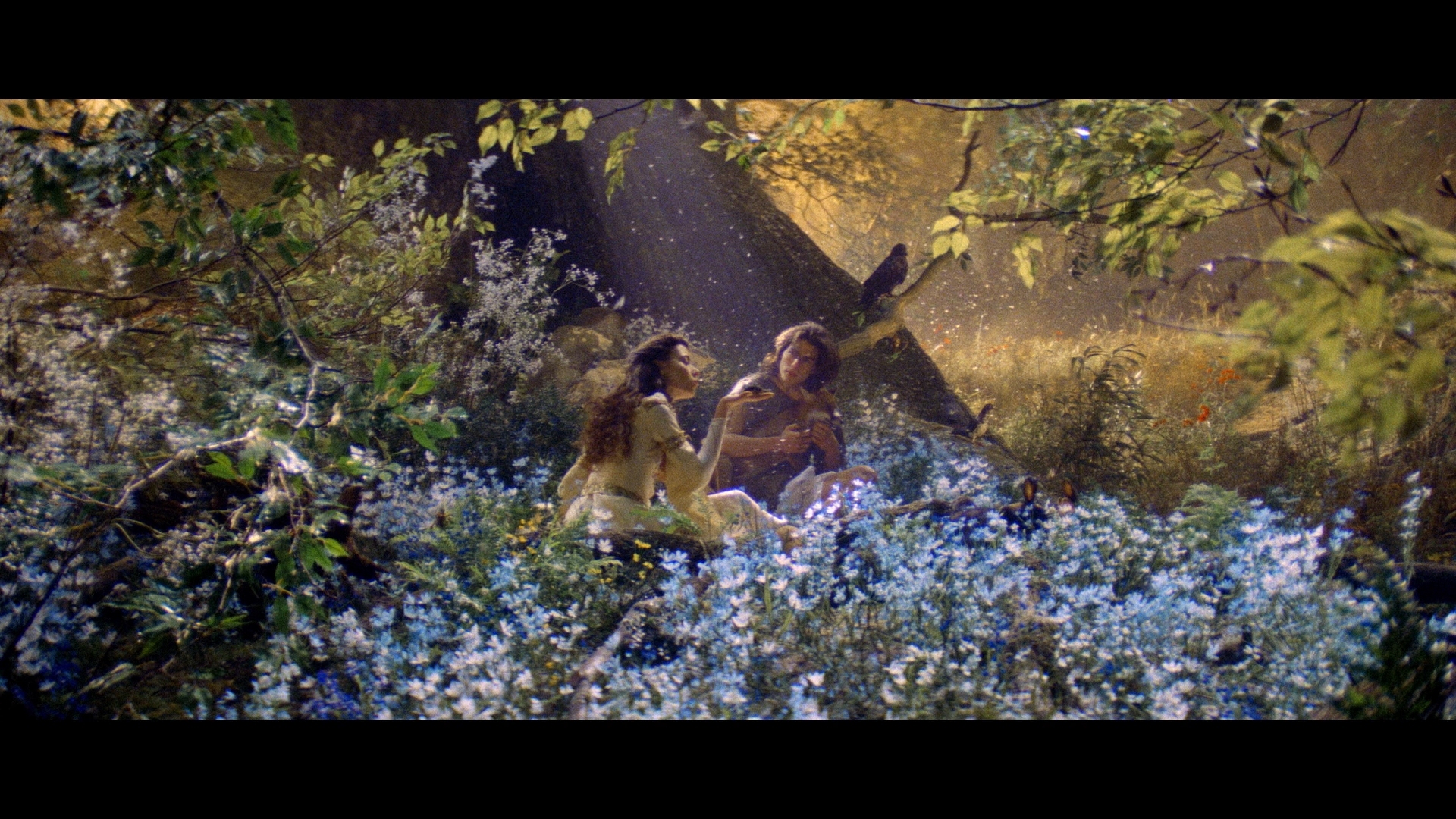

Admittedly, even though the elements may have been scanned in 4K, the transfer notes state that the restoration work was completed at 2K resolution (no explanation given). Also, according to those same notes, the Director’s Cut was used as “the primary grading master for the restoration of the U.S. Theatrical Cut.” It almost sounds like Arrow made a deliberate point of matching the theatrical cut to the look of the Director’s Cut, flaws and all, even if that meant holding it back from the potential to look better than a known compromised source. If true, I can’t say I agree with that decision.
To be fair, Arrow’s theatrical cut transfer is a tremendous improvement over the monumental shitshow that Universal made of the theatrical cut on the 2011 Blu-ray. I’ll take a soft and grainy picture over a hideous over-processed mess any day. By that measure, Arrow’s work is very welcome.

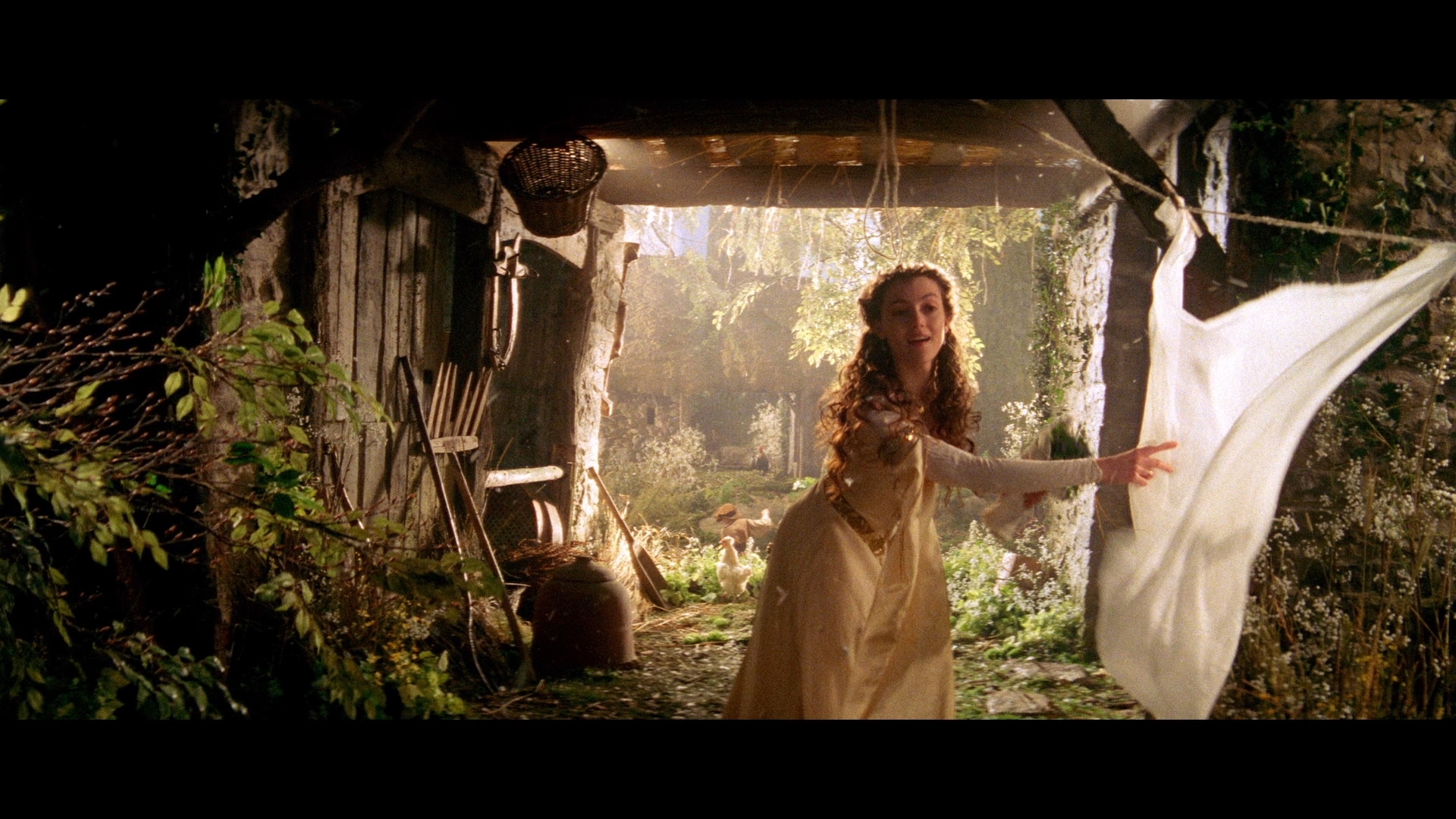
I’m also cognizant of the double standard of my saying a few nice words about the Director’s Cut and then expressing disappointment that the theatrical cut looks pretty much the same as it. Still, I suspect that the film’s original prints in 1985 likely had richer colors, texture, and more depth than anything we’re seeing on these Blu-rays now, and I would’ve hoped that a new scan from the OCN could have brought us closer to that.
As with the Director’s Cut, the soundtrack comes in DTS-HD Master Audio 2.0 or 5.1 flavors. In this case, the quality of the two tracks is much closer. I marginally preferred the 5.1 as a little bit crisper and more expansive, but could go back and forth on that recommendation.
In all of the audio options on both versions of the movie, dialogue is very forward in the mixes. That’s undoubtedly a consequence of much of the cast’s dialogue being replaced with ADR.
Supplements on the theatrical cut disc start with an audio commentary by Paul M. Sammon, author of Future Noir: The Making of Blade Runner and Ridley Scott: The Making of His Movies. Following that are isolated music tracks (for the Tangerine Dream score, or music & effects), an alternate opening narration created for the television version, a handful of featurettes (some new, some old), a hour-long 2003 documentary about Ridley Scott, and a Bryan Ferry music video.
Related
- Ridley Scott (director)
- Tom Cruise
 The Video File Blog
I’m very conflicted by this film. Saw it on HBO when I was a teenager and bought the TG soundtrack when Varese Saraband issued it in the early 90’s. Bought (and still have) the special edition DVD with the see-through cover. I think I even watched it. When the Arrow BD was announced I thought about getting it, but honestly I think I’ve outgrown this movie. The last time I saw it I just couldn’t get into it. Spot on review. I’m surprised you didn’t comment on the whole set burning down during production.
LikeLike
I mentioned the soundstage fire in the second paragraph.
LikeLike
I remember almost 10 years ago you stating that in your opinion, Ridley Scott had not made a good movie since Blade Runner. Is that still your contention or has your stance softened somewhat?
LikeLike
Ooh, calling me out on an old opinion, eh? 🙂
I suppose I may have softened a little. What I will say now is that I still don’t think Ridley Scott has made anything approaching a great movie since Blade Runner. This certainly doesn’t get there. Some fans like to proclaim the Director’s Cut of Kingdom of Heaven a masterpiece, but I’m very lukewarm on that one.
I probably need to watch Thelma & Louise again sometime. I know it’s very highly regarded, but I didn’t especially care for it when I first saw it many years ago. I have not seen The Martian, which is supposedly decent. The original book it’s based on was OK.
I thought Gladiator was an absolute joke and left the theater opening weekend certain it was going to be a massive bomb. I have no idea why it became so popular, beloved, or how it won so many Oscars. What a stupid movie that is.
Prometheus… you know… fuck that movie. I wish I could purge it from existence.
Most of his other stuff I have little to no interest in watching or revisiting. I’ve seen a fair amount and the majority ranges from forgettable to terrible.
LikeLike
Well since we’ve been discussing movies online for a decade or so it felt apt given the current revisit to Sir Scott’s filmography.
If anything my stance on his output is a lot more ambivalent these days. He’s made some great/good movies but a lot of misses as well.
I always thought Gladiator was “ok” and was kinda surprised it won all the Oscars as well.
Kingdom of Heaven is decent but pretty heavy-handed in the political commentary department. I needn’t a reminder that mankind’s fanatical adherence to an ancient religion can cause untold amounts of bloodshed and suffering, I can just look at the current state of things.
If anything I think Scott’s less-heralded movies are the best stuff post BR.
Still love Black Rain, Matchstick Men is super-underrated with one of Cage’s best performances, Body of Lies isn’t one of the great spy-thrillers of all time but it’s an entertaining yarn for what it is. Covenant was at least an improvement over Prometheus albeit nowhere near the same quality as the original film.
Probably the biggest surprise in his latter period was The Last Duel which if you haven’t seen it yet is quite good and definitely worth seeing.
LikeLike
I rewatched Black Rain when it came out on HD DVD and found it quite ridiculous, sorry. Did not think much of Body of Lies either. I haven’t seen Matchstick Men or The Last Duel, but a friend of mine was recently ranting on Facebook about how much he hated the latter. 🙂
LikeLike
I hate the karaoke scene in Black Rain but if you watch it with the notion it’s basically an elevated B movie it’s fun enough. I think it’s cool they actually shot it on location in Osaka as well.
Agree to disagree on BOL
MM is a lot of fun.
I’d be curious to know what your friends’ criticisms of The Last Duel were. He’s not super right-wing is he?
LikeLike
Black Rain is very dumb and quite racist. My friend’s complaints about The Last Duel were mostly to do with the script not making any sense, but again, I haven’t seen it myself.
LikeLike
The movie isn’t dumb and racist, but Douglas’ character is, that’s the point though! That’s his arc !🤷♂️
In all seriousness though, the movie could definitely be accused of exoticism or cultural fetishization, but Hollywood has always done that.
On the subject of Legend though I totally agree about the score, Tangerine Dream aaaaallll day. I’ll watch any movie with a TD score, they elevate any movie.
LikeLike
Nah, the movie’s also pretty racist. Even though Douglas’s character supposedly has an arc, he’s presented as way cooler, smarter, and more badass than any of the incompetent and useless Japanese cops he has to work with.
LikeLike
And what happens when he arrives in Japan? The bad guy gets away and his partner is decapitated! Subtext man!
LikeLike