
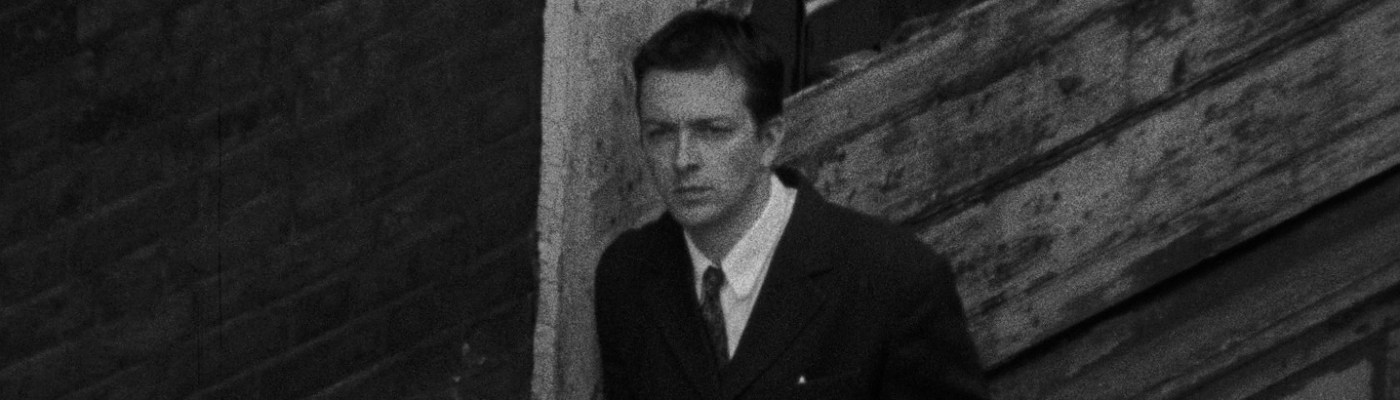
Before he became a brand unto himself with a rabid cult fandom slavering to see his latest three-hour-long, bombastic IMAX spectacle, Christopher Nolan started his filmmaking career with a very modest, small art film called Following that was little seen by anyone until the Criterion Collection picked it up on home video. To be honest about it, I prefer this Christopher Nolan to the current version.
Like most viewers, I first became aware of Nolan through his 2000 indie film sensation Memento, which immediately marked him as an emerging auteur to keep an eye on. I was blown away by Memento when I saw it in theater, and continue to find it rewarding in repeat viewings – even despite acknowledging that Nolan stole its structural gimmick from Harold Pinter’s 1983 Betrayal and the famous “backwards” Seinfeld episode of the same title from 1997. I eagerly followed the director’s subsequent work as he quickly moved onto the Hollywood A-List, and for a while convinced myself that he was the rare talent capable of making smart, thought-provoking blockbuster hits.
As time has gone on, however, I’ve grown disenchanted with most of Nolan’s filmography and have found his last few movies just about insufferable. The way I see it currently, he peaked with Memento and everything afterward has followed a downward trajectory, each new project a little worse than the last. While the hype and early Oscar buzz leave me at least a little curious about his new Oppenheimer bio-pic, I’ve been burned one too many times by Christopher Nolan and can’t help feeling skeptical about anything new he makes. Perhaps I’ll have to eat my words about this later, but for now I’m in no hurry to see it.
| Title: | Following |
| Year of Release: | 1998 – Film festivals 1999 – Limited release |
| Director: | Christopher Nolan |
| Watched On: | Blu-ray |
| Also Available On: | The Criterion Channel AMC+ Tubi Various VOD rental and purchase platforms |
Depending on the reference you look at, Following can be credited as either a 1998 or 1999 film. The movie played in festivals in ’98, but didn’t have a general theatrical release until ’99. Because the end credits have a 1999 copyright date, I lean toward that answer. In any case, exposure to the film was extremely limited until well after Nolan’s breakthrough with Memento.
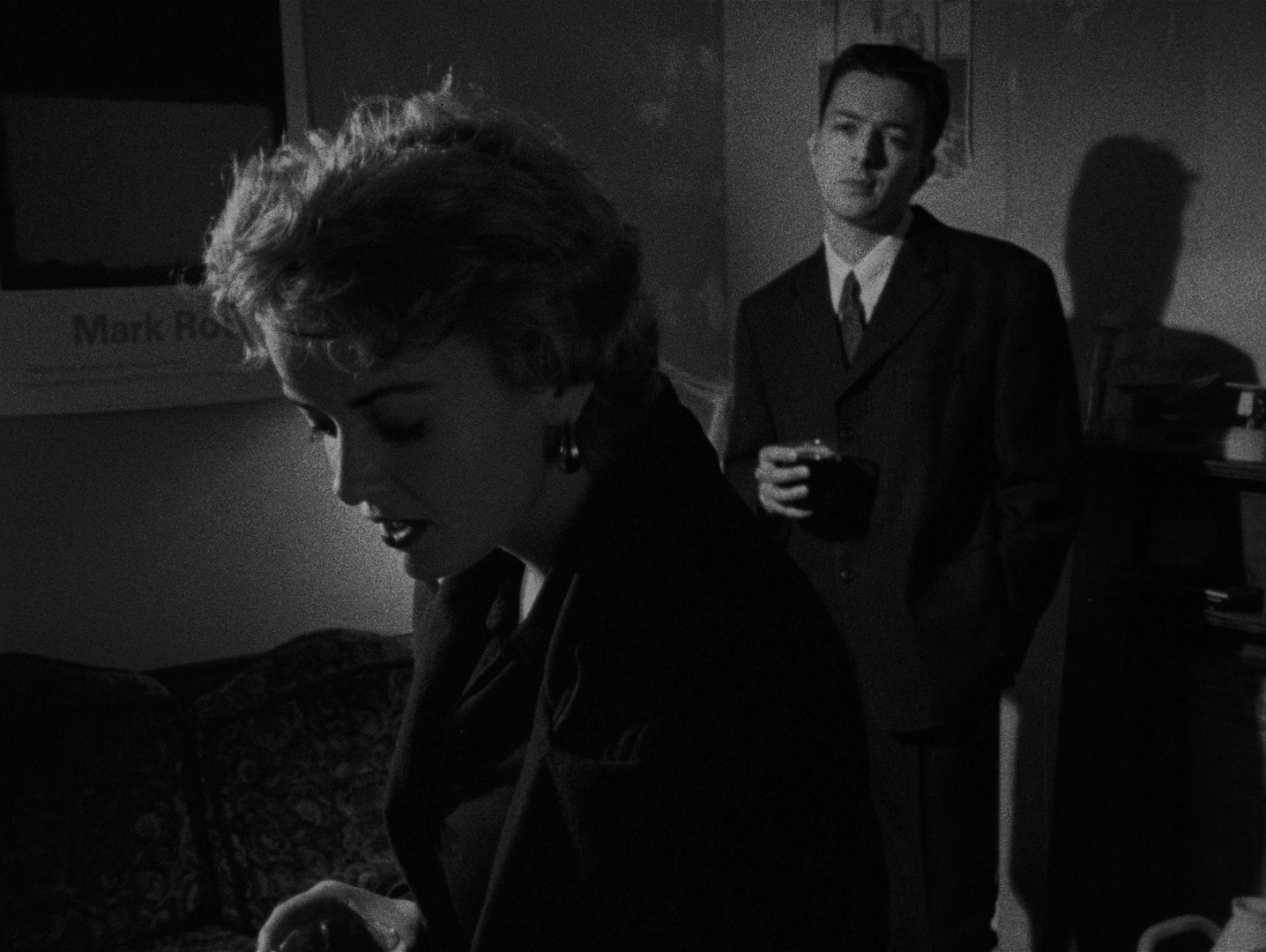
At a very brisk 70-minute length and with a production clearly made for next to no money, Following could almost be described as a glorified student film, except that Christopher Nolan never actually studied film in school. Instead, he studied English Literature while he and younger brother Jonah played around making short films. After graduation, Christopher scraped together a pittance to shoot his first feature in 16mm black & white for submission to the festival circuit.
Nolan’s friend Jeremy Theobald stars as a character officially called “The Young Man,” but who goes by Bill or Danny at various points, neither of which is likely his true identity. Professing boredom, the Young Man has taken up a troubling pastime of stalking random people he spies on the street, following them around for a period to see where they’ll go and what they’ll do. He claims to be a writer “gathering material” for his work, though we never actually see him do any writing. All signs point to him just being an obsessive creep.
This new hobby hits an obstacle when one of the Young Man’s marks confronts him and, worse, turns out to be a burglar who breaks into people’s homes for reasons not too dissimilar from the Young Man’s motives. Cobb (Alex Haw) is less interested in finding things of value to steal than in the thrill he gets from the effects his intrusions will have on his victims. “You take it away and show them what they have,” he rationalizes of his thefts. The two form a problematic kinship as Cobb drags the Young Man around with him to teach him the art of burglary.
More complications arise when the Young Man fixates on one particular victim, known only as The Blonde (Lucy Russell), and insinuates himself into her life. The girl’s been dating a dangerous criminal and, before long, an ill-advised plan is hatched for the Young Man to use his new robbery skills to steal from the shady boyfriend. What he doesn’t realize until too late is that the Blonde may have an agenda of her own.
Following is without question a formative work, made with almost no resources by an untested young director. It’s total length is barely a third of what a current Christopher Nolan film will run, and the soundtrack has not even one instance of deafening bass to pummel viewers until their brains turn to jelly, which I’m sure disappoints him greatly in retrospect. However, Nolan makes the extreme low budget work for him by styling the piece after classic film noir in visual appearance, tone, and plotting. The story features twists and double-crosses, and even a femme fatale. Yet it somehow doesn’t just feel like a throwback. To make it his own, Nolan employs a complicated non-linear structure in which events jump around out of sequence, forcing viewers to piece together the narrative like a puzzle. He’d of course perfect that technique with Memento, but the effect works well here as well.
For a first feature, Following is a strong effort and remains interesting to revisit today. It’s not the mind-blower or crowd-pleaser that Memento would be, but it shows clear signs of a developing talent on the cusp of coming into his own.
I just wish the filmmaker hadn’t grown quite so full of himself the more success he’d achieve afterwards.
The Blu-ray
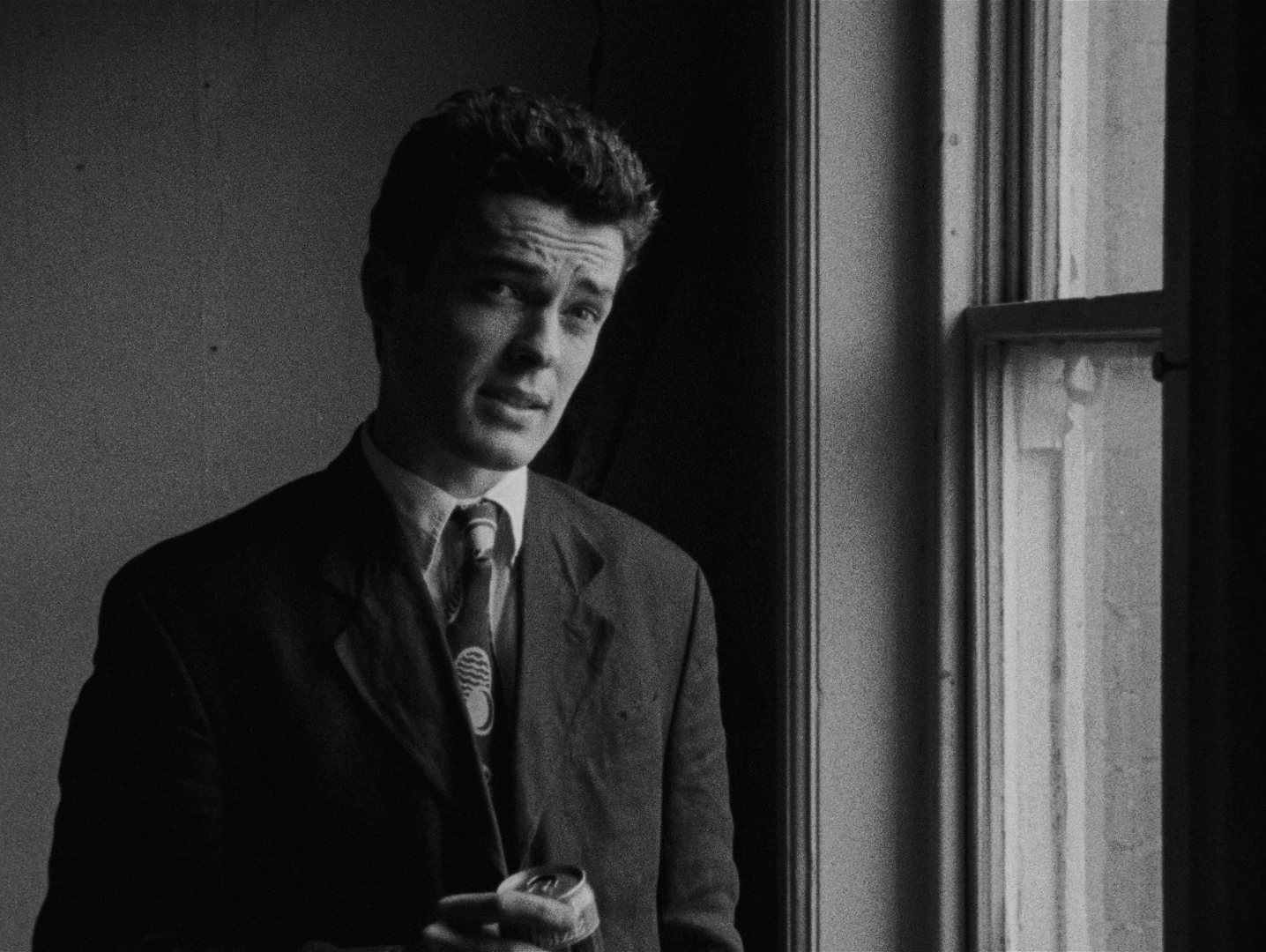
Following was released on DVD and Blu-ray by the Criterion Collection in 2012 as spine #638. Both sport a director-approved transfer based on a 4K scan of the original film elements. The movie is presented in a 1.33:1 aspect ratio (not 1.37:1) that would have been highly unusual for a theatrical release in 1999, but if The Blair Witch Project got away with it, I suppose Christopher Nolan could have too. The technical specs on IMDb are a little ambiguous and may suggest that the movie was cropped to 1.85:1 at that time. If so, it must have looked terrible. The photography is composed with an abundance of tight close-ups that don’t crop well at all.
Considering the limitations of the 16mm film source, the Blu-ray’s 1080p image quality is about as sharp as it probably can be, and I don’t imagine that a 4K disc upgrade would get anything more out of it. The black & white picture is heavily grainy, but has good texture as well as nice gray scale and contrast. The film elements suffer some occasional light scratches and a couple instances of hair stuck in the gate at the bottom of the frame, but neither issue is too distracting.
Originally monaural, the movie’s soundtrack was remixed and remastered into DTS-HD Master Audio 5.1 for the Blu-ray. From the sounds of it, I believe the musical score by David Julyan may have been re-recorded at that time as well, because the music has much richer and clearer fidelity than the rest of the soundtrack. Although bass isn’t especially deep, the score has a nice driving beat and some bleed to the surround channels.
Dialogue sounds a little soft in the mix. I don’t know if that’s an issue with the original recording elements or just a Christopher Nolan decision. (In his later movies, Nolan has developed a perverse fondness for drowning out dialogue beneath music and sound effects an order of magnitude louder.) For what it’s worth, the dialogue here is all intelligible. If anything, sound effects are rather muted.

A booklet in the case provides an essay by film critic Scott Foundas that forced me to change my original (and frankly superior) “Nolan Begins” headline for this review because he’d already taken it.
On-disc supplements include an audio commentary by Christopher Nolan, a separate video interview with the director, a copy of his 1997 surrealist short film Doodlebug (3 min.), a script-to-screen comparison of three scenes, two trailers, and an option to watch a “linear cut” of the movie. I sampled the latter but haven’t watched the whole thing. From what I saw, the movie still doesn’t seem to be particularly chronological, and the rearranging of scenes just made it even more confusing.
Related
- Christopher Nolan
 The Video File Blog
“I just wish the filmmaker hadn’t grown quite so full of himself”
Maybe it runs in the family (thinking “Westworld”)
LikeLike
Definitely.
LikeLike
My god…talk about something stupid pretending to be smarter than it is. I could hear the thoughts of its fans while watching episodes of Westworld: “They use a lot of science words, so it’s like super smart! Yippie! Time for more nudity and swear words!”
I started laughing when the dialogue of the “smartest person” there (Shannon Woodward’s character) felt like a competition to see how many swear words she could fit into a single sentence. I’m not opposed to bad language, but when all your character does is constantly swear, it shows how little intelligence the writers writing the character actually have.
I have a sibling who thought they were reinventing storytelling with that show…what a joke…
LikeLike