

Coming up soon on six decades since its inception, the Mission: Impossible franchise is, remarkably, still going strong. Of course, the property has changed quite a bit in that time, as it transitioned from a team-based espionage TV show to a Tom Cruise action blockbuster movie series. In fact, looking back on the pilot episode that kicked the whole thing off, some viewers may even be surprised by the glaring absence of something – or, more specifically, someone – they likely most identified with the original version of Mission: Impossible.
Launched at the height of the 1960s spy craze, Mission: Impossible was incredibly popular and ran for seven seasons on CBS. For most of that time, the show was fronted by Peter Graves, who served as the face of the series all the way through a two-season revival in the late 1980s. Until Tom Cruise took over in 1996 to make it his own star vehicle, Graves’ name was synonymous with Mission: Impossible in the eyes of most fans. And yet, his character Jim Phelps didn’t actually join the show until its second season. When the program premiered in 1966, the IMF team was led by Daniel Briggs, played by actor Steven Hill.
If the face looks a little familiar, you may remember Hill as a much older man during his long stint as the District Attorney on Law & Order.

| Title: | Mission: Impossible |
| Season: | 1 |
| Episode: | 1.01 – Pilot |
| Release Date: | Sept. 17, 1966 |
| Watched On: | Paramount+ |
| Also Available On: | Blu-ray |
In its original conception, Mission: Impossible concerned the exploits of a secretive government agency called the Impossible Missions Force, tasked with (as you might gather from the name) carrying out high-risk objectives that the FBI, CIA, NSA, or what have you are incapable of completing themselves. At the beginning of each episode, the team leader (Briggs for the entire first season) is briefed on the mission parameters and must select the most appropriate agents to aid him in accomplishing it.
This structure would allow some variety in the supporting cast from week to week. Realistically, however, Briggs (and later Phelps) typically relied on a small batch of recurring players. Future Oscar winner Martin Landau was featured in nearly every episode of the show’s first three seasons as master-of-disguise Rollin Hand – as was Landau’s real-life wife Barbara Bain as the alluring Cinnamon Carter, expert at deception and misdirection. Greg Morris appeared in all 171 episodes as tech whiz Barney Collier, while Peter Lupus was in nearly as many as team muscle Willy Armitage.
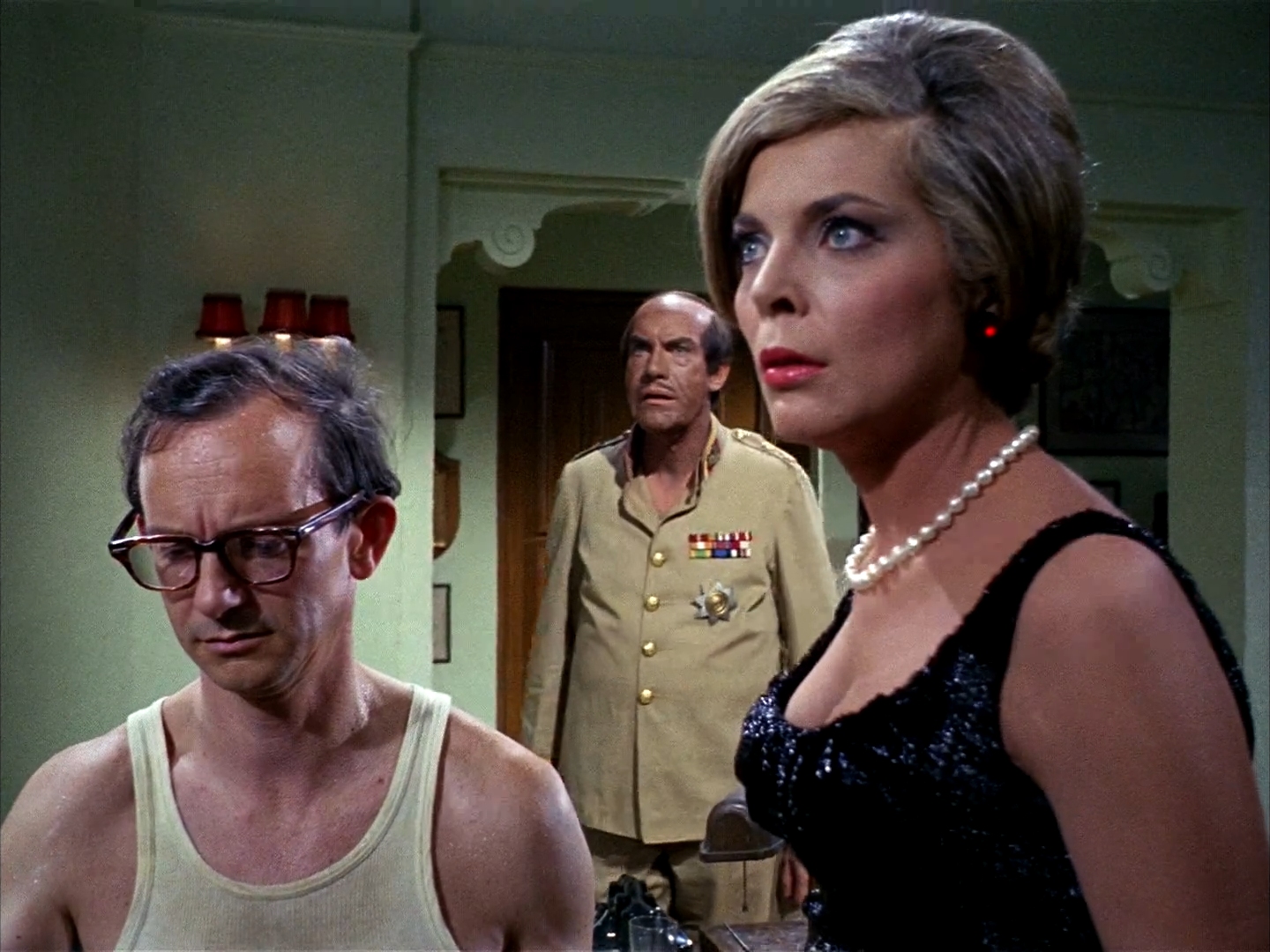
The pilot episode finds the squad sent to the fictional Central American nation of Santa Costa, where Rollin must impersonate the country’s military dictator so that the others may retrieve a pair of nuclear warheads from the secured vault holding them. Rollin’s rubbery makeup is pretty gimmicky and doesn’t really hold up to scrutiny now seen in High-Definition clarity, nor does Landau’s appearance as the real Generalissimo, but I expect those problems were probably easier to overlook in the broadcast quality of the era. The episode plotting is also perhaps a little strained to come up with very specific tasks for everyone else to fulfill, but makes enough of a case for why this job has to be a team effort, rather than a one-man super-spy adventure (which is what most of the Tom Cruise movies turned into).
Many TV shows take a while to find their footing, but Mission: Impossible locks down its successful formula right out of the gate. The cast is very appealing (especially the stunning Barbara Bain, who was quite a knockout) and has great chemistry. He may not have lasted in the role, but Steven Hill makes a perfectly suitable and fine lead. The episode scripting is clever and the series premiere remains entertaining and rewatchable even more than half a century later.
Contributing a great deal to that is the fantastic Lalo Schifrin opening theme, which still gets the blood pumping and somehow has never grown old despite decades of repetition.
It’s really no wonder this premise would prove so durable in the long run. I wasn’t born until after the show ended, and wouldn’t become acquainted with Mission: Impossible until the ABC network acquired the rights and brought it back in 1988. I thought that version was pretty great at the time, though I haven’t seen it since and can’t speak to whether it holds up as well as the original.
Video Streaming
If you can believe it, Paramount actually released the entire seven-season, 171-episode run of the classic Mission: Impossible TV series on Blu-ray in one massive 46-disc box set in late 2020. At the time of this writing, the whole thing is even currently available for well under $100 on Amazon and other retailers.
Even so, I think most fans (much less casual viewers) would consider such a huge package cumbersome and inconvenient. Content like this is what streaming was made for. To that end, the 1966-1973 Mission: Impossible streams on Paramount+. Sadly, the two-season 1980s revival series was last released only on DVD in 2011 to 2012 and is not available for streaming at this time.
Episodes of the 1960s show are preserved in their original 4:3 aspect ratio, but remastered at a much higher 1080p resolution than they saw during broadcast. I haven’t watched the Blu-rays to compare against. The streaming version looks pretty good, with a big caveat that you’ll get different results depending on how you stream it. Watched on the Paramount+ app directly, the picture quality is very sharp and detailed (quite revealing of Martin Landau’s rubbery makeup prosthetics), but is also plagued with compression issues that make grain look incredibly noisy and result in periodic blockiness and pixelation.
Because I subscribe to Paramount+ through the Amazon Prime “channels” system, I’m also able to watch any content from that streamer on the Prime Video app. Doing so, the compression is more stable and less distracting. Although the picture is also mildly softer, that’s a tradeoff I’m willing to make in this case.
In other respects, regardless of which service you use, the image is very bright (perhaps overly so) and colors can be garish. That’s pretty common of TV series from the era, which went out of their way to flaunt being broadcast in vibrant color.
Another notable difference between the two platforms is that Amazon streams the show in Dolby 5.1 surround format (the Blu-rays were 5.1 as well), whereas Paramount+ is limited to 2.0. For a TV show mixed in stereo in the 1960s, the format specs don’t amount to much, except that the Amazon stream is also encoded at a lower volume and will require a boost in amplification. Once done, the musical score is bold and broad, with a thumping beat in that famous theme tune. Dialogue is perhaps a bit bright, and things like gunshots and explosions are mostly weak, but a fireworks display at the end of the first episode makes good use of the surrounds.
 The Video File Blog
Have never seen this, but that Blu-ray box sure sound tempting. So cheap for so much value.
Any idea why ‘Steven Hill’ was replaced?
LikeLike
The official story is that his adherence to Orthodox Judaism caused too many schedule conflicts because he refused to work on the Sabbath.
So, probably actually racism.
LikeLike
Ah, classic Hollywood racism.
LikeLike
Reading up on this a little, it sounds like Hill may have been a bit of a pain in the ass regarding how strictly he observed his faith, and tried to organize other Jewish actors and crew (whether Orthodox or not) from both M:I and the Star Trek set working next door, into doing the same. His role was reduced over the course of the season until he was barely in episodes except to bookend the stories by choosing the team and congratulating them at the end.
Martin Landau and Barbara Bain, who were both also Jewish, stayed with the show for three seasons and left on their own terms. Landau was replaced with Leonard Nimoy, another Jew.
So, I don’t know. There was probably still some latent racism involved, but Hill may have also been difficult to work with.
LikeLike
Fair enough.
LikeLike