
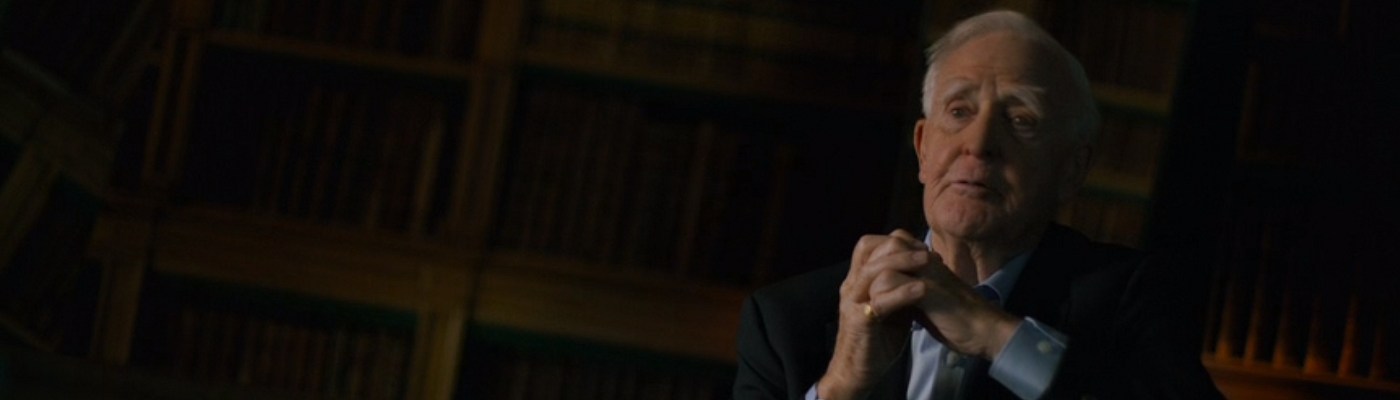
For his latest cinematic interrogation, Oscar-winning documentarian Errol Morris (The Fog of War) trains his cameras onto David Cornwell, better known to fans and the public at large by his pen name, John le Carré. Over a sixty-year career, the acclaimed author published dozens of hugely popular and influential novels, mostly in the espionage genre. As Morris shows us in The Pigeon Tunnel, the writer’s real life was pretty fascinating as well.
Casting an unfortunate pall over film, sadly, is the fact that Cornwell/le Carré passed away in December 2020, after recording the interviews seen here. Morris never specifies exactly when he shot this footage, but the author, in his late 80s, appears just as spry and sharp-witted as ever, fully capable of dazzling the world once again with another tale of international intrigue. That he feels so tuned-in and present in these interviews makes the eventual acknowledgement of his loss at the end hit all the harder.
| Title: | The Pigeon Tunnel |
| Year of Release: | 2023 |
| Director: | Errol Morris |
| Watched On: | Apple TV+ |
The man best known as John le Carré became a literary superstar with the publication of his third novel, The Spy Who Came in from the Cold, in 1963. Released both at the height of the Cold War and in the peak days of the James Bond phenomenon, the book was presented as something of an antidote to the far-fetched fantasy adventures of Agent 007. Its title spy, Alec Leamas, was no action hero, but rather a rumpled government functionary assigned the difficult task of working as a double-agent, by posing as a turncoat and pretending to defect to East Germany, all for the purpose of spreading disinformation about the British intelligence operation to its enemy. Marked by its very realistic details and moral complexity, the book was an instant bestseller that launched the author into decades of further commercial success and critical esteem.
Much like his contemporary Ian Fleming, le Carré had some personal history working as an actual spy in real life before becoming a writer – in his case as an agent of both the British MI5 and MI6 intelligence services. Over the years, the author was typically evasive about the details of exactly what he did at either agency, brushing off the question by insisting that he was merely a junior operative never assigned to anything of consequence. That may well be true, but he doesn’t elaborate much on that here either, and, disappointingly (if even a little uncharacteristically), Morris doesn’t press him further on the topic.
Instead, the documentary delves into le Carré’s childhood. Raised by a father who was a con artist, and with no mother around (he didn’t properly meet her until he turned 21), the young David Cornwell spent most of his youth on the run, bouncing from one home to another to avoid various debt collectors and agents of the law, with a string of stepmother figures flitting into and out of his life. Those experiences ingrained him with a preoccupation with the theme of deception, and a perspective that saw the world divided between “those in control and those being controlled.”
Among other subjects, Morris later spends quite a bit of time focused on the Kim Philby Affair, the scandal in which a top British intelligence officer defected to the Soviet Union, and how those events inspired le Carré’s other great masterwork, the 1974 novel Tinker Tailor Soldier Spy.
The film takes its title from the author’s 2016 memoir. An explanation for the phrase is provided via a reminiscence and, in typical le Carré fashion, has significant metaphorical value. (Be advised that the film contains some graphic footage of birds being shot for sport.)
Although the bulk of The Pigeon Tunnel consists of what essentially amounts to a very long talking-head interview with one man, Morris has constructed the film in what has become his signature style. The interview itself is photographed with unusual, off-kilter compositions, interspersed with stylized re-enactments, a multitude of movie and TV clips, and other material of visual interest. The director/interviewer himself never appears on camera, but allows his voice to be heard once or twice.
Over the past couple decades, Errol Morris has perfected this type of thing into his own personal art form. The Pigeon Tunnel is another strong entry in his filmography. John le Carré is an engaging subject who led a very interesting life and tells some stories worth hearing. What this documentary may lack, however, is the sort of probing insight Morris brought to The Fog of War (about Robert McNamara, architect of the Vietnam War) or its spiritual successor The Unknown Known (about Donald Rumsfeld, who served a similar role during the invasion of Iraq), in which the interviewer had to dig for a deeper truth his subjects had vested interests in not revealing. The stakes are lower in this story and, consequently, when le Carré has certain topics he refuses to address (including his love life), the director respectfully allows him to keep those secrets.
All the same, The Pigeon Tunnel is a worthwhile watch that fans of either the author or the director should enjoy.
Video Streaming
The Pigeon Tunnel streams on Apple TV+ in 4K HDR, but possibly might have looked better – at least on my screen – if it didn’t. The film’s photography is a bit soft, with nothing that particularly resembles 4K worth of information. The HDR encoding just makes the whole thing look frustratingly dim. Benefit of the doubt, perhaps this could be a tone-mapping issue with my display. Maybe it looks better on a Dolby Vision monitor? I can’t speak to that, because projectors don’t support Dolby Vision. All I can say is that, in projection, the HDR10 picture is quite soft and overly dark. When I checked the movie again later on a standard 1080p TV, the basic HD SDR version looked better to me there (albeit much smaller).
Errol Morris shot the documentary at an aspect ratio of 2.39:1. Vintage movie, TV, and stock footage clips have been cropped to that ratio, in many cases quite severely so. The quality of those clips is also typically poor, with tons of grain and artifacts from old video masters that are magnified by the zoom-in
I hate to suggest that the movie looks lousy. Morris is actually an adept visual stylist and his films are filled with striking imagery. I’d probably have a more favorable impression of this one if the encoding weren’t so damned dim.
The Dolby Atmos soundtrack is surprisingly bassy, enough to make something in my room rattle pretty severely. That hasn’t happened to me in a while and I’ll need to track down the source of it. The musical score, credited to Philip Glass and Paul Leonard-Morgan, is warm and enveloping. Surround use provides a subtle sense of atmosphere, though I didn’t notice anything happening overhead.
 The Video File Blog