
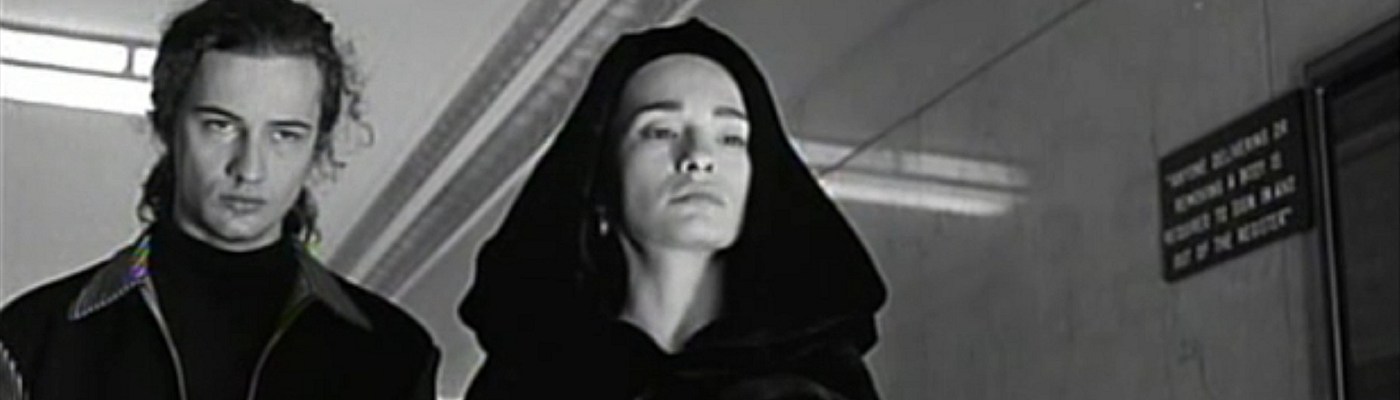
I’d never be so brazen as to call the low-budget, arty vampire film Nadja any sort of neglected or misunderstood masterpiece. It’s not nearly good enough to earn that distinction. However, watching the movie again so many years later takes me right back to a very specific moment in the indie film renaissance of the early 1990s, when it felt like a world of possibilities had opened up for a new generation of young filmmakers now able to create weird and esoteric art from limited resources and somehow get it distributed to theaters, potentially to be seen by audiences across the country or beyond.
I remember watching Nadja for the first time in 1995, projected onto a modest screen at the hole-in-the-wall art cinema on my college campus. I didn’t necessarily love the movie itself, but I did love what it represented. I left feeling inspired and invigorated, like even I could become a filmmaker so long as I had enough nerve and ambition to go out and do it. (Spoiler: I couldn’t, or at least I didn’t.)

| Title: | Nadja |
| Years of Release: | 1994 – Film Festivals 1995 – General Release |
| Director: | Michael Almereyda |
| Watched On: | Amazon Prime Video |
| Also Available On: | DVD Roku Channel |
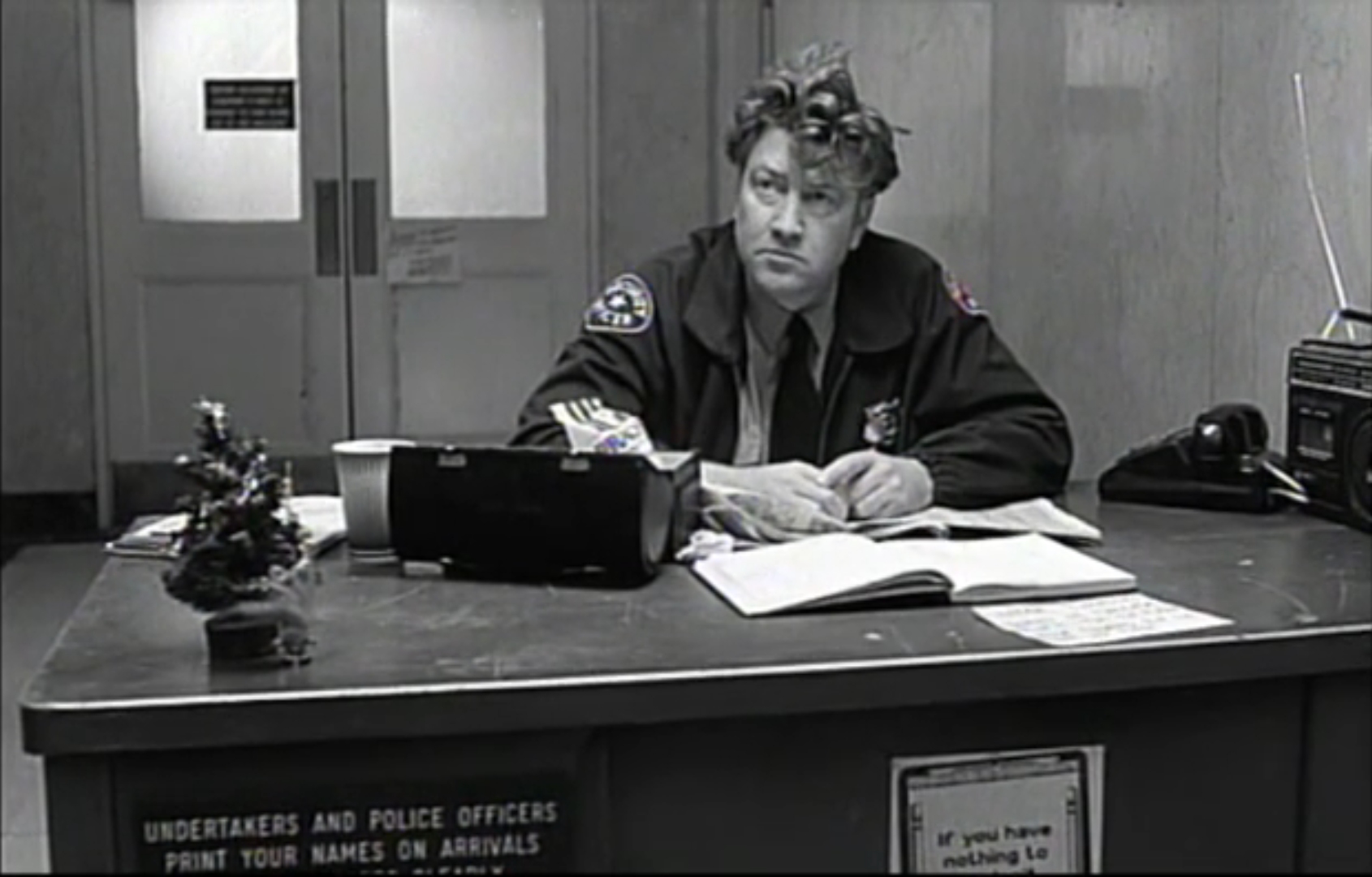
Nadja was a pretty obscure movie even at the time. It had played in film festivals in 1994 and has that copyright date in its credits, but didn’t receive its limited release to other theaters for another year. I mostly knew about it through David Lynch fandom. While, no, Lynch didn’t direct the movie himself, he was impressed enough with the pitch from young director David Almereyda (a good decade older than I was, but then still in his early 30s) that Lynch agreed to finance a $1 million production budget, and helped secure actual recognizable movie star Peter Fonda to act in it. In those days, fans were abuzz in USENET newsgroups on the just-emerging internet about any Lynch-related or -adjacent projects, and talk of Lynch’s one-scene cameo appearance as a morgue security guard was enough to get Twin Peaks groupies like myself out to a theater to support the work.
Shot entirely in moody black-and-white, Nadja was also notable for having many sequences photographed in so-called “PixelVision,” using a Fisher-Price toy camcorder that recorded extremely low-resolution video onto literal audio cassette tapes. Although PixelVision was never intended to be used in professional applications, certain indie artists of the day came to appreciate the almost abstract, impressionistic images it created. In that regard, Almereyda used it for flashbacks and other shots from the main character’s point-of-view, to give them a hazy, distorted, dreamlike tone he desired.
The story is a vampire tale by classification. More importantly, it’s a snapshot of early 1990s urban youth nightlife. The title character (Elina Löwensohn) may technically be a few hundred years old, but that’s barely young adulthood by vampire standards, and her appearance blends easily with recent college graduates and other twenty-somethings. Like any New York hipster of the day, she lives primarily at night, staying out until the crack of dawn drinking coffee, smoking cigarettes, and having pretentious philosophical conversations with others on her schedule, many of whom of course wear flannel while cruising trendy bars in central Manhattan. Her activities are choreographed to a soundtrack by alt-rock bands like The Verve, My Bloody Valentine, and Portishead.
Nadja happens to be the daughter of Count Dracula himself, recently killed by a stake through the heart. The assassin was Van Helsing (Fonda), played as a 1960s burnout still going through the motions of his old routines even though the rest of the world has mostly forgotten and no longer cares about him. When explaining the situation to his nephew, Jim (Martin Donovan), Van Helsing describes Dracula as, “like Elvis in the end” – tired, drug-addled, and oblivious. Both men were relics of another era, one ready for his time to be over and the other clinging to some pretense of relevance he may believe he still has.
Even though her relationship with her father was strained, Nadja feels obligated to retrieve his body before it can be beheaded or burned. Van Helsing, meanwhile, is insistent upon finishing the job he started, and needs help from the reluctant and disinterested Jim to do that.
The plotting beyond that is somewhat perfunctory and inconsequential. A lot of the story, action, and character behavior is confusing or nonsensical. Some of the acting is amateurish. The quirky humor, including a running bit about vampires sending “psychic faxes” to one another, is pretty weird. For a vampire movie, Nadja almost entirely lacks traditional thrills or scares.
The film is a mood, and never strives to be much more than that. I’m sure that’s exactly what drew David Lynch to it. As a viewer, the limited coherence or ambition can feel frustrating, but something about it still resonates with whatever remnants of my 21-year-old self linger inside me. That may be a very personal reaction that I don’t expect everyone to share, especially not anyone younger than myself. Nevertheless, I find the way the movie reminds me so vividly of that moment appealing.
At just 93 minutes, director Almereyda had the good sense to not drag this experiment of his out too long. Also interesting, in addition to Fonda, Donovan, and Lynch, a couple supporting roles are filled by Suzy Amis (promising star of The Ballad of Little Jo before doing a bit part in Titanic and then quickly giving up her acting career to become Mrs. James Cameron) and Jared Harris (hard-working character actor from hundreds of movies and TV shows after this).
Video Streaming
Nadja is a very idiosyncratically stylized movie that is, at least in part, supposed to look like crap. Significant portions of it were photographed using a Fisher-Price PXL 2000 PixelVision video camera. All that footage, which generally represents the vampires’ point-of-view, is extremely blurry and (as per the name) heavily pixelated. I saw this film in the theater in 1995, and believe me, those scenes always looked “bad” in objective terms. However, this was done with intention for a deliberate purpose.
When it comes to watching the movie on home video, unfortunately, the problem is that all the regular scenes look nearly as poor, which wasn’t meant to be the case. The majority of Nadja was photographed on traditional film. IMDb says 35mm, but I don’t know if that’s necessarily accurate; it may have only been 16mm. Regardless, there should be a clear contrast between the normal footage and the PixelVision footage.
As a fairly obscure movie, Nadja has largely fallen through the cracks of home video distribution. The best available physical media copy is a DVD released by Artisan Entertainment (a predecessor to Lionsgate) back in 2000. To my knowledge, no high-definition video master has ever been struck for the film. I don’t own that DVD, and had to resort to streaming the movie from Amazon Prime Video.
The copy on Amazon streams in standard-definition black-and-white, at an aspect ratio that measures about 1.55:1. I feel pretty confident that this is the same video transfer from the DVD, which probably originated further back with the Laserdisc from Image Entertainment in 1996. Even by those standards, sadly, Amazon’s slapdash effort to convert and compress it for streaming has made quite a hash of it. The video source obviously started in interlaced format, and has been very poorly deinterlaced here, resulting in terrible combing artifacts during motion throughout every scene. In addition to that, fine details and straight lines (notably the pinstripe pattern on henchman Renfield’s jacket sleeves) exhibit serious moiré artifacts.
Even accounting for this transfer being standard-def and having intentional pixelation during the PixelVision scenes, the image is marred by a lot of distracting edge enhancement and suffers compression-related pixel break-ups in regular scenes as well.
In short, even for a movie that frequently looks bad on purpose, the copy streaming on Amazon looks much worse than it should. A halfway decent high-definition remaster could do wonders for all the scenes that weren’t shot with the PixelVision camera.

The movie’s end credits state that it played theatrically with a Dolby Stereo soundtrack. For some reason, Amazon streams it only in mono. With an upmixer engaged (such as Dolby Surround or DTS Neural:X), the 2.0 track collapses entirely to a center speaker. That’s especially disappointing for all the alt-rock songs that were obviously created in stereo. The dialogue is also slightly out of sync with the actors’ mouth movements.
A friend of mine owns the old DVD edition. When I asked him to check, he confirmed that the disc has better dialogue sync and a true stereo soundtrack with different sounds in the left and right channels (validated by ripping the disc and opening the audio file in Audacity audio editor). I can hardly fathom how Amazon wound up downgrading that to mono.
It’s a pretty sad state of affairs when the best available video streaming edition for a movie is so poor that it’s easily bested by a 25-year-old DVD that wasn’t particularly great quality to start.
 The Video File Blog
Hey Josh…if you’re looking for another black & white, moody vampire movie (and you haven’t already seen it), give A Girl Walks Alone At Night a spin.
It’s pretty good, and it’s B&W scope cinematography on your setup would have to look pretty cool.
It’s in Persian with subtitles, and Elijah Wood is one of the producers on it to boot. I would go in cold to watch it as the movie has some fun twists here and there. Also, it features the very cool tune Death by White Lies during one of the crucial character scenes.
If you haven’t seen it yet, I think you’ll dig it.
LikeLiked by 1 person