
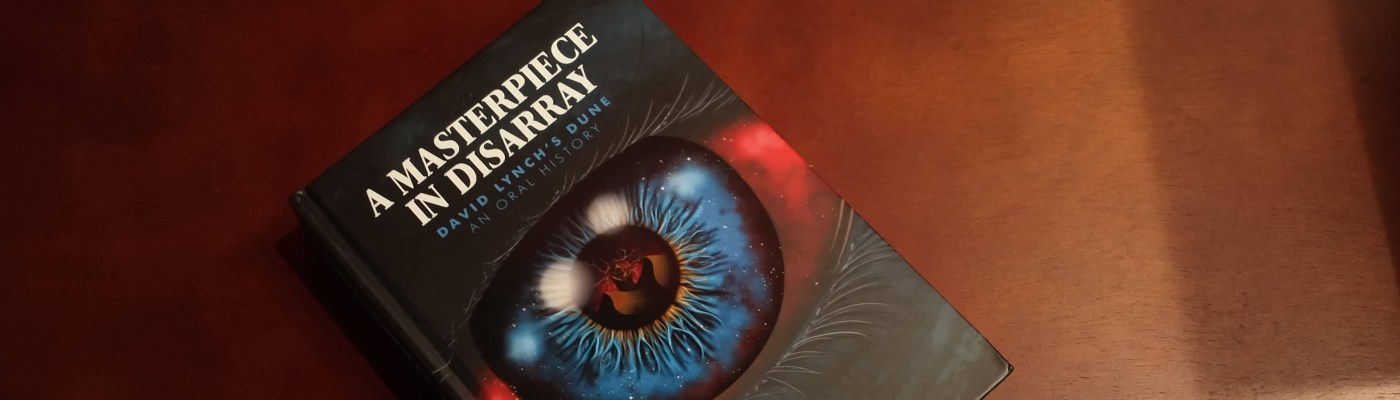
Even among fans who love it, David Lynch’s adaptation of Dune must be acknowledged as a very messy production with a terrible reputation. One of the most expensive movies ever made at the time, the result was met with critical scorn and box office disaster upon its release in late 1984. Four decades later, author Max Evry has put together what may be the definitive account of the film’s creation. His book A Masterpiece in Disarray: David Lynch’s Dune not only details the facts of what went wrong, but also makes a case for why this notorious flop has built a passionate cult following.
As an obsessive Dune fan myself (very specifically this version of Dune), one of the biggest compliments I can give Evry’s book is that, after reading all of it, I feel like he wrote it just for me – as if he’d peered into my brain, scanned through everything I’ve ever learned or felt about the movie, as well as everything I’ve ever wanted to know more about it, and then put to paper the most thorough and comprehensive gathering of all that knowledge into a text structured and written exactly as I’d like to read it. I don’t think I’ve ever experienced anything like that before.
| Title: | A Masterpiece in Disarray: David Lynch’s Dune – An Oral History |
| Author: | Max Evry |
| Published: | 2023 |
| Format: | Hardcover Book |
I’ve long defended Lynch’s Dune. I became obsessed with the movie slowly, over a period of years after first discovering it on home video in the early 1990s via my fandom of Lynch’s television series Twin Peaks. I may not have loved the movie on my first watch, but something about it got under my skin. Learning of the film’s troubled production added to my fascination with it. When it started filming, Dune had all the elements in place to become a surefire blockbuster, and possibly the most acclaimed, serious-minded science fiction feature since Stanley Kubrick’s 2001: A Space Odyssey. Obviously, those ambitions didn’t work out for it. Due to heavy studio interference, the director was forced to make major compromises that left the final product extremely disjointed, uneven, and frustrating for most viewers.
Because Lynch himself doesn’t like to talk about Dune, the story of how he lost control of the project is something I’ve had to piece together from various interviews, essays, magazine articles, biographies, and home video bonus features over the years. Even then, many of the specific details remained fragmented and elusive. In this weighty 518-page tome, Evry assembles all the pieces of this puzzle into a remarkably coherent narrative tracing its arc from the earliest moments of conception through to the aftermath of its failure and the legacy it has left so many years later.
The book is organized chronologically, starting with an overview of the original Frank Herbert novel and previous aborted attempts to adapt it to film by Planet of the Apes producer Arthur P. Jacobs, Chilean surrealist Alejandro Jodorowsky, and Alien director Ridley Scott. The story of Jodorowsky’s nearly-filmed acid-trip opus was previously covered in the pretty good 2013 documentary called Jodorowsky’s Dune, but Evry digs up interesting new facts about the Jacobs and Scott projects that I hadn’t seen published before.
Of course, the meat of the book concerns the David Lynch version that actually went into production. Once he gets to that part of the story, the author devotes a very lengthy chapter to the film’s casting, and uncovers some startling information about many actors who were considered for and/or auditioned to be in the movie but didn’t make the cut, including future superstars Tom Cruise, Val Kilmer, and Kevin Costner.
From there, Evry progresses systematically through every stage of the film’s development, from pre-production design, to filming in Mexico, post-production editing and visual effects, and right through to its December 1984 release and bitter reception. In addition to being exhaustively researched and brimming with revelations that even a Dune aficionado such as myself may not have known, each segment of the book is capped by an Oral History section featuring new interviews with people who worked on the film (star Kyle MacLachlan, producer Raffaella De Laurentiis, costume designer Bob Ringwood, members of Toto), some who didn’t but nearly might have (actors Zach Galligan and Kenneth Branagh), and many more. Perhaps most surprising and enlightening among them are two voices that provide a view from the studio perspective: former Universal Pictures executives Thom Mount and Frank Price.
Fulfilling the wishes of many a David Lynch fan, the author even manages to get the filmmaker himself on the record for a few (sadly brief) words about a difficult passage in his life that he now describes as “a sadness.”

If anything, the book is almost too thorough. Naturally, depending on their amount of attachment to the film, readers may find some parts of the story more interesting than others. I also have to admit that, in many sections, the author has a tendency to get bogged down in the minutiae of trivia about the subject (such as lengthy bios and résumés for actors who didn’t get cast in the movie, and lists of follow-up projects for his interview subjects).
Prepared for this, Evry has smartly structured the book in such a way that readers can jump directly to the sections of most interest and circle back around later if they wish, without feeling lost or confused.
A Masterpiece in Disarray is a very lengthy, substantive, and engrossing book. I can hardly begin to catalog the wealth of insight it contains into a flawed but (in my opinion) beautiful film that has rarely been given much respect over the years.
Buy at: Amazon | Barnes & Noble
 The Video File Blog