
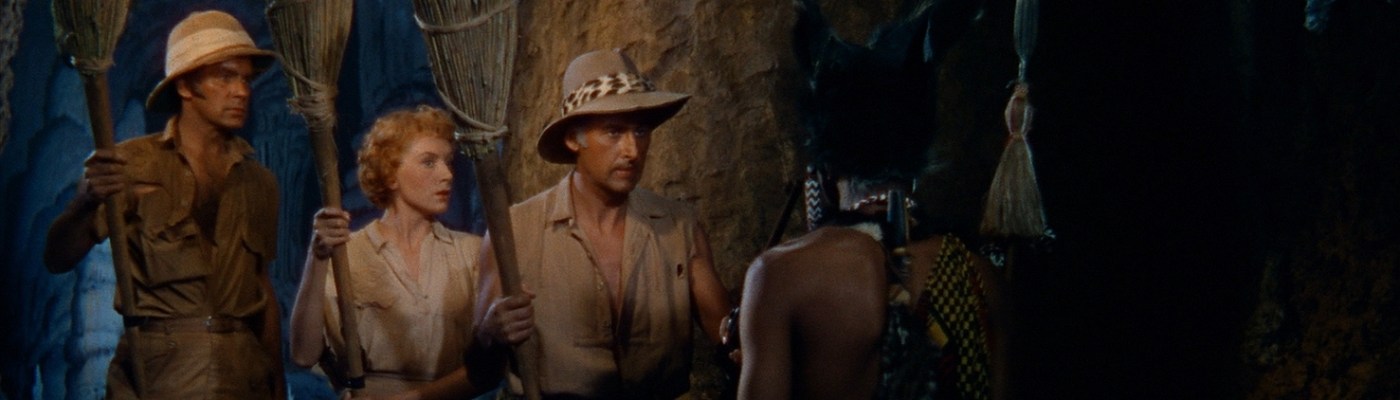
Author H. Rider Haggard’s 1885 adventure novel King Solomon’s Mines has been popular fodder for movie and TV adaptations over the years, most of them sadly not very good. Of the various attempts to bring it to screen, the most successful and arguably best was the 1950 version starring Stewart Granger and Deborah Kerr, which was a big box office hit that came in as the second highest-grossing film of its year. Even so, the book and movie, and especially their hero Allan Quatermain, are perhaps best remembered as inspirations for the later creation of Indiana Jones.
Watching it today, the 1950 film carries some baggage from its era that a modern viewer will likely regard as old-fashioned, starting with its slow pacing, lack of action, and the very broad, theatrical performances from its stars. More to the point, the story has some less than enlightened attitudes toward race and gender that, even if unsurprising, may cause discomfort now.

| Title: | King Solomon’s Mines |
| Year of Release: | 1950 |
| Director: | Compton Bennett Andrew Martin |
| Watched On: | Blu-ray |
| Also Available On: | Various VOD rental and purchase platforms |
I can’t claim to have read the book, but perfunctory internet research suggests that none of the movies derived from it have been particularly faithful to the original story. Set in 1897, this version finds renowned African safari guide Allan Quatermain (Granger) hired to lead an expedition into uncharted territory deep within the continent’s interior, a job he takes only grudgingly. The client is wealthy British heiress Elizabeth Curtis (Kerr), whose husband went missing while on a fool’s errand searching for the legendary (perhaps mythical) treasure belonging to King Solomon of the Bible.
As much as Curtis insists that she loves her husband and wants to see him brought home safely, Quatermain – who has little tolerance for the frivolities of the fairer sex – suspects that she really only wants to confirm the man’s death. He also fully expects her to give up and head home as soon as she realizes the difficulty and danger of the journey. Much to his surprise, however, the woman proves headstrong and resilient, impressively so for her gender, even if she can still be a damned nuisance with her waking up screaming every night and fainting at inopportune moments.
This King Solomon’s Mines is an adventure film, but not an action-adventure film. Those expecting a prototype Raiders of the Lost Ark should temper expectations for its action content, of which it has very little, beyond the characters ducking and covering during an animal stampede in the middle. A tribal duel at the end doesn’t even involve our heroes, who can do little more than stand by and watch. Instead, the picture is more a travelogue as the characters traverse across African jungles and plains, encountering exotic wildlife from giraffes and hippos to monkeys, tigers, and more that white audiences of the time had likely only ever seen caged in zoos.
To that end, the film was quite an impressive production for its day. Shot mostly on location in Africa, in areas with no local film industry or support, it must have been a hell of an undertaking. That effort is reflected on screen. This is no cheapie Tarzan serial filmed entirely on a soundstage. MGM spared little expense to capture the land with some feeling of authenticity, which included participation from indigenous peoples.
Credit where it’s due, Kong Solomon’s Mines has a large supporting cast of Black background characters and tries not to be too overtly racist (quite an achievement in those days). Quatermain himself is mostly respectful toward the natives. He makes some attempt to learn their languages, and expresses feelings of sympathy when his “bearers” are injured or killed. He also doesn’t hold grudges against the ones who abandon him when the quest proves too difficult.
Nevertheless, this is clearly a white man’s story, made for white audiences and told from a white perspective. Almost all of the Black characters are servants or otherwise subservient to the whites, and very few of them are given names or defined personalities, much less dialogue to speak. The story is framed as an adventure of civilized white explorers trekking into primitive terrain – that was of course already populated by other cultures long before being discovered by fair-skinned Europeans. The rituals and power struggles of the Watussi [sic.] tribe at the climax of the film are treated as a spectacle for the white characters (and audience) to gawk at. And when they find it, King Solomon’s treasure is essentially just sitting around, waiting for a white man to claim it.
For all that, after viewing the original trailer, which boasts of a “story of primitive savagery” set in “the strange and wild interior of darkest Africa… where no white woman has ever been before,” I certainly braced for worse. The film itself isn’t nearly as offensive as the promotion for it. In fact, with the proper expectations and mindset, the movie is still quite enjoyable.

The Blu-ray
King Solomon’s Mines was released on Blu-ray in May of this year as part of the Warner Archive Collection. The disc’s pillarboxed 1.37:1 image is pleasingly sharp and detailed with a light texture of natural film grain seemingly rendered accurately. The three-strip Technicolor photography has been carefully aligned to reproduce a rich but not too ostentatious color palette that looks vivid and lifelike in most scenes – though vibrant red blood looks a little too obviously like paint.
The occasional soft shot or scene are common for this filming process, and some day-for-night shooting stands out as artificial, but neither should be marked against the video transfer. A few shots (mostly those of characters highlighted against the sky) also exhibit a halo ringing effect, but I think that’s possibly another issue with the film elements in this case rather than electronic sharpening. Short of some potential future 4K HDR edition (unlikely anytime soon), I can hardly imagine King Solomon’s Mines being treated better.

The DTS-HD Master Audio 2.0 mono soundtrack is crisp and clear for the most part, but also limited quite a bit by its age. The MGM lion roar at the head of the film is weak. In a more modern soundtrack, I’d also expect rifle shots, the pounding drums of African villagers, or the rumble of stampeding zebras to exhibit more dynamic range. For a movie from 1950, it sounds fine.
The only extras on the disc are the aforementioned super-racist trailer and a vintage ten-minute short that presents itself as a making-of promo but, hilariously, turns out to be a shameless commercial for Dodge trucks.
Related
- Deborah Kerr
 The Video File Blog