
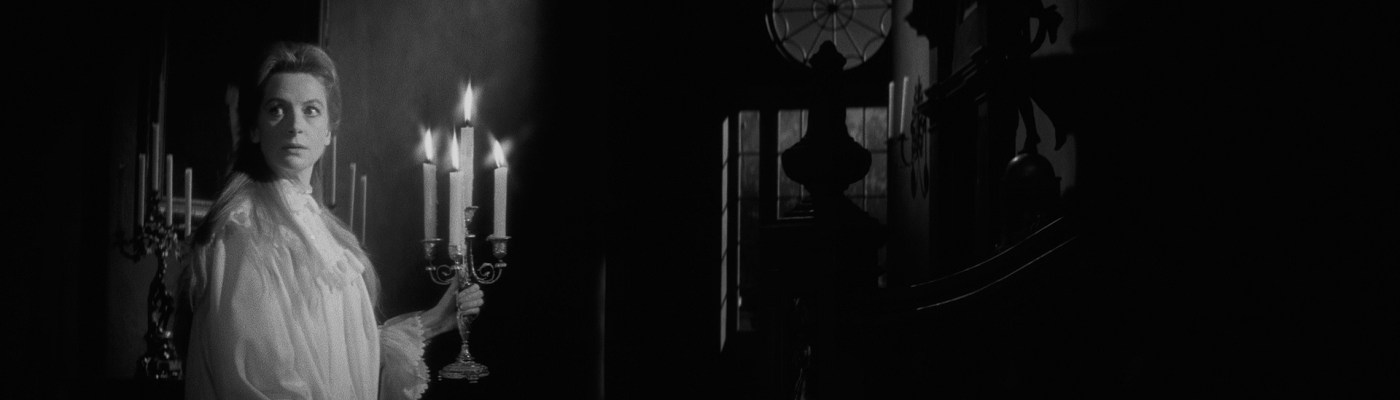
Movies are an inherently sensationalized medium, and haunted house movies in particular often rely heavily upon cheap scare tactics to startle viewers into spilling their popcorn and clutching the hand of the date they brought to the theater. Subtlety is not generally a defining trait of the genre. Produced in 1961, director Jack Clayton’s The Innocents is a self-consciously classical ghost story that strives instead for a literary quality.
For context, The Innocents was released not long after famed schlock-meister William Castle’s 1959 House on Haunted Hill and 1960 13 Ghosts attempted to shock audiences with in-theater gimmicks such as plastic skeletons flying over the crowd on a pulley system, or specially colored glasses that allowed viewers the choice either to see or not see ghosts on screen. Those were the sorts of things moviegoers of the time expected from a haunted house flick, but Clayton had no interest in nonsense like that. His film is more psychological thriller than theme park ride.

| Title: | The Innocents |
| Year of Release: | 1961 |
| Director: | Jack Clayton |
| Watched On: | Blu-ray |
| Also Available On: | DVD |
Based on the 1898 Henry James novella The Turn of the Screw, by way of a 1950 stage play previously adapted from that text, the movie’s screenplay was co-written by William Archibald (author of the play) and Truman Capote. Clayton, the director, was an established film producer who’d worked with John Huston on Moulin Rouge, Beat the Devil, and Moby Dick – and whose own feature directing debut in 1958, Room at the Top, had been nominated for several Oscars, including Best Picture and Best Director. With multiple Oscar nominee Deborah Kerr (From Here to Eternity, The King & I) attached to star, The Innocents was decidedly a prestige production by the time it arrived in 1961, and was stacked with talent that might have seemed overqualified for the genre.
The story is set around the same turn-of-the-century period during which the original novella was written. Kerr stars as Miss Giddens, a governess hired to care for two recently orphaned children whose wealthy uncle (Michael Redgrave, father of Lynn and Vanessa) can’t be bothered to deal with them himself. Upon taking the job, Giddens is explicitly told that she will be left fully in charge and that she is not to contact the uncle again for anything. “Leave me alone,” he bluntly tells her. Although she finds this odd and a little troubling, Giddens is in need of the work. Her exact situation is never specified, but her own behavior hints at a complicated backstory.
Upon arriving at the family’s idyllic country estate, Giddens is introduced to young Flora (Pamela Franklin), a precocious little darling almost too perfectly charming. Slightly older brother Miles (Martin Stephens) had been away at boarding school, but has been expelled with the vague explanation that he was “an injury” to other students, and will return home shortly. Housekeeper Mrs. Grose (Megs Jenkins), the only other employee Giddens ever interacts with, assures her that the boy is also an angel and she can’t imagine what that awful school report could possibly mean.
The film has no other speaking characters for the duration of its length, as these four are left in isolation and the impressive mansion becomes a little world unto itself. At first, Giddens seems to settle in nicely, and finds both children delightful – apparently not bothered that Miles is a little creep who acts four times his age and keeps calling her “my dear.” However, after learning the tragic fates of the previous governess and the abusive valet that the woman had been romantically entangled with, Giddens begins experiencing strange phenomena all through the house, including seeing visions of those two deceased former employees. Even though neither Mrs. Grose nor the children witness anything unusual, Giddens becomes convinced that the house is haunted and, worse, that both children may be possessed by the corrupting influence of the disturbed spirits.
Of the four main cast members, Deborah Kerr carries most of the movie. Because the story is entirely filtered through Miss Giddens’ perspective, hers is the only fully developed character, and we’re left unsure how much we see of the others is entirely accurate. Kerr delivers an elevated, theatrical-style performance of the type that isn’t much in vogue in movies anymore, but that nevertheless feels fitting with the Victorian era setting, the (deliberately) florid writing and dialogue, and the character’s very high-strung nature.
The film is loaded with ambiguity and symbolism designed to make viewers question whether anything Giddens sees really happens, or if it’s all in her head and we’re watching the character have a mental breakdown. The more her anxiety and paranoia ramp up, the less certain we can be that she’s a reliable narrator of this story. Yet nothing overtly contradicts her suspicions, either. The narrative could be taken literally, exactly as it’s told, if one chooses.
Photographed by Freddie Francis (who’d just come off an Oscar win for Sons and Lovers) in gorgeous black & white CinemaScope, with an exceptional sense of widescreen composition and sculpting of light and shadow, the movie is a sumptuous visual treat. Clayton masterfully directs the tale with an emphasis on atmosphere and emotional distress, forgoing the usual haunted house tropes in which scary monsters make loud noises and jump out toward the viewer.
Even six decades later, The Innocents remains one of cinema’s classiest ghost stories, whether it actually has any ghosts or not.
The Blu-ray
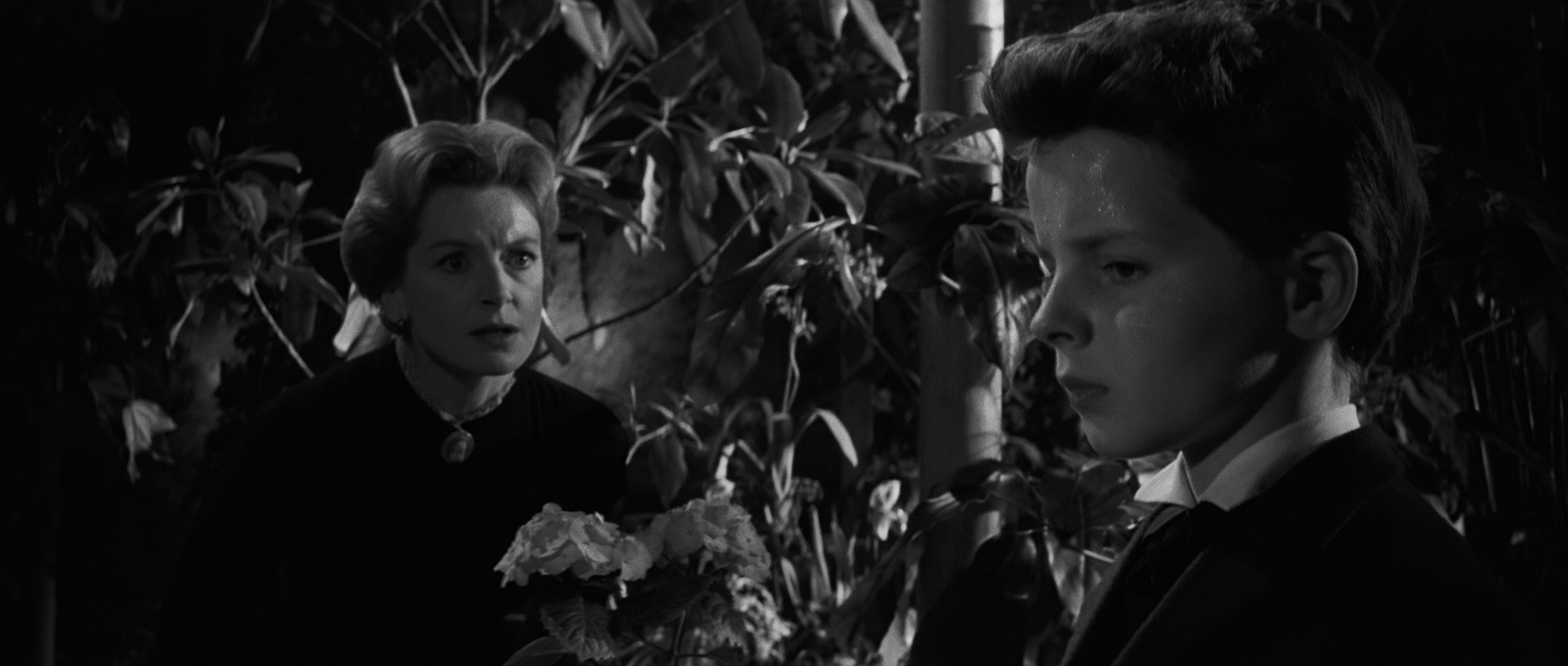
The Criterion Collection released The Innocents on both DVD and Blu-ray in 2014 as spine #727. According to the liner notes in the enclosed booklet, the video transfer was sourced from a 4K scan of the film’s original 35mm camera negative. Even that being the case, the Blu-ray’s picture quality is a bit soft. However, it must be noted that may be an inherent quality of the CinemaScope format, which placed an additional layer of glass in the camera’s light path and required two separate lenses be focused independently. The movie also has a significant number of dissolves, opticals, and other process shots that tend to soften image resolution. Whether a 4K disc release could eke any more detail out of this source, I can’t say for certain, but I’m skeptical on that front. I’d expect it to just magnify grain.
As it stands, the 2.35:1 black & white image has a light but unobtrusive texture of grain. It also has very nice gray scale. Contrast seems slightly flat considering the shadowy nature of the photography. If a 4K release should ever happen, I’d be interested to find out if HDR grading might deepen blacks and clarify the brighter highlights that sometimes look mildly washed-out now. Then again, without knowing the latitude and other specific characteristics of the film stocks used, or Freddie Francis’ intentions, it’s difficult to judge whether anything is technically wrong here or not. It’s a good-looking transfer regardless.

The monaural soundtrack is encoded in uncompressed PCM 2.0 format and has very nice fidelity for a film of this age. Although the track may not have much bass, clarity of music and individual audio elements is excellent, and dialogue is always intelligible. The movie makes quite effective use of silence, whispers, and clever aural effects without resorting to obnoxious stinger scares.
The booklet in the case features an essay by critic Maitland McDonagh. On-disc supplements start with a 23-minute long “introduction” by film scholar Christopher Frayling that you definitely should not watch before seeing the movie, as it digs deep into the story’s Freudian symbolism and gives away most of the plot. Frayling also contributes a very listenable audio commentary over the film. Cinematographer John Bailey (Silverado, In the Line of Fire) offers a 19-minute appreciation for Freddie Francis. Another featurette is comprised of older interviews with Francis himself, as well as the film’s script supervisor and its editor. A vintage trailer rounds out the modest but pretty substantive package.
Related
- Deborah Kerr
 The Video File Blog