

Nostalgia is a trap that Indiana Jones and the Dial of Destiny both comments upon and falls victim to. The fifth entry in the venerable franchise arrives fifteen years after the last one, which was itself already nineteen years after everybody already assumed that the Indiana Jones Trilogy had satisfactorily concluded. Coming so late, the film yearns as much for the glory days of its own series as Dr. Jones himself does for the wonders of the ancient world.
As the presumed end of a blockbuster franchise that has maintained the same lead actor for four decades without a reboot, Dial of Destiny also can’t help but address the fact that star Harrison Ford is now more than 80-years-old, and not exactly in the prime of his action-adventuring days anymore. The methods by which it does this were greeted to mixed reaction from critics and fans, and the movie was the only Indiana Jones installment to flop at the box office (relative to its ridiculously inflated budget).
Despite that failure and some other disappointments, the film is still, in my opinion, a decided step up from Kingdom of the Crystal Skull and makes a far worthier swan song for the globe-hopping archaeologist. Whether it’s ultimately a necessary movie, or whether the franchise should have just left be, is perhaps a more difficult question to answer.

| Title: | Indiana Jones and the Dial of Destiny |
| Year of Release: | 2023 |
| Director: | James Mangold |
| Watched On: | 4K Ultra HD Blu-ray |
| Also Available On: | Blu-ray Disney+ Various VOD rental and purchase platforms |
Dial of Destiny is also the first Indiana Jones movie not directed by Steven Spielberg, who steps back into an Executive Producer role while James Mangold (Logan, Ford v. Ferrari) takes over directing duties. Before taking the job, Mangold obviously did his homework studying up on Spielberg, and does a fairly good job emulating the style of the earlier Indy pictures (the first three that anyone cares about, anyway). However, this sometimes leads to an Uncanny Valley effect where the movie looks and feels almost but not quite right. That issue is most pronounced during the opening 20-minute prologue, an extended VFX showcase (and budget burner) in which a digitally de-aged Harrison Ford appears as a younger Indiana Jones at the end of World War II, once again battling Nazis over an ancient relic believed to possess supernatural – or at least inexplicably super-advanced – powers.
To be fair, the digital de-aging technology has improved in leaps and bounds in recent years, and this may be the best application of it to date. The effect is very convincing and nearly seamless for the entire action-heavy flashback, which features younger Indy engaged in plenty of running around and fighting and derring-do while all sorts of chaos explodes around him. We’ve come a long way since the creepy simulacrum of young Jeff Bridges in Tron: Legacy.
Nevertheless, the audience full well knowing that Harrison Ford is over 80 while looking at this artificially generated young version of him causes a sense of cognitive dissonance more pronounced than, say, had a younger lookalike actor simply been cast in the role. (Apple TV+’s Monarch: Legacy of Monsters has had some good fun with Kurt Russell and his son playing the same character at different ages.) Moreover, with the return of more Nazis, this entire storyline feels like another warmed-over rehash of Raiders and Last Crusade. For all its other faults, at least Crystal Skull moved forward a decade and updated the villains.
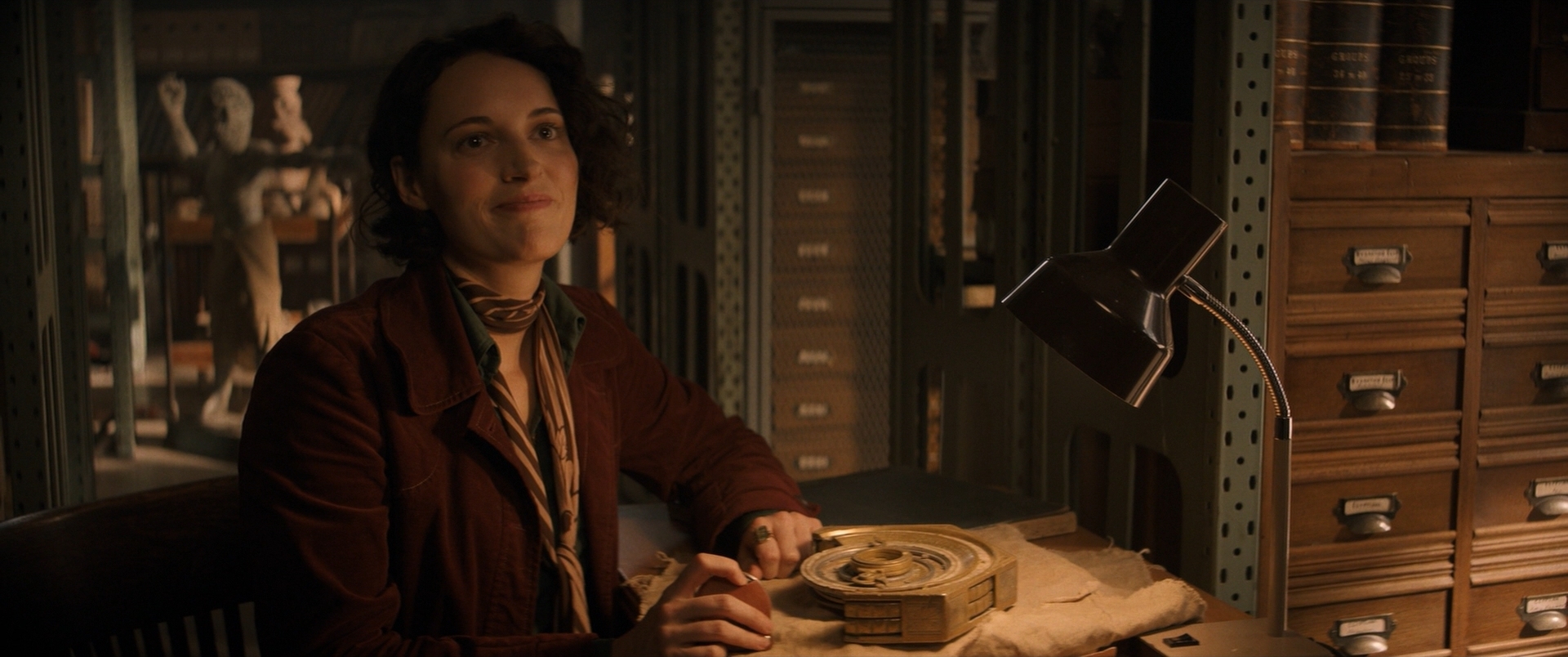
After that part’s done with, the movie does indeed jump ahead in time to 1969 and picks up with Dr. Jones in his twilight years, played by Ford as-is without any digital trickery. Still teaching archaeology, but now at a much less esteemed college where the bored students pay no attention to him, the elderly Indy is a cantankerous sourpuss (but at least he still has both eyes, which officially bumps the depiction of “Old Indy” from The Young Indiana Jones Chronicles out of canon). In one of the film’s smartest notions, Indy spends almost all of his time pining for what he perceives as the greatness of ancient history, unable to recognize that he’s living through some pretty momentous historical events happening right around him at that very moment.
At the urging of his goddaughter, Helena (Phoebe Waller-Bridge), Indy embarks upon one final adventure, to help find the missing half of an artifact called the Antikythera, an ancient dial used by Archimedes that can supposedly locate rifts in space-time. Of course, they’re not the only ones looking for it. Former Nazi scientist Dr. Voller (Mads Mikkelsen) is on the same trail, and hopes to use the Antikythera to travel back to 1939 so he can assassinate Hitler – not to end World War II early, but to take over as Fuhrer himself and lead the Third Reich to the thousand-year reign that Hitler was too incompetent to achieve on his own.
For the second movie in a row, the addition of science-fiction elements has not sat well with the Indiana Jones franchise, even when prior entries played just fine with magic and the supernatural. Ghosts and magic stones and eternal life all seem to be fair game in this series, but as soon as you bring in UFOs and time travel, something just doesn’t feel right. That problem definitely weighs down this entry, if not quite as badly as it did in Kingdom of the Crystal Skull. Not to get too spoiler-y, but the last act when the time travel aspect actually comes into play goes off the rails into cheeseball territory before reining itself back in.
The scripting has other issues. Most of the clues to Indy’s quest come far too easily, and some are found in public places where they should have been discovered decades if not centuries earlier. The movie also suggests that the time rifts are naturally occurring and that the Dial merely helps locate them (rather than create them). That being the case, wouldn’t aircraft accidentally fly into these things all the time? How is this not a widespread, worldwide problem long since identified and solved by various travel safety boards? Moreover, a critical plot twist fails to consider that Archimedes’ math calculations wouldn’t just affect how far back in time the rifts go, but also the Dial’s ability to find one. As such, the entire climax of the movie shouldn’t happen at all.
Quibbles with the plot aside, the film’s biggest problem is that, for as hard as he tries to copy Spielberg’s shooting style and action set-piece construction, James Mangold doesn’t quite have a handle on the breakneck pacing that famously characterized all of the earlier Indiana Jones pictures. In contrast, Dial of Destiny has many long, sluggish sections that slow to a crawl. At 2 hours 34 minutes, it’s the longest Indy movie by nearly half an hour, and frankly feels even longer. My viewing got interrupted at what I could have sworn must have been very close to the end, and I was shocked to pause and find that I still had another entire hour left to go. Perhaps an argument can be made how that’s reflective of Indy himself slowing down in old age, but it makes for a frustrating viewing experience.
Having just made all those complaints, I actually found that I liked Indiana Jones and the Dial of Destiny more than I expected. As I said, it’s a better movie than Kingdom of the Crystal Skull. To be blunt, it’s a better movie than Temple of Doom, too. The film has a number of very nice character grace notes and callbacks from the entire series, and Harrison Ford puts in some good work to make this a proper sendoff for one of his iconic characters. I also expect that it plays better in the more forgiving waters of home video, where viewers can pause and take breaks as needed. In his 80s now, I imagine that Ford himself probably needs two or three of those to get through it.

The 4K Ultra HD Blu-ray
Indiana Jones and the Dial of Destiny is the first film in the franchise distributed by Disney rather than Paramount. After its disappointing theatrical run over the summer, the studio released the movie to VOD steaming platforms in August, followed by Disney+ streaming on December 1st and, finally, to physical media (DVD, Blu-ray, and 4K Ultra HD) on December 5th, 2023. As a collector, I waited for the latter. Specifically, I opted for the 4K SteelBook edition sold exclusively through the Best Buy retail chain.
Unfortunately, this particular release happened to coincide with Best Buy announcing that it will be dropping physical media sales altogether in early 2024. As such, Dial of Destiny may be the final Best Buy exclusive SteelBook ever, and quantities were especially limited. The title sold out online almost instantly as soon as it went up for sale. However, come release day, a small number came back in stock, reserved for in-store sales. I checked the web site early that morning, saw that one copy was available at the Best Buy a couple towns over from me, and immediately purchased it for pickup that day.

Lest one think this story has a happy ending, my heart sank as soon as the store clerk handed me the item and I spotted a long scratch gouged all the way across the SteelBook’s front cover beneath the shrinkwrap. Of course, not only was this the only copy in stock at that store, it was the only copy available within 250 miles of my location. Basically, the choice was take this or go home empty-handed. Thanks a lot, Best Buy. I don’t think I’ll miss shopping at your damn store in the future.
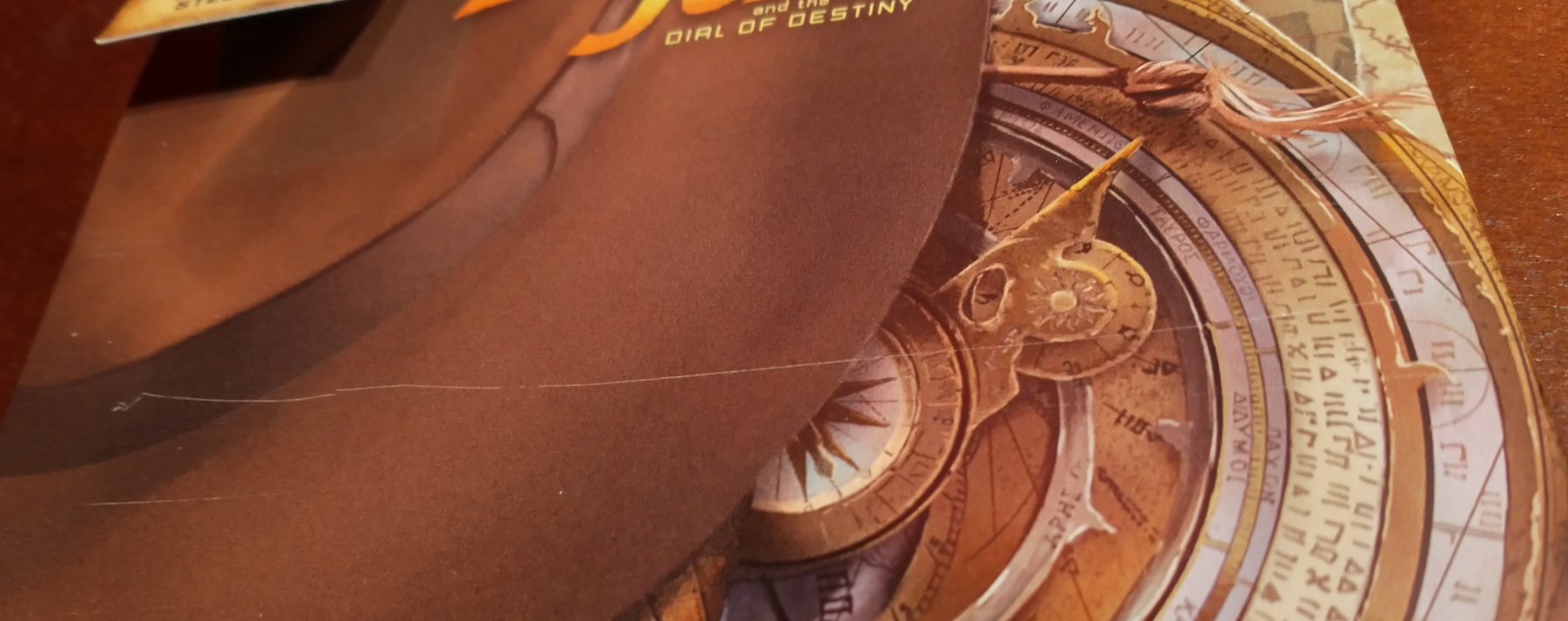
Looking at eBay right now, speculators are selling this SteelBook for upwards of twice the original price (which was, quite frankly, overpriced at Best Buy in the first place).
As for the 4K disc itself, the 2.39:1 image is extremely sharp and detailed, enough to expose all the actors’ skin pores and stubble, and the thread counts of their clothing in close-ups. The contrast features deep black levels and very nice HDR grading. Colors are also very rich, with the caveat that much of the movie has been given a noticeable yellow bias that I assume was intentional but kind of looks like every film “restoration” coming out of European post facilities these days.
Despite being shot digitally, the movie blends more naturally with the original three entries in the franchise than the much more artificial-looking Kingdom of the Crystal Skull did, even though that one was, technically, shot on 35mm film.
[Constant Image Height viewers will note that the film has a fair amount of subtitled foreign-language dialogue. All subtitles are safely positioned inside the 2.39:1 image area and are safe for CIH display.]
Dial of Destiny is the first Indiana Jones movie mixed in Dolby Atmos from the onset, rather than remixed to that format after-the-fact. Nonetheless, much like the soundtracks for the 4K editions of the earlier four films, the Atmos mix here seems to be limited to 7.1.2 channels. I didn’t hear a peep coming out of my Front Wide speakers, and overhead activity collapsed to the Top Middles. However, unlike the earlier movies, Dial of Destiny has a fair amount of bass. Explosions boom, Indy’s punches land with a thump, and gunshots have a little bit of kick. That said, I still wouldn’t call the movie a dynamic range powerhouse by any means. Most disappointingly, the musical score (perhaps John Williams’ last) sounds a little flat.
In terms of Atmos usage, planes will zoom through your overhead speakers, and a scene in a cave at about 1hr. 42min. plays around with some pretty fun echo effects.
Extras are light. The 4K disc has none, aside from an option to watch the movie with a score-only audio track. The accompanying Blu-ray disc only adds a making-of documentary that’s been broken into five parts to make it seem more substantial than its one-hour length actually amounts to.
Related
- Indiana Jones franchise
- Raiders of the Lost Ark (1981) 4K Ultra HD
- Raiders of the Lost Ark (1981) Film at 11 Podcast Review
- Indiana Jones and the Temple of Doom (1984) 4K Ultra HD
- Indiana Jones and the Temple of Doom (1984) Film at 11 Podcast Review
- Indiana Jones and the Temple of Doom NES Video Game (1988)
- Indiana Jones and the Last Crusade (1989) 4K Ultra HD
- Indiana Jones and the Last Crusade (1989) Film at 11 Podcast Review
- Indiana Jones and the Last Crusade NES Video Game (1991)
- Indiana Jones and the Kingdom of the Crystal Skull (2008)
- Harrison Ford
- Karen Allen
- Steven Spielberg (producer)
Note: All screenshots on this page were taken from the standard Blu-ray edition of the film and are used for illustration purposes only.
 The Video File Blog
I kind of hated it, and I maintain Crystal Skull is still the better of the latter Indy movies. After Dial wrapped up I re-watched Skull and it was like night and day. For all it’s faults (Blanchett’s dodgy Russian accent, LaBeouf laying it on way to thick), it at least felt like a bit like a classic Indy movie, this on the other hand had none of that same charm.
Also I’m not sure if Skull was shot on film or digitally bet it felt more “tangible” in a way that older movies shot in physical film stock do as opposed to Dial which made me feel like I was watching a 2 1/2 hr extended cut scene from a videos game.
And the ending (without trying to spoil it), let the old man have what he wants. It would have been a perfect swan song for the character and redeemed the movie a but but they had to ruin that to. Part of me wonders if they changed the ending after test-screenings or something.
Honestly, Skull is a better movie and actually a pretty decent adventure flick overall, especially compared to Destiny.🤷♂️
LikeLike
Crystal Skull was shot on 35mm film, but despite Spielberg making some public statements to the contrary, was inundated with extensive green-screen and CGI throughout. The entire movie looks extremely “digital” and fakey, IMO, from the first shot of that damned CGI gopher to the end with the UFO. Even the sunsets are fake because Spielberg couldn’t be bothered to wait for Golden Hour to shoot.
What you say about Dial of Destiny looking like a video game is exactly how I felt about Crystal Skull.
Dial of Destiny was shot digitally and probably has more digital work in it overall (including all that de-aging), but it’s much better done than Crystal Skull, to my eye. At least, as it appears on 4K UHD. I didn’t see it in theaters. YMMV.
LikeLike
The digital effects in Skull may be easy to pick out and earlier tech compared to modern day, but at least they were presented against a backdrop that felt organic and real, Dial felt like wall-to-wall CGI which is far worse imho, but I digress.
Also, one of the things that made the other movies great was multiple cohorts, Indy and his sidekicks. Phoebe-Waller Bridge is neither charming or attractive enough to carry the movie with Ford alone. I got mildly excited when Salah tells Indy at the airport that he misses their adventures. Bring the guy along! We need more characters and banter!
I’m no Indy hipster and won’t claim Temple is a misunderstood masterpiece (it’s easily the weakest of the OT), but you genuinely think Dial is better? The opening sequence alone in Shanghai and the subsequent chase alone has more going for it than anything in this latest installment.
LikeLike
The opening scene is pretty much the only good part of Temple of Doom.
LikeLike
As for the ending, I think the idea was that nostalgia needs to have its limits, and at the end of the day you’ve got to come back to the real world and live your actual life.
LikeLike
I wouldn’t go that far but it’s probably the best part of the movie for sure.
LikeLike
I really really liked ‘Dial of Destiny’. Sure, it’s not ‘Raiders’ or ‘Crusade’ good, but then again, very few movies are.
Final scene and final frame are a perfect send-off to a legendary silver screen hero.
LikeLike