

Released very early in 1950 as one of the first new American films of that decade, the noir thriller Gun Crazy wasn’t regarded as a piece of art worthy of much distinction, at least not at first. Upon its arrival, notable critics of the day dismissed it as just another B-movie, a trashy crime picture like so many others cluttering cinemas at that moment. With time, however, the film’s reputation grew and it came to be recognized as an important progenitor of the lovers-on-the-run genre, highly influential on later works including Bonnie and Clyde, Badlands, and even Natural Born Killers, among others.
Looking back on it more than seven decades later, Gun Crazy still has a surprising amount to say, not just about its genre, but about American culture. While it may not feel, while you’re watching it, like a movie of big themes or ideas, more is brewing beneath the surface than might be apparent at first glance.

| Title: | Gun Crazy (a.k.a. Deadly Is the Female) |
| Year of Release: | 1950 |
| Director: | Joseph H. Lewis |
| Watched On: | Blu-ray |
| Also Available On: | DVD Tubi Various VOD rental and purchase platforms |
Like many a red-blooded American boy, Bart Tare loves guns. Always has. He’s not a violent person, and has a strong aversion to killing. Yet even as a young kid (played by future West Side Story and Twin Peaks star Russ Tamblyn), his hand just felt empty without a pistol or a rifle in it – like he was born to shoot. To that end, he was always a far better shot than any of his friends. Unfortunately, a lack of money and one very poor decision led to Bart spending most of his youth in reform school.
After growing up, Bart (now played by John Dall from Alfred Hitchcock’s Rope) served some time in the Army but didn’t take to it as a lifetime career. Returning home to visit his sister and some friends, he winds up wasting a lazy evening at a carnival as it passes through town. This is where he’s introduced to Miss Annie Laurie Starr (Peggy Cummins), the featured attraction in a sharpshooting act. Popping balloons from a distance, shooting the lit cigarette out of an assistant’s mouth, and so forth may seem like modest entertainment, but Bart is immediately infatuated. Laurie (as she prefers to be called) is the first person he’s ever met almost as good with a gun as he is. The two of them hit it off instantly. Laurie invites Bart to take a job at the carnival, and in little time at all they rush into a whirlwind marriage.
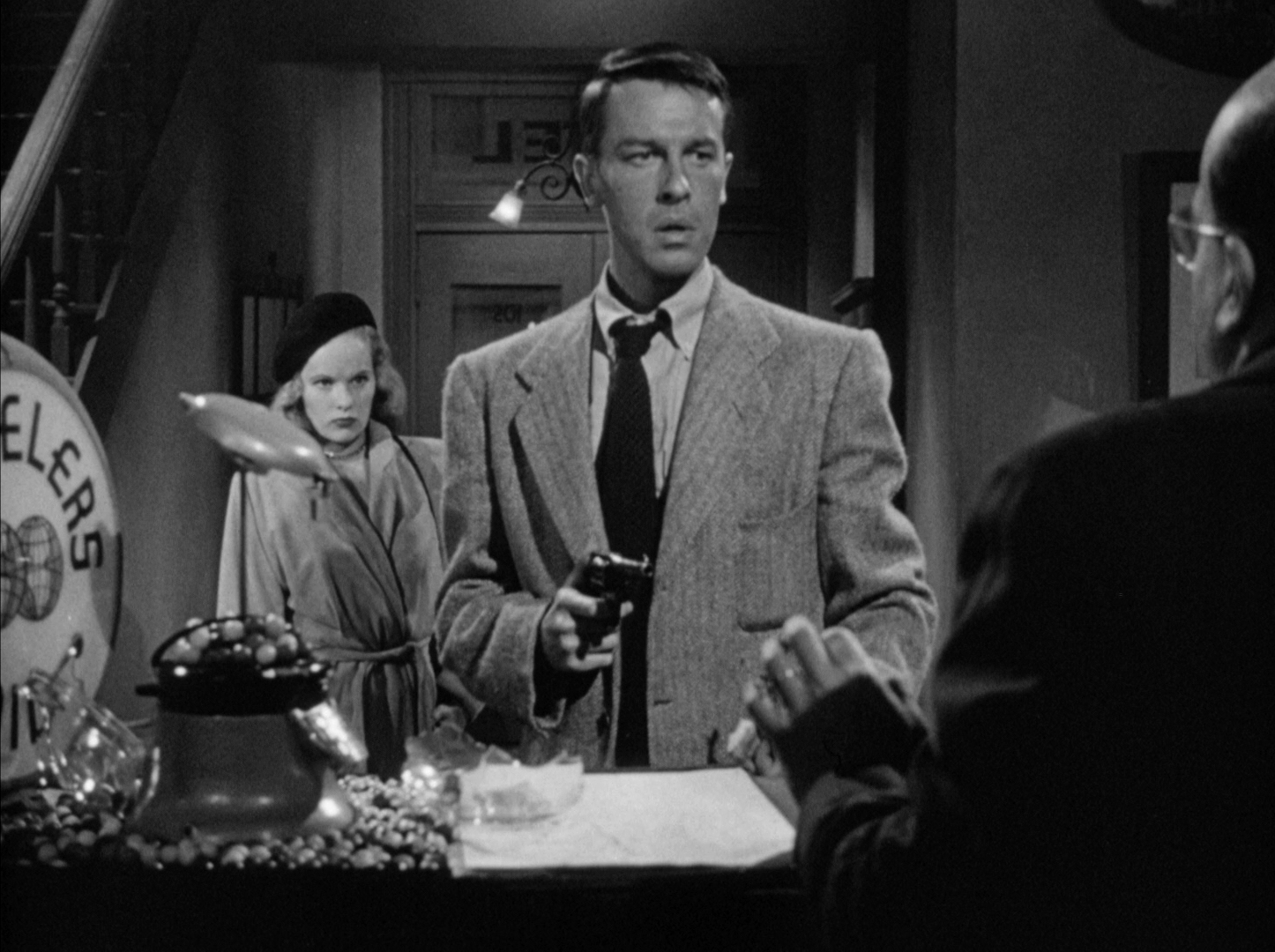
The speed at which their relationship moves is almost matched by how quickly they run out of money to sustain it. When Laurie suggests a solution to that problem using their mutual skill with guns to their advantage, it becomes clear enough – to viewers, if not to Bart – that this girl may be bad news. As much as Bart doesn’t want to become a common stick-up man, he allows Laurie to rope him into a life of crime, holding up shops and banks and other businesses in a string of successful robberies throughout the American Southwest. Bart does this grudgingly, but Laurie is turned on by their crime spree, to the point Bart can barely hold her back from murdering their victims.
After a heist on the payroll office for a meat packing company goes badly, the pair find themselves the subject of an FBI manhunt. By that point, a sense of inevitability settles in. They may dodge imminent capture, but can’t avoid it forever. The longer they hold out, the more exhausted they become, and the more desperate their situation grows.
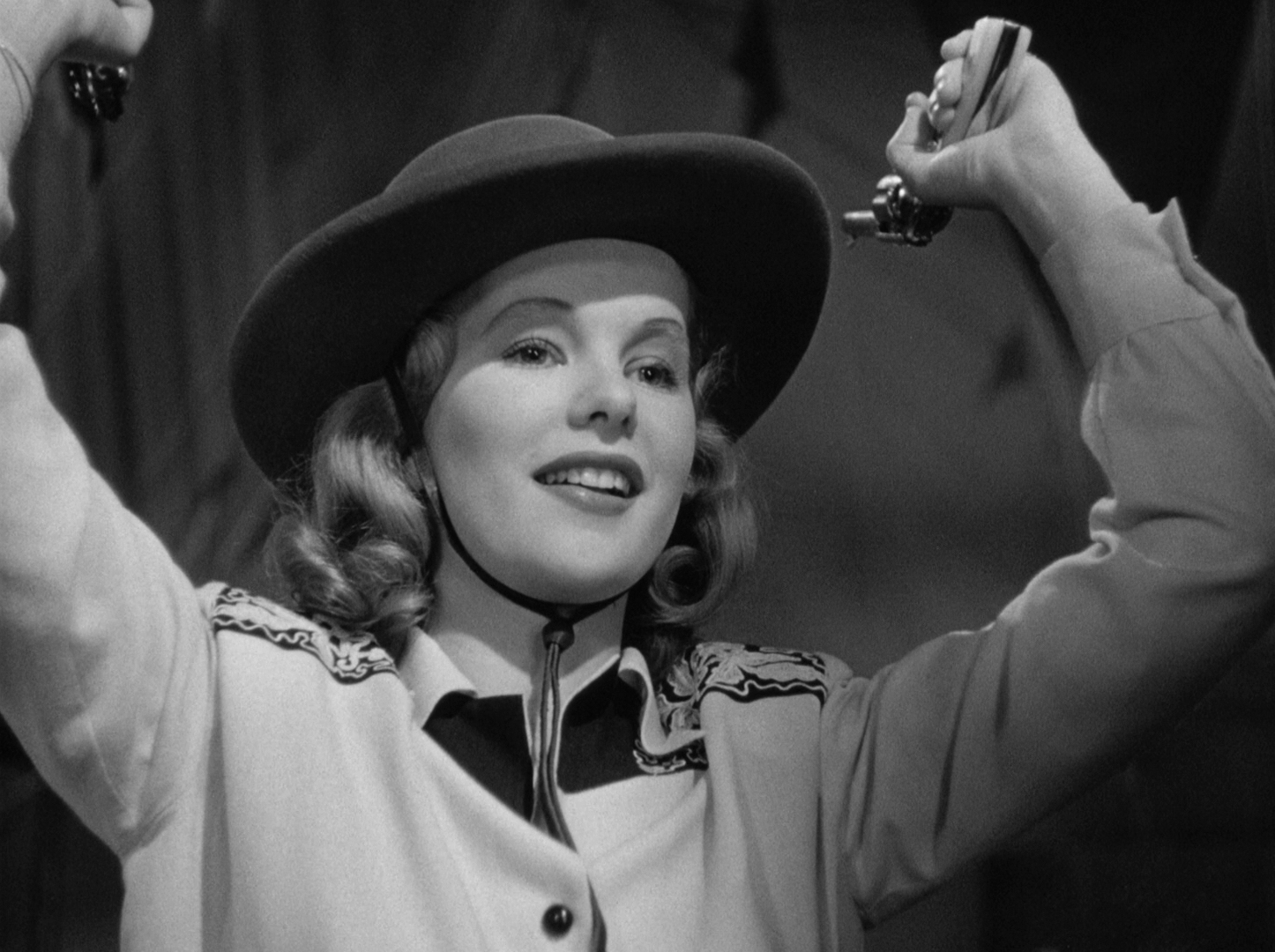
In many respects, Laurie is a classic femme fatale, and Bart the gullible sap who falls for her wicked ways. Their relationship follows the basic structure set up by countless noir pictures throughout the 1930s and ’40s leading up to this one. Even that being the case, Bart here is no blameless victim. He falls for Laurie hard and willingly goes along with her plans, putting up little objection. Clearly, he’s blinded by love, but even more than that, he’s blinded by his own need to feel important and useful, and the only way he knows how to do that is to use a gun.
Gun Crazy may suffer a little from some of the sexism so commonly ingrained in films of its era and genre, but the movie is ultimately less about an evil woman tainting a good man than about the both of them being tainted by their distinctly American obsession with guns. Without making a big deal about it or turning overtly preachy, the film examines the sense of power and control that a firearm can instill into a person who otherwise lacks those feelings.
Bart loves guns so much because he’s good at using them in a way few others are, and doing so makes him feel powerful when so much else in his life drives him to feel the opposite. He becomes a criminal not through an inherent fault in his character, but because society has seemingly left him no other choice, while simultaneously selling him a myth that tells him there’s no greater American achievement than a man pulling himself up by his own bootstraps. Plentifully available and easily obtained, a gun is the tool that allows him to better his circumstances. Why wouldn’t he use it? What other options does he even have in life?
This theme, seemingly hidden in plain sight within the story, was likely the doing of blacklisted screenwriter Dalton Trumbo, working here under the pseudonym “Millard Kaufman.” As directed by B-movie veteran Joseph H. Lewis, the film is efficient and unpretentious. It wastes no effort trying to sell its own self-importance. It can be a little melodramatic and stiffly acted at times, but charmingly so. The robbery scenes are brisk and suspenseful, and the centerpiece single-take payroll office heist is still pretty impressive in its technical showmanship even seventy-plus years later.
The Blu-ray
Gun Crazy made its way to the Blu-ray format in 2018 as part of the Warner Archive Collection. In my pixel counting, the video master measures about 1.34:1 rather than the more precise 1.37:1 a film of this vintage ought to be, but the difference is too small to quibble about. The black-and-white image is quite crisp and nicely detailed for 1080p. Grain texture is moderate but not overwhelming. Gray scale looks accurate enough to my eye. I wouldn’t expect this movie to benefit much from 4K, except perhaps to boost contrast and likely aggravate the grain. I don’t feel it’s necessary.
The DTS-HD Master Audio 2.0 mono soundtrack, on the other hand, is disappointingly weak and thin. I had to boost volume well above my normal levels, and even then, it still sounds very subdued. Dialogue is clear enough, but music is brittle and some analog hiss is evident. Most frustratingly, gunshots (a quite critical component of this sound design) lack punch. I don’t necessarily expect a movie from 1950 to have slam-bang dynamic range, but this is nevertheless underwhelming.

Bonus features are light, and all carried over from DVD. Critic Glenn Erickson (better known as the DVD Savant) provides a very listenable audio commentary. Following that, an hour-long documentary on the broad subject of film noir touches on Gun Crazy but isn’t specific to this film.
Related
- Lovers-on-the-Run Movies
 The Video File Blog
Hey Josh,
Do you have the DVD of this movie to compare the audio to see if it has been messed with?
LikeLike
Sorry, only have the Blu-ray.
LikeLike
Well…it was just a thought.
LikeLike