

By this point, I’m sure most people understand that the first Godzilla movie (or Gojira as originally known in Japan) from 1954 was, for all its inherent absurdity and cheese, designed and intended as something a little more thoughtful and introspective than just a schlocky giant monster fright flick. This is hardly a new observation. The film and its title creature were born from the ashes of Japan’s atomic devastation during World War II, and served as an enormous (if perhaps corny) metaphor to help that nation’s people come to terms with what had happened to them, while pondering how civilization could possibly move forward in light of now possessing enough power to literally destroy the world.
Miraculously, the movie manages to accomplish all that in barely over 90 minutes of screen time. Modern filmmakers could probably take some notes on the efficiency of storytelling.

| Title: | Godzilla (a.k.a. Gojira) |
| Year of Release: | 1954 |
| Director: | Ishirô Honda |
| Watched On: | Blu-ray |
| Also Available On: | The Criterion Channel Max Roku Channel Shout Factory TV Various VOD rental and purchase platforms |
Of course, Godzilla also is a schlocky giant monster fright flick, produced in imitation of and quite purposefully meant to capitalize on the popularity of comparable American movies – especially 1933’s King Kong, which had just come off a very successful re-release in 1952. Godzilla, as a character, was to be Japan’s own Kong. To that end, both gigantic creatures are introduced as terrifying forces of death and destruction that, over the course of their respective features, would eventually earn some measure of sympathy from the human heroes and from the audience.
Despite being the most expensive film made in Japan up to that time, Godzilla often looks, to modern eyes, like a cheap and chintzy production. In fact, this was even noted by American critics during its U.S. release a couple years later. The monster itself, when not hidden in darkness, is clearly a man wearing a rubber costume in wide shots and a puppet in close-ups. Its rampage through Japan is depicted with obvious models and miniatures. Although that’s endearing in many ways, the darker themes of the piece are a little difficult to take seriously when the big action set-pieces look like toys being pulled around by visible strings.
The film’s acting performances are often melodramatic and its science is frankly ludicrous. I’ve never understood how the lumbering Godzilla is supposed to be a natively underwater creature yet is unmistakably based on a land-based Tyrannosaurus Rex with huge, muscular legs and no sign of flippers or fins. Unless the subtitles simply get the translation way off, a paleontologist character repeatedly states that the monster is a dinosaur from the Jurassic era and is two million years old. (The Jurassic Period was between 150 to 200 million years ago. Two million years ago would have been the Cenozoic Period. A paleontologist ought to know that.) Another scientist creates a potentially world-ending super-weapon called the Oxygen Destroyer that sure seems to give off a lot more oxygen than it destroys. All it basically does is create a lot of bubbles in the water.

Nevertheless, unlike the many sequels and spin-offs to follow, this first Godzilla movie takes its story very seriously. A lot of the plot consists of scientists, politicians, and other human characters debating not just how to handle the threat, but the ethics and morality of doing so. The creator of that Oxygen Destroyer makes every effort to ensure that the weapon can never be deployed again after this one, regrettably necessary usage. And when Godzilla dies (yes, the monster is conclusively terminated at the end!), the paleontologist mourns him.
Even more to the point, cheesy though much of it may look in execution, director Ishirô Honda conjures some apocalyptic imagery of Tokyo burning that must have been quite bracing to an audience that had been traumatized by the horrific real-life destruction their small nation endured just a decade earlier. In its most shocking and powerful scene, a woman cowers from the wreckage of the world crumbling around her and tries to reassure her three terrified young daughters that, “We’re going to join Daddy! We’ll be where Daddy is soon!” Later, a group of reporters trapped on a radio transmitter tower bravely keep broadcasting as the beast marches toward them, describing its progress right up until it topples the tower and pushes them to their doom. Even in a movie that can seem incredibly silly at times, both moments sting.
Unsurprisingly, Godzilla tapped into the cultural zeitgeist and was a tremendous hit in its native country, while its monster action thrilled international audiences as well. However, the movie’s American release was considerably altered by the distributor to cut out a great deal of the serious-minded content and insert a newly-shot storyline starring Raymond Burr as an American reporter (hilariously named “Steve Martin”) covering the spectacle in Japan.
As we now know, death was but a small impediment that couldn’t stop Godzilla from returning in a long series of sequels that toned down the seriousness and played up a deliberate sense of cheesiness and camp, even going so far as to make Godzilla a hero and protector of Japan. Most of those are entertaining in their own rights, but the original film (specifically in its original Japanese version) continues to stand apart.

The Blu-ray
The entire Godzilla franchise has been a staple of home video for decades, released in too many editions to track on every media format to come along. At one point in the 1990s, the Criterion Collection announced that it would release several of the earlier movies on Laserdisc, but those plans were canceled and the discs were never produced. More than a decade later, Criterion finally inducted the original film onto DVD and Blu-ray in 2012, labeled as spine #594. Criterion has elected to use the Godzilla nomenclature, rather than Gojira, on the packaging and in all subtitle translation.
Because the film’s Original Camera Negative no longer exists, Criterion’s video transfer was based on the best surviving elements, primarily (as stated in the accompanying booklet) a 35mm fine-grain master positive. The pillarboxed 1.37:1 black & white image is acceptably sharp, though obviously limited by the circumstances. Still, it has enough clarity to expose the wires holding the miniatures. Gray scale and contrast look good.
Light-to-severe scratches cover much of the movie, especially the big monster action scenes, which were no doubt excerpted and printed more often than the talky dialogue portions. A couple sequences further utilized stock footage at the time, and those look particularly rough. Even so, the movie remains very watchable.
The movie’s mono soundtrack is encoded in uncompressed PCM format and sounds every bit its age. While no doubt cleaned up as much as possible, the track is very thin and strident, with scratchy dialogue, a lot of overt ADR, and negligible dynamic range. The drumming score, the pounding of Godzilla’s footsteps, and his iconic roar are all pretty weak. I have to assume that not much could be done about that. It sounds fine for what it is.
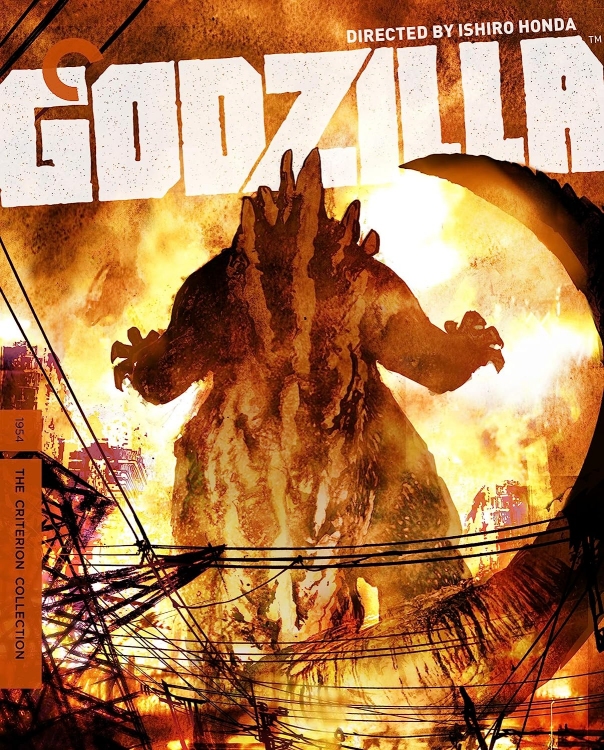
Criterion’s digipak package has a neat pop-up feature when you open it. An enclosed booklet offers an essay by film critic J. Hoberman. The most important bonus feature on the disc is the 1956 American version of the movie, called Godzilla, King of the Monsters, also restored in high-definition from its best available elements.
Other on-disc supplements include audio commentaries over both versions of the movie by film historian David Kalat, some cast and crew interviews, a featurette about the photographic effects, a photo essay about a real boating incident that inspired the film’s opening scenes, and a couple trailers.
Related
- Godzilla
- Other Giant Monsters
 The Video File Blog
So did your kids like this one? You’ve been watching/revisiting Transformers with them so they might be the right age.
I first saw this film sometime in the 90’s, after spending the 80’s watching the sequels and their ilk on Creature Double Feature, so it struck me as a bit rough in its execution. I imagine the subtext was completely lost on me. I did always enjoy the miniature work. I love me some small-scale motorized tanks/planes/spaceships/etc. especially the way the Japanese did them in this genre.
LikeLike
My kids are not yet able to appreciate anything either black & white or that requires subtitles, sadly. If I were to introduce them to Godzilla, I would probably start with one of the later, campier movies.
LikeLike