
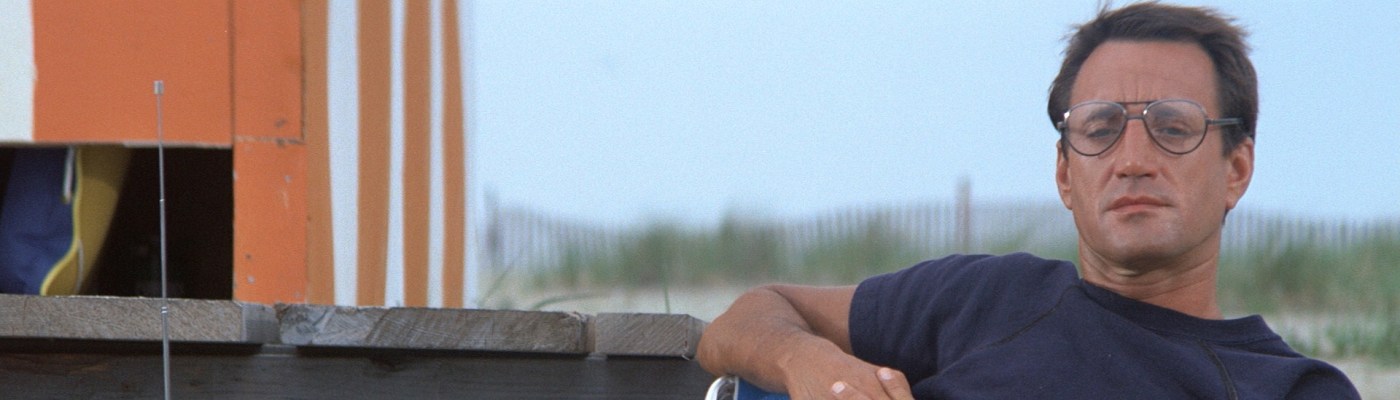
Despite its PG rating (PG-13 didn’t exist at the time) and 50-year age, Jaws may not be an appropriate movie for an 11-year-old viewer, no matter how smart and otherwise mature he or she may be. That’s a big takeaway I got from this week’s Film at 11 podcast viewing with my son.
Perhaps that lesson may seem completely obvious to many parents, who’d never consider letting their own young kids watch a famous horror movie. In my defense, I hadn’t seen Jaws myself in ages, and what I mostly remembered of it is that the shark didn’t look particularly realistic. My son Joseph had been intrigued by all the publicity for the film’s 50th anniversary, and had not-so-subtly hinted that he wanted to watch it. I figured he could handle it. After all, how scary could a 50-year-old movie really be to a modern kid?
Indeed, let me assure you that Joseph survived the experience, and I don’t think was too traumatized. However, I definitely underestimated Steven Spielberg’s ability to craft a movie that would work every bit as well today as it did for audiences in 1975. Jaws is still a flat-out masterpiece, and it astounds me that a young filmmaker working with limited resources could have possibly pulled it off as well as Spielberg did.
Nevertheless, be advised that, notwithstanding the shark itself looking less than fully convincing, Jaws contains a fair amount of gore and other disturbing imagery, including a scene where a young boy about the same age as my own is killed in a bloody frenzy. It’s shown from a long shot, yes, but Joseph was certainly troubled by that and other key moments in the film.
| Title: | Jaws |
| Year of Release: | 1975 |
| Director: | Steven Spielberg |
| Watched On: | 4K Ultra HD Blu-ray |
| Also Available On: | Blu-ray Netflix Various VOD rental and purchase platforms |
The 4K Ultra HD Blu-ray
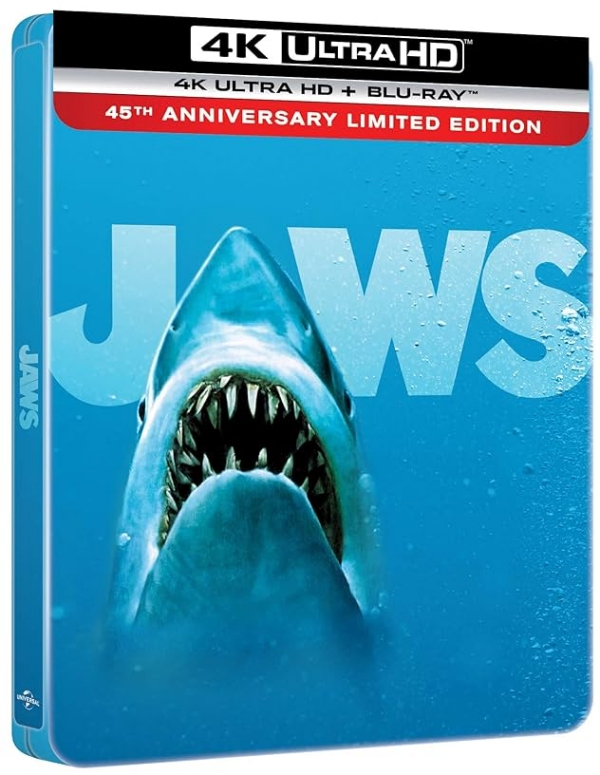
Jaws first came to Blu-ray in 2012, and I bought a copy in Digibook packaging at that time. When an upgrade to 4K Ultra HD Blu-ray followed in 2020, I locked in an order for a 45th Anniversary Limited Edition SteelBook right away, but never quite found time to watch that one. Here we are another five years later and I finally pulled the 4K SteelBook off the shelf.
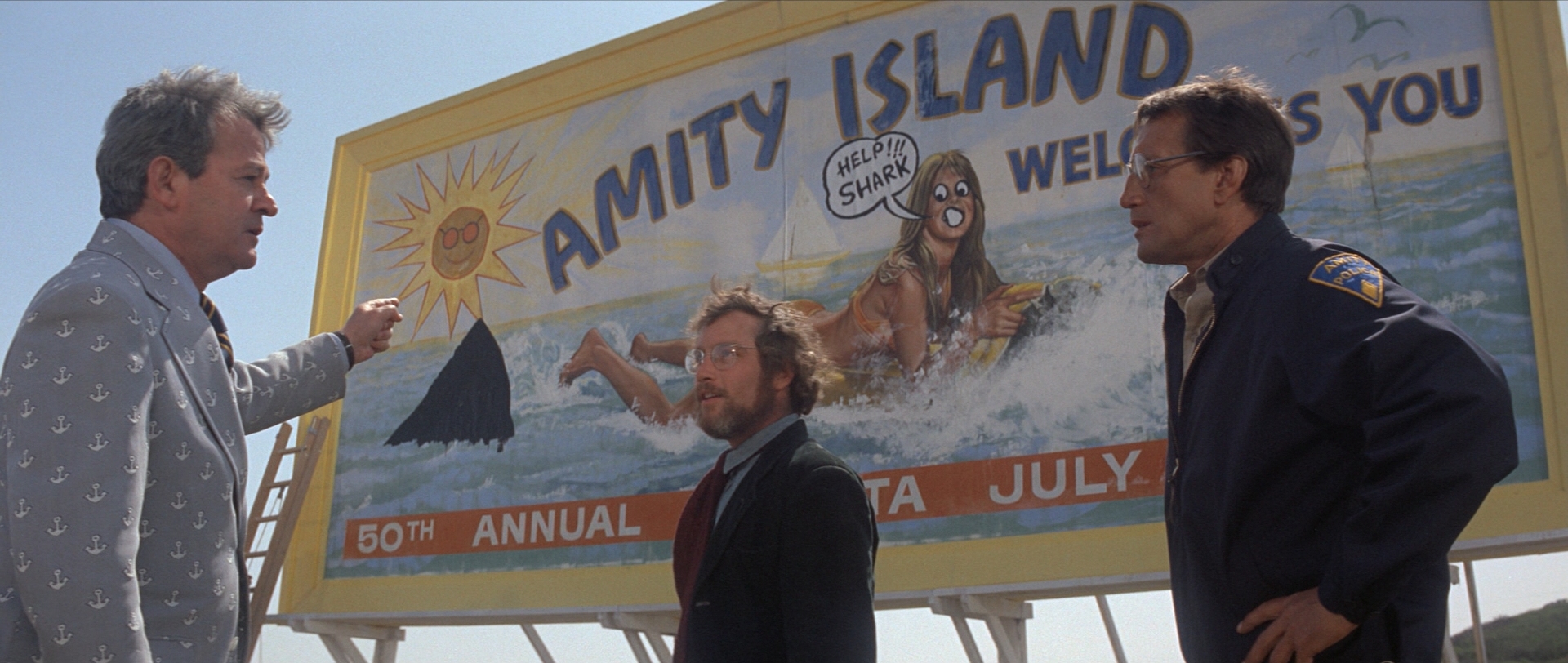
The 4K transfer is very respectful of the film’s age and origin. The source elements have been cleaned of dirt and damage, but Jaws still looks like a movie from 1975. The 2.35:1 image is rather grainy, hazy, and generally soft. However, I feel pretty confident that we can now see every bit of detail present on the camera negative. The picture hasn’t been scrubbed of grain or artificially sharpened, at least not noticeably so.
I can’t say for certain how faithful the color grading is to what theatrical prints may have looked like in 1975 (the day-for-night footage at the beginning looks a lot less blue than the old trailer on the disc), but colors are mostly solid and pleasing. Thankfully, both the sky and the ocean water remain naturalistic shades of blue. Neither are infested with a green shift that would push them to teal, as has marred so many other modern releases of older movies.
The 4K disc defaults to a Dolby Atmos remixed soundtrack, and also offers a copy of the original mono in DTS-HD Master Audio 2.0 format as well. Because I wasn’t watching alone, I had to pick one and stick with it. I couldn’t experiment and compare during our viewing. I probably should have known better, but I chose the Atmos track, mostly because I hoped some immersive audio would be more involving for my son.
For the most part, the Atmos track is a tasteful expansion of the original mono. The musical score is of course spread to stereo. Surround dimensionality is typically restrained and used in a logical fashion. A helicopter flying around the soundstage works pretty well. The remix thankfully avoids sounding too gimmicky.
On the other hand, the Atmos also sounds a little thin. During our watch, I wrote this off as just a trait of being a 50-year-old movie, but when I did more extensive comparisons later that night, I found the mono track on the disc to have noticeably more dynamic range. This especially benefits low-end strum in the John Williams score. Had I known, I would’ve chosen the mono for our viewing. I’ll be sure to make that my default for the future.
Although the 4K disc has no new bonus content, it carries over most of the supplements from the 2012 Blu-ray, including an excellent two-hour making-of documentary (sadly, in Standard Definition video) and the 101-minute The Shark Is Still Working retrospective doc (in HD). Also provided are an 8-minute restoration featurette (about the Blu-ray transfer), some mostly dull deleted scenes, a vintage behind-the-scenes promo piece, and a trailer.
The enclosed standard Blu-ray is simply a copy of the 2012 disc, complete with the annoying “swoosh” menus Universal insisted on foisting onto everything at the time, and a BD-Live link that’s long since been disabled. In addition to the above items, it also adds a still gallery of storyboard art, behind-the-scenes photos, posters, and other marketing material.
Related
- Steven Spielberg (as director)
- E.T. The Extra-Terrestrial (1982) Film at 11 Podcast Review
- Indiana Jones and the Dial of Destiny (2023)
- Indiana Jones and the Kingdom of the Crystal Skull (2008)
- Indiana Jones and the Last Crusade (1989)
- Indiana Jones and the Last Crusade (1989) Film at 11 Podcast Review
- Indiana Jones and the Temple of Doom (1984)
- Indiana Jones and the Temple of Doom (1984) Film at 11 Podcast Review
- Jurassic Park (1993) Film at 11 Podcast Review
- Raiders of the Lost Ark (1981)
- Raiders of the Lost Ark (1981) Film at 11 Podcast Review
- Steven Spielberg (as producer)
- Roy Scheider
- Richard Dreyfuss
- Robert Shaw
Note: All screenshots on this page were taken from the standard Blu-ray edition of the film and are used for illustration purposes only.
 The Video File Blog