

The legend and myth of El Mariachi are a lot bigger than the movie itself could ever hope to live up to – even though, ironically, that entire story is predicated on how small the film is. The debut feature from director Robert Rodriguez was famously made on an almost inconceivably paltry budget of just $7,000 (yes, that’s seven thousand dollars, not million). Even by the standards of the time, that made it one of the most “micro” of micro-budget feature films. That Rodriguez could further make a somewhat credible action movie for that tiny pittance of money, rather than just a two-person character drama shot in an apartment, and find distribution from a major Hollywood studio for the final product, was truly an astounding inspiration for young film students everywhere, myself included.
I was in my early days of film school when Columbia Pictures gave El Mariachi a national theatrical release that played in the little cinema on my campus. Much like just about everyone else in my class, I came away thinking, “If he could do that for only $7,000, imagine what I can do!” Ultimately, I wound up spending almost exactly that same amount to make a twenty-minute short film (a two-person character drama shot in an apartment, of course) that played for one screening and was never seen again.
While anyone can spend $7,000 to make a film, not everyone can be Robert Rodriguez. That’s a lesson I learned the hard way.
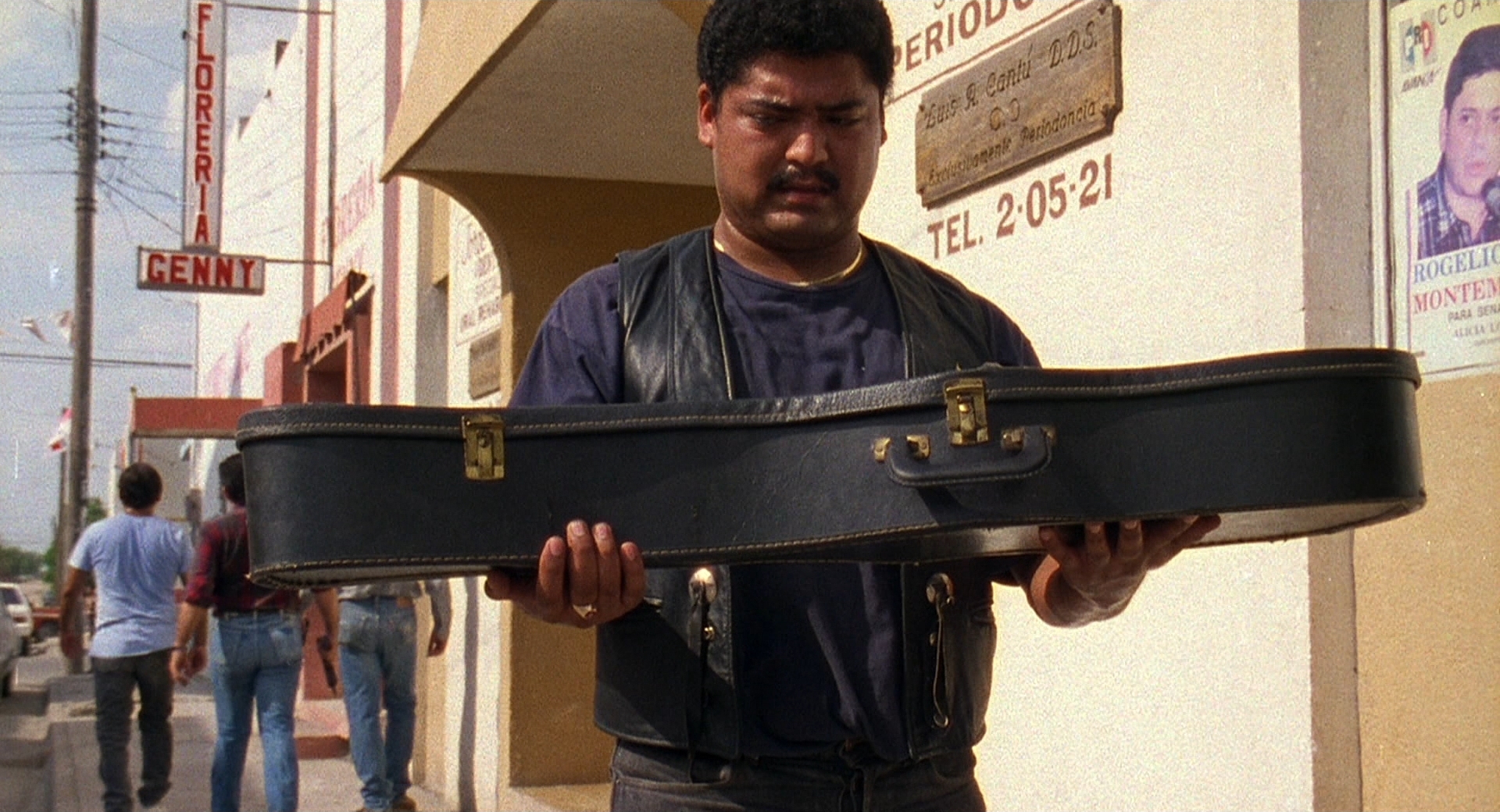
| Title: | El Mariachi |
| Year of Release: | 1992 – Film Festivals 1993 – General Release |
| Director: | Robert Rodriguez |
| Watched On: | Blu-ray |
| Also Available On: | Various VOD rental and purchase platforms |
In actuality, the story of El Mariachi‘s $7,000 budget turns out to be a bit exaggerated. After seeing an early cut of it and agreeing to distribute the movie, Columbia Pictures pumped a couple hundred thousand extra dollars into polishing the film in post-production and giving it a professional sound mix significantly better than the one Rodriguez had recorded on his Radio Shack microphone and tape deck. More funds were then doled out for a very effective promotional campaign playing up the movie’s low-budget nature. All told, the studio invested way more into the film than Rodriguez originally had. Even so, the movie was still an incredibly small production made with way more ambition and ingenuity than money.
As the writer/director/cameraman/producer/editor tells it, he and a group of friends threw together El Mariachi using a single 16mm camera, some tail-end remainders of film stock, and not much else, intending to sell it as a cheapie direct-to-VHS action movie for the the Latino home video audience. When even distributors for that market passed on it, Rodriguez went for broke and sent the trailer around to bigger studios as well, feeling he had nothing to lose by trying.
His timing was fortuitous. The success of Seven Soderbergh’s Sex, Lies, and Videotape and a few other notable mini-budget productions around that time had ushered in a booming renaissance for independent cinema that was really starting to flourish by 1992. Recognizing the potential for a new revenue stream and wanting a piece of that action, the major Hollywood studios opened up their own specialty art film subdivisions. Upon seeing footage from El Mariachi, representatives from Columbia Pictures honed in on it as a product they knew they could sell to a growing audience hungry for new content outside the Hollywood norm.

To be very clear about this, El Mariachi should in no way ever be classified as an art film. The picture is much in the same vein as other low-budget action schlock that proliferated on video store shelves and late-night cable. The difference in this case was that its Spanish-language origins gave the movie a slightly exotic flair and the backstory of its production made good copy the studio could use to tag it as the work of an emerging auteur. That Rodriguez himself was charismatic enough – and, honestly, talented enough – to live up to those ambitions made that a very easy sell.
The director’s friend Carlos Gallardo stars in the title role as a traveling musician who comes looking for work in an impoverished Mexican town, arriving with nothing in hand but his guitar and a smile. Almost immediately, the mariachi is mistaken for a local criminal named Azul (Reinol Martinez) known for carrying his weapons around in a guitar case. When Azul has a falling-out with drug kingpin Moco (Peter Marquardt), the latter sends a squad of goons to take him out. None of them having any idea what Azul actually looks like, the incompetent henchmen target the first guy they see carrying a similar case. This puts the innocent mariachi in the crossfire of a gang war he knows nothing about, forcing him to fight back and become an inadvertent action hero if he wants to survive.
This very formulaic wrong-man scenario is quite thinly sketched, with just barely enough plot to string together a series of very modest action sequences constructed mostly of clever misdirection and a lot of creative editing. Nothing in the story breaks even remotely new ground, the actors are obviously not professionals, and some of the attention-grabbing handheld camerawork and jokey speed-up effects are a little obnoxious. Really, in just about anyone else’s hands, the entire movie would be borderline insufferable.
Yet, somehow, it’s not. Miraculously, on his blatantly shoestring budget, Rodriguez uses pure craft to build a continuous sense of momentum that keeps this very silly film moving at a breakneck pace that might actually convince you it’s a genuine action movie made by someone who knows what he’s doing. El Mariachi may not be a good movie in most objective terms, but it’s energetic, scrappy, and even a bit charming.
With this successful calling-card under his belt, Robert Rodriguez got right to work making a proper Hollywood feature that would open in wide release two years later. Part sequel and part remake, the English-language Desperado was made for $7 million (one thousand times the budget of the original) with Antonio Banderas taking over the lead role. If still quite a modest budget by Hollywood standards, the sequel is also at least a thousand times better than El Mariachi and defiantly announced Robert Rodriguez as a creative force to be reckoned with.
Whether all of his subsequent work has really lived up to that potential is a longer and more complicated discussion.

The Blu-ray
Sony released El Mariachi on Blu-ray back in 2011 as part of a Double Feature with the film’s first sequel, Desperado. I assume most fans at the time bought the set mainly to get the latter. Regrettably, both movies were compressed onto a single disc. Fortunately, both are rather short pictures. El Mariachi barely runs 81 minutes.
In 2024, Arrow Video claimed the license and released a three-film box set called the Mexico Trilogy, which took the odd configuration of bundling a 4K Ultra HD disc for just Desperado with regular Blu-rays for the first and third movies. (There are legitimate technical reasons behind this decision, but it still feels awkward.) Having seen the third film, Once Upon a Time in Mexico, in the theater in 2003, I drew an immediate line in the sand as soon as the credits rolled that I never needed to watch that movie again for the rest of my life. I still stand by that. As such, I’ve made a conscious decision not to purchase the Mexico Trilogy box set. Instead, I picked up the standalone 4K release of Desperado and held onto the much older Blu-ray for El Mariachi.
Keeping in mind that El Mariachi has always been an incredibly low-budget movie shot on scraps of 16mm film, the 2011 Sony Blu-ray is… watchable. Mostly. The entire movie is matted to 1.85:1, which may technically be its legitimate theatrical aspect ratio, but Robert Rodriguez originally shot the footage in full-frame 4:3 intending to sell it directly to VHS home video during the days before DVD or widescreen HDTV. The 1.85:1 transfer is clearly over-matted and regularly clips off character foreheads. The fact that almost every shot in the movie is a close-up really exacerbates that problem.
Rodriguez mentions in the disc supplements that the prior DVD had been transferred from a 35mm blow-up source. I’m not sure whether the Blu-ray was as well or went back to the original 16mm. In either case, that the footage would be full of scratches, dirt, and hair on the film elements should not come as any surprise. Nor would I expect any of that to bother the director in the slightest. (Hell, he’s even added fake digital versions of all that stuff to his later movies on purpose!) For something that originated on 16mm, the image is surprisingly sharp and detailed. However, it’s also grainy as hell, and that grain looks noisy and awful.
If Sony applied any artificial sharpening to the picture, I don’t see the usual telltale signs of edge halos around objects in the frame. I suspect that poor digital compression may be the root of the problem. When paused for still-frames, the grain has a very blocky, digital appearance.
I’m curious whether the newer edition from Arrow Video handles this better, even if using the same underlying source master. With better encoding, it very well might. Yet, as I said, I’m still not inclined to buy that Mexico Trilogy box set just to find out. Frankly, I don’t care about El Mariachi that much.
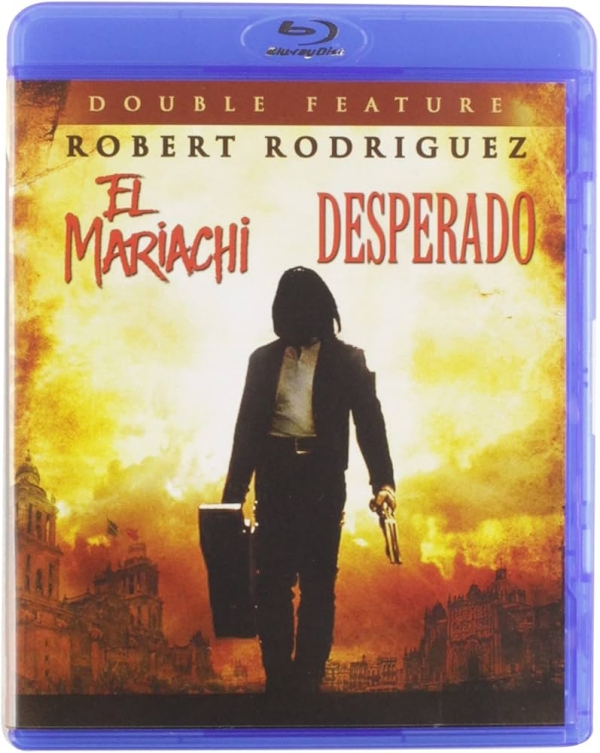
The movie’s audio is better than its video. For that, you can thank Columbia Pictures for investing extra money into the film’s sound design. The soundtrack comes in a choice of either the original Spanish or an English dub, both in DTS-HD Master Audio 2.0 stereo surround. For what it’s worth, the Spanish version was shot silent and all the dialogue was recorded separately on the set after each take finished filming. The lip-sync at least reasonably matches the picture, and Rodriguez used creative editing to work around when it strayed too far.
The foleyed sound effects, most importantly the gunshots, were all replaced by the studio later and sound very crisp and clear. The musical score may be a little monotonous, but at least has some decent bass from time to time. Dialogue is mostly flat but adequate, and many scenes are missing ambient sounds or atmosphere behind the dialogue and effects. This may not be a world-class action movie soundtrack, but it certainly sounds better than you’d expect from a movie of this budget.
Bonus features include an audio commentary by Robert Rodriguez, a copy of his early short film Bedhead, and the first entry in the director’s recurring Ten Minute Film School lecture series. MovieIQ pop-up cast notes and a BD-Live “Cutting Room” interactive editing feature both previously required internet connectivity and are long since disabled. (They look like they were both super-lame, anyway.)
Related
- Sequel
- Robert Rodriguez (as producer)
 The Video File Blog