
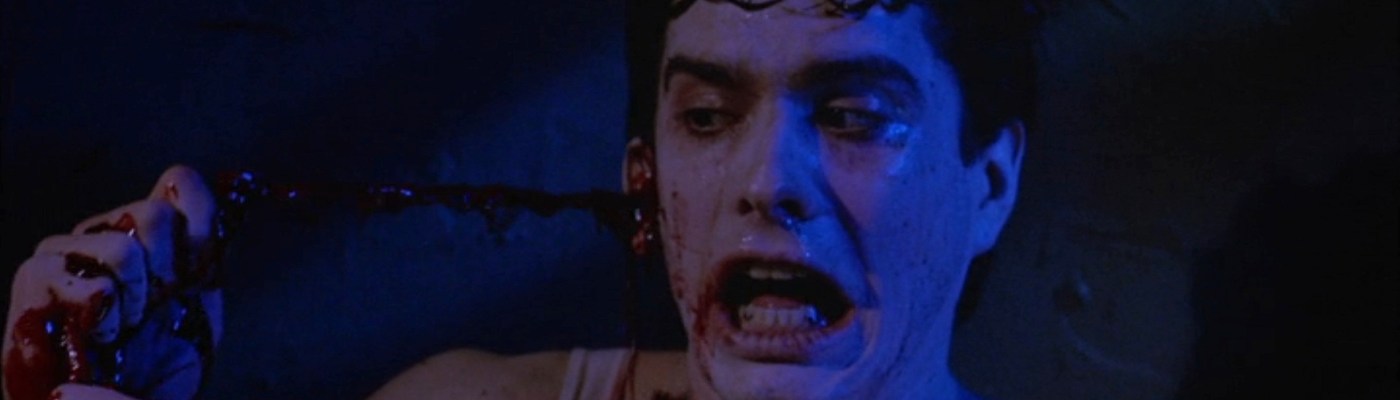
Fans of schlocky 1980s horror undoubtedly know the name Frank Henenlotter as director of the ultra-low-budget midnight movie and VHS rental staple Basket Case. With that grungy classic under his belt, Henenlotter scraped together nearly $2 million (still a pittance by most movie production standards, even at the time) for his next horror offering, the 1988 creature feature Brain Damage. Sadly, the follow-up was not nearly as… is “successful” the right word?… and took a long time to slowly grow its own cult following on home video.
Despite growing up in the 1980s, I was a bit too young for most of that decade to develop a deep appreciation for its horror movies, much less those with an R or harder rating. Even today, I remain more casually interested in the genre than a true connoisseur. Nevertheless, I’m in a B-movie kind of mood at the moment, and this one’s title jumped out at me. As a first-time viewer, the film worked its sick magic on me and got me cackling with shock and delight during at least one scene. (If you’ve seen it, you know the one.)

| Title: | Brain Damage |
| Year of Release: | 1988 |
| Director: | Frank Henenlotter |
| Watched On: | Fandango at Home (VUDU) |
| Also Available On: | Blu-ray Kanopy Roku Channel Tubi |
Coming as no surprise for a movie of this type and budget, Brain Damage has no major stars in the cast. The film’s only real marketing hook was that it came from the guy who made Basket Case. The lead is an actor named Rick Hearst (credited here by his original spelling, Herbst) who’d go on to a steady soap opera career later. The majority of his co-stars have limited to no other acting credits on their résumés. The quality of their acting is amateurish and frequently over-the-top, but that feels appropriate enough. You don’t watch a movie like this expecting award-worthy performances.
What you should expect, and will get plenty of, are gallons of fake blood sprayed in every direction, gooey gross-out gore, and lo-fi creature effects thrown together with more imagination and homemade ingenuity than attempted photorealism. The main attraction, a slimy slug-like thing with big blinking eyes and a mouth full of sharp teeth, is clearly a puppet, when it’s not just as clearly stop-motion animated. If anything, the production leans into its cheesiness for laughs.
Hearst/Herbst plays Brian, a young slacker who wakes up one morning to discover a mysterious bloody wound on the back of his neck. While he was sleeping, a monstrous parasite slithered into his bed and (literally) got its hooks into him, injecting Brian with an addictive secretion that can give him the most amazing euphoric high of his life. While tripping on its blue “juice,” Brian can feel and hear colors. The entire world feels much more vibrant and alive. Unfortunately, the cost for this experience is steep. The creature needs to eat, and brains – specifically, human brains – are the basis of its diet. If Brian values keeping whatever is left of his own, he’ll need to secure a steady food supply for the disgusting new organism that has attached itself to his body and taken over his life.
Obviously, this story is a metaphor for drug addiction, and the horrible things an addict will do to stay high. The movie is completely unsubtle about that, and openly makes the comparison in dialogue. Thankfully, this is neither some preachy after-school special, nor is it Requiem for a Dream. Brain Damage is pure schlocky horror. To that end, the most fun thing about the movie is that the creature can talk, and not in some gravelly monster voice or whispered telepathic connection. It has a name – Aylmer – and personality, and is even quite friendly to Brian. Aylmer speaks in a hilariously genteel and erudite voice, and somehow sounds entirely reasonable when asking Brian to, for example, murder strangers so the creature can suck their brains out for a snack.
Being from the creator of Basket Case, Brain Damage of course goes for broke with its kill scenes and gore. The centerpiece sequence is so graphic, gross, and marvelously sick I had to question how this movie could have possibly gotten by with only an R rating. When I looked up the details afterward, I learned that in fact it didn’t. Without realizing it, I was watching a more explicit unrated cut of the film. The version released to theaters was edited down significantly in that scene to appease the MPAA board, and the initial VHS release followed suit with the theatrical cut. I suspect that’s why Brain Damage didn’t do so well initially. That scene really makes the whole movie. Having seen it uncut, I wouldn’t want to lose a frame of it.
Not to worry, Frank Henenlotter would bounce back into horror fans’ good graces with his Basket Case sequels and his other great cult classic, 1990’s Frankenhooker. As mentioned, Brain Damage would also gain more of an audience over time on home video, especially once the uncut version was restored for DVD in the early 2000s.

Video Streaming
Although Arrow Video released Brain Damage on a limited edition Blu-ray in 2017, I felt that streaming would suffice for my needs on this one. I actually started watching a free version on Tubi (with ads), but while the video there was acceptable, the audio was flat as a board and sonically deadened. When I tried another movie and found similar results, I figured this must be a Tubi issue and decided to risk a few bucks on a rental from Fandango at Home.
Indeed, Fandango’s streaming version has significantly better audio quality than Tubi, enough that I felt my rental dollars were well spent. Though still mono, the Dolby Digital track is richer and more vibrant, with some reasonable bass and dynamic range. As a low-budget movie from 1988, Brain Damage doesn’t exactly have the highest quality or most elaborate sound design, but for a horror flick like this, it helps a lot if the audio is loud and can hit you with a few decent stinger effects. I can forgive the film if the dialogue sounds a little shrill or muddy at times. The majority of it is fine, and music in the punk rock club scene throbs nicely.
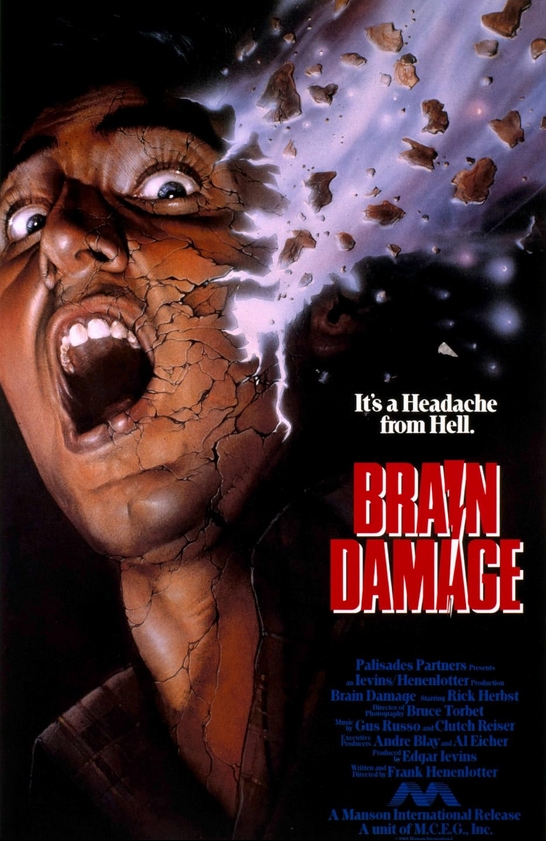
Fandango’s “HDX” 1080p video is likewise better than I might have expected for a movie of this age and origin. My initial assumption was that Fandango must be using the Arrow Video remaster, but some research tells me that Arrow’s Blu-ray was mildly letterboxed to 1.85:1. The streaming version is either slightly opened-up or slightly cropped (I honestly can’t tell which) to full-screen 16:9. The difference in framing is marginal either way.
Regardless, the image is acceptably sharp, with some surprisingly deep and vibrant colors. I really love all the rich blues. The hallucination sequences are bright and vivid. (A warning to photosensitive viewers: this movie features a lot of bright flashing lights.) Grain is a little mushy and probably could be better resolved. However, if anything, light scratches and other occasional film damage actually add to the grindhouse aesthetic.
For true fans who want to own a copy of this movie, I’m sure the Arrow Blu-ray is the way to go, but the Fandango streaming version is plenty satisfying on its own accord.
For the record, despite an R rating in the site’s listing, Fandango is actually streaming the fully uncut and unrated version of the movie.
Related
- Thematically-Similar Alien Movies
 The Video File Blog