

Long a cult item with a highly divided reputation among viewers, Barbarella is simultaneously an awful movie and also kind of amazing. I’ve seen it a number of times over the years and somehow both love it and inevitably feel bored senseless by it well before its short 98-minute runtime peters out. I don’t think that’s an uncommon reaction.
Barbarella is also just about the most “1968” movie actually produced in the year 1968. Intended as a science-fiction parody, it also plays in retrospect as a pretty effective parody of filmmaking and cultural fads of the Swinging Sixties. If Austin Powers were a sci-fi spoof rather than a spy spoof, this is just about the movie it would be. But Barbarella already existed as-is, so there was no need to fill any genre void there three decades later.

| Title: | Barbarella |
| Year of Release: | 1968 |
| Director: | Roger Vadim |
| Watched On: | 4K Ultra HD Blu-ray |
| Also Available On: | Blu-ray Kanopy Various VOD rental and purchase platforms |
1968 saw the release of three major science-fiction films that went on to become classics in different ways. Stanley Kubrick’s ultra-serious 2001: A Space Odyssey strove for rigorous scientific verisimilitude for a near-future just around the corner, while Planet of the Apes presented an outlandish (perhaps a little silly at times) dystopian nightmare, and Barbarella went full camp lunacy.
Loosely based on a popular and controversial French comic strip that repressive types at the time frequently labeled “pornographic,” Barbarella is a science-fiction story set some 40,000 years in the future, yet clearly reflected societal trends of the 1960s involving themes of free love and female liberation. In the comic, the title character was a sort of galactic spy who went on adventures from planet to planet, many of which involved sexual escapades – outdated concepts of sexual morality being long-since abandoned in this more enlightened future.
The movie version changes some of the details, but manages to keep and emphasize the focus on sex. One year following her breakout hit romantic comedy Barefoot in the Park, Jane Fonda plays a “five-star, double-rated astro-navigatrix” assigned by the President of Earth to locate a missing scientist named Durand Durand. (Yes, the later ’80s pop band Duran Duran took inspiration for its name from Barbarella.) Despite most of the universe having been pacified millennia ago, Durand has invented a dangerous weapon that could endanger the loving peace and harmony of all humanity. Barbarella tracks him to obscure planet Tau Ceti, a dreary world oppressed by a leader known as the Great Tyrant (model Anita Pallenberg). With the help of new friends including a birdman “angel” (John Phillip Law from Danger: Diabolik), a daffy inventor (famed mime Marcel Marceau), and a rebellious resistance leader (David Hemmings from Blow-Up), she’ll have to infiltrate the Tyrant’s sanctum, discover what Durand is up to, and hopefully prevent his weapon from being used. Doing so will involve having sex, in various strange permutations, with most of these characters and others.
The plot is pure nonsense, and no one in the film pays it much attention. One of the seven or so writers responsible for the screenplay was American humorist Terry Southern, famous at the time for having penned Dr. Strangelove. In his early draft, Southern no doubt envisioned the movie as a satire of science-fiction tropes with some political overtones, but most of that was watered down or eliminated in the revisions by multiple others. Grandiose Italian producer Dino De Laurentiis had no interest in politics or satire, but was all about showmanship, spectacle and, in this case, sex appeal.
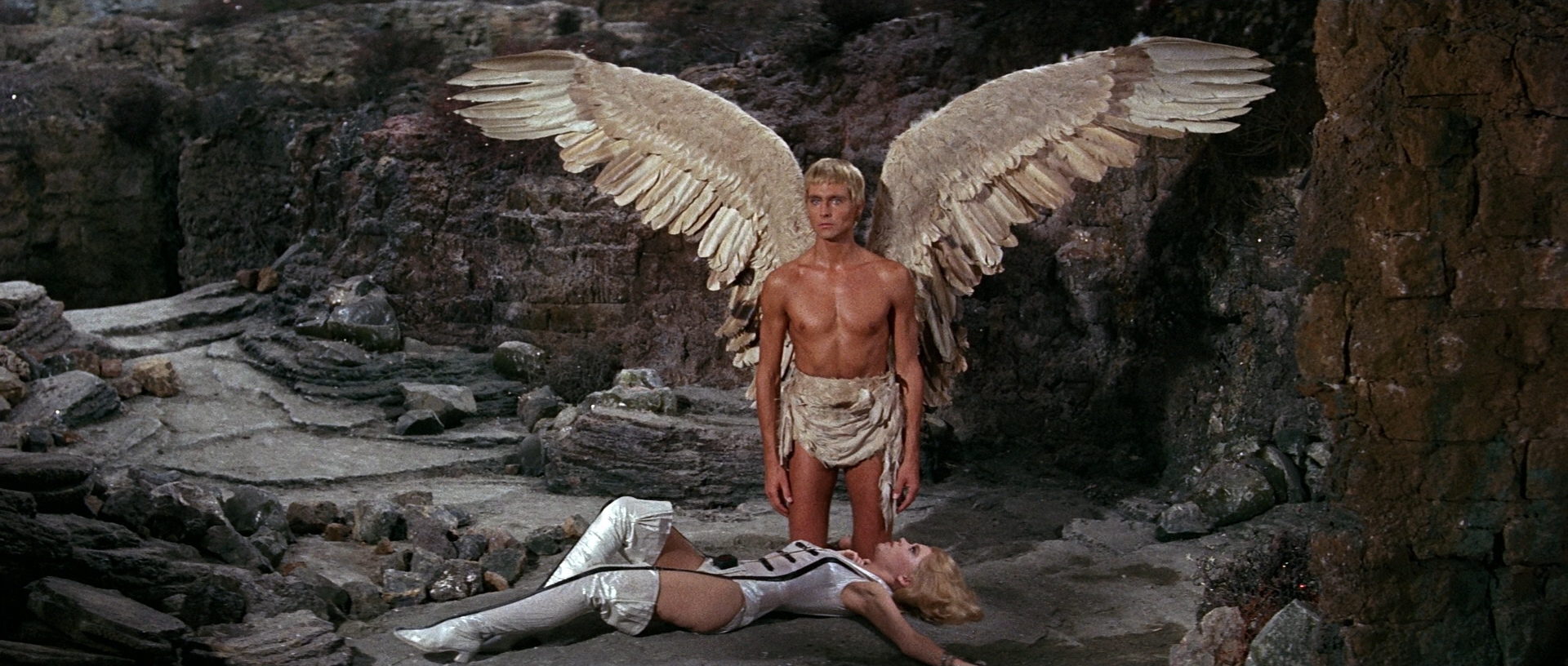
Directed by Fonda’s then-husband Roger Vadim (who’d made Brigitte Bardot an iconic sex symbol in …And God Created Woman), Barbarella in essence boils down to an extended 98-minute lewd sex joke. The movie opens with Fonda doing a playful zero-gravity strip tease that’s still one of the hottest things ever put to celluloid. Barbarella’s spaceship looks like a weird sex toy, and the very first man she meets offers her a ride in exchange for letting him make love to her – a concept she’s unfamiliar with until he teaches her how it’s done. While the actual amount of nudity on screen is fairly limited (most of it shown during the opening title sequence), sex is used as currency or as a plot device in numerous scenes afterward. Many of the sets and props have suggestive designs, and Hemmings’ character is given the groan-worthy name Dildano.
The film’s sexual politics haven’t aged especially well. On the one hand, it may be argued that Barbarella becomes empowered by her free love experiences and learns to take control of her own sexuality. Working against that, the movie is also just plain rapey a lot of the time. With much talk over the years of various filmmakers wanting to reboot the property, I can’t imagine Barbarella being made today in anything approaching the same way.
The movie is a product of the late 1960s through and through, but that datedness is also the source of its greatest enduring appeal. From the silly costumes and production design, to its jazzy music, songs, and wonderfully terrible special effects, the film is a a phantasmagoric explosion of psychedelic visuals and groovy far-out vibes. An expensive production for its day, De Laurentiis spared little money bringing this elaborately cheap-looking vision to life, and Vadim leans wholeheartedly into the “comic” aspect of making a comic strip into a movie. Those parts are all still hugely fun.
Where Vadim fails, unfortunately, is tying any of this to an interesting story. Barbarella simply doesn’t have one. Nor is he remotely skilled at directing an action scene. What passes for action here is almost totally incoherent. Other than Fonda, whose ingenue performance remains delightful, Vadim somehow manages to make almost everyone else in the cast seem incompetent at acting, even those who’d headlined prior movies. John Phillip Law is awkwardly rigid and stone-faced in every scene, and David Hemmings goes the opposite direction to embarrass himself with over-the-top goofy antics, as if no one on set had been instructed what sort of tone they should be working toward.
The result of all this is a movie that can be alternately a blast of pure camp hilarity and a tedious bore over the span of barely an hour and a half. Even that unevenness has it own charm, however. Barbarella might be less memorable if it were less flawed or too satisfying. The fact that I want it to be better, and keep struggling to find better qualities in it, is one of the things that makes me come back to the film so often.

The 4K Ultra HD Blu-ray
Back in 2012, Paramount released Barbarella on a Blu-ray disc that, quite honestly, still looks damn great. Giving it a quick perusal again now, I can’t find much to fault with its video transfer. (Images on this page are also taken from that disc.) If I had much rational sense about these things, I would have checked that first and decided I was perfectly happy with it. Nevertheless, because I’m a sucker for certain cult films, I felt the need to upgrade Barbarella to 4K Ultra HD after Arrow Video licensed the title in 2023. In a remarkable show of restraint at that time, I managed to hold back from buying the label’s expensive Limited Edition box set and instead waited a few months for the less-pricey Special Edition in a plain keepcase.
The Special Edition is a two-disc set with the feature film on 4K Ultra HD Blu-ray and a regular Blu-ray disc dedicated to bonus features. It does not include the movie itself on standard Blu-ray. Claiming a “4K restoration from the original negative by Arrow Films,” the new video master looks terrific, and almost certainly better than any theatrical prints back in 1968 may have. I have no doubt this is probably the best that Barbarella can be expected to look. With that said, it doesn’t look tremendously different than the Paramount Blu-ray from a decade earlier already did, either. I suppose that means both studios put their best work into this very silly film.
Aside from the many optical effects that should be expected to look a little dupey, the 2.35:1 image is very sharp and detailed, enough to see the wires holding up spaceship models and the seams in the rear projection backdrops (among other details a fan might want a clearer view of). Grain texture is well resolved but not obtrusive. Colors are deep and rich. With cinematography by Claude Renoir (nephew of Jean Renoir, for whom he’d famously shot Grand Illusion), Barbarella is a much better-photographed movie than you might expect given its reputation or other tacky production values.
Compared to the older Paramount Blu-ray, Arrow’s 4K edition gains a small but welcome uptick in detail and clarity. The HDR grade, while subtle, also adds to its sense of richness and depth. If I were only marginally interested in the movie itself, I’d find the Blu-ray plenty satisfying, but for those who actually care enough to want the best copy of Barbarella, the Arrow 4K disc is the way to go.

Arrow presents the movie’s soundtrack in choices of either English or French PCM mono or a new Dolby Atmos remix (English only). Jane Fonda recorded her own dialogue in both languages, but given that she spoke English on set and on camera, that’s typically considered the primary language version for this movie. However, be aware that other actors around her (including Anita Pallenberg) mostly had their dialogue dubbed over in the English track.
The original English mono is prioritized in the disc setup menus and was my default listening experience here. Dialogue and the majority of sound effects are clear and crisp. For mono, the music has nice fidelity and some strumming bass that’s quite satisfying. Explosions sound pretty thin, but that’s to be expected for a movie of this age and origin.
I didn’t compare them extensively, but I listened to a few minutes of the Atmos track and found it mostly pointless and underwhelming. Jumping straight to the ridiculous battle scene between Barbarella and the planet’s version of an Air Force, I detected very little directionality even when flying ships were buzzing around the screen. Although those explosions seem to have been goosed a little, they just sound annoyingly boomy. I bored with that quickly and went right back to the mono.
The main supplement on the 4K disc is a very academic and somewhat dry audio commentary by critic Tim Lucas. Also available are alternate versions of the opening and ending credits sequences, which I believe were created for the film’s 1970s PG-rated re-release under the title Barbarella: Queen of the Galaxy, to more obscure (but still not totally eliminate) some of the nudity.
Tim Lucas returns on the Disc 2 Blu-ray in a more engaging two-hour conversation about the history of Barbarella from comic to screen with his friend, former comic book artist and frequent Video Watchdog magazine collaborator Stephen R. Bissette. Other extras include a half-hour appreciation for the film by critic Glenn Kenny, a vintage behind-the-scenes promotional film, plus several featurettes and interviews (ranging from 14 to 32 minutes each) devoted to the costume design, cinematography, Italian actor Ugo Tognazzi, producer Dino De Laurentiis, and the body-double who stood in for John Phillip Law in certain scenes. A few trailers, TV spots, and an image gallery round out the contents.
Related
- Dino De Laurentiis (producer)
- Terry Southern (writer)
Note: All screenshots on this page were taken from the 2012 Paramount Blu-ray edition of the film and are used for illustration purposes only.
 The Video File Blog