
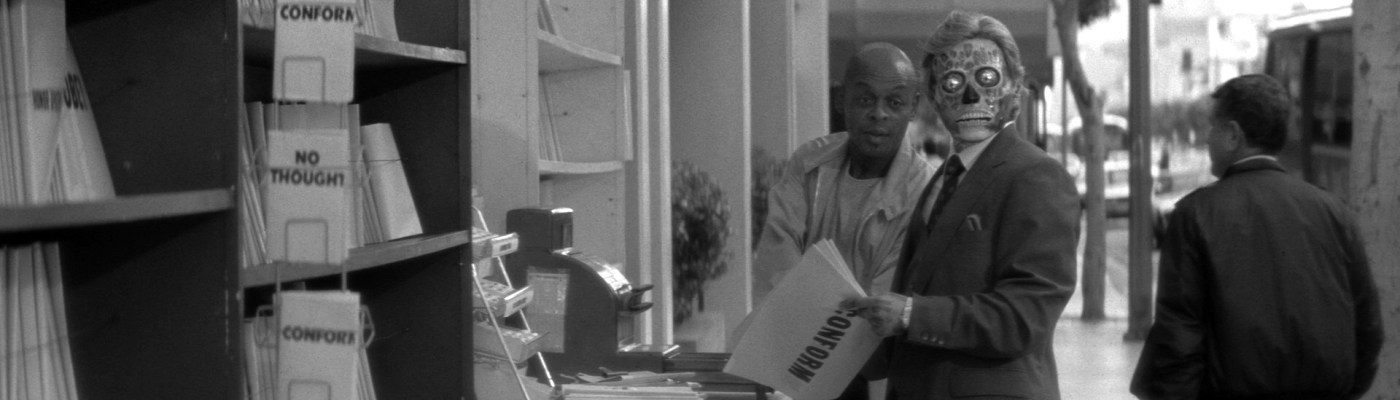
“We all sell out every day. Might as well be on the winning team,” says a character in John Carpenter’s They Live, a movie originally sold as a sci-fi/horror flick but that has become more famous over time for its blunt political satire. Originally produced at the height of the Reaganomics era, the film’s messaging was never exactly subtle, nor was it intended to be, but nearly four decades later it’s still distressingly on-point. There’d be no need for anyone to attempt a remake of They Live now. This still feels like a movie about today, the moment at which it’s being watched, and likely will continue to feel that way for the foreseeable future.
Simultaneously, They Live also embraces its roots as a 1980s B-movie, in both form and style. The fashions and media technology have dated, and more than that, the film’s characters are thinly-sketched and the plot is thinner still. For fans, that actually makes it more fun. They Live is the very rare sort of movie that can feel both unpretentious and extremely pretentious all at once, and somehow make both sides work.
| Title: | They Live |
| Year of Release: | 1988 |
| Director: | John Carpenter |
| Watched On: | 4K Ultra HD Blu-ray (45 minutes) Blu-ray (remainder of movie) |
| Also Available On: | AMC+ The Criterion Channel Roku Channel Various VOD rental and purchase platforms |
At the time he made it, director Carpenter may have also been commenting on his own career as much as contemporary politics. Just a few years earlier, he’d jumped into the middle of Columbia Pictures’ very troubled production of Starman, a big-budget (for the day) film that had already been through several directors and a lot of different writers before cameras rolled with him at the helm. Known mostly for low-budget exploitation fare, Carpenter hoped that Starman would be his big mainstream breakthrough, but the movie was not especially embraced by either critics or audiences at release. Nor was his subsequent effort, the goofy supernatural action-adventure Big Trouble in Little China, made for 20th Century Fox. With those two flops to his name, the director then retreated to lower-budget projects on which he could keep more creative control with less risk of feeling like a sell-out.
Carpenter developed They Live himself, based on a 1963 sci-fi short story and its subsequent comic book adaptation published in 1986. The movie was produced by independent label Alive Films on a modest budget of $3 million, about 1/8th what Starman had cost. Unable to afford any major stars, which his friend and prior collaborator Kurt Russell had become by that point, the director hired professional wrestler Roddy Piper to headline the cast, hoping his fame in that arena would transfer to theatrical box office success as well.
Beyond his showboating antics in the wrestling ring, Piper didn’t have a lot of experience or range as an actor. To work around that, Carpenter wrote the screenplay and fashioned the role so that it wouldn’t require much. The lead character is a classic tough guy of few words archetype, of such limited depth he’s never even given a name during the course of the movie. (The end credits playfully list him as “Nada.”)
The hero is a down-on-his-luck drifter who wanders into a big city looking for work, which he soon finds on a construction site, where he also makes friends with a coworker named Frank (Keith David). Nada’s a guy with a lot of muscles but a generally amiable attitude so long as he isn’t getting harassed. He’ll stand up for himself if necessary, but doesn’t aim to create trouble if he doesn’t have to. Unfortunately, trouble finds him in a big way after he discovers a pair of sunglasses that, when worn, show him the world as it truly is – a bizarre dystopian nightmare filled everywhere with subliminal messages conditioning the populace to stay complacent and subservient to a secret race of alien masters, hiding in plain sight disguised as humans. Specifically, Nada learns that almost everyone wealthy or successful around him will most likely turn out to be hideous monsters when he can see their true faces.
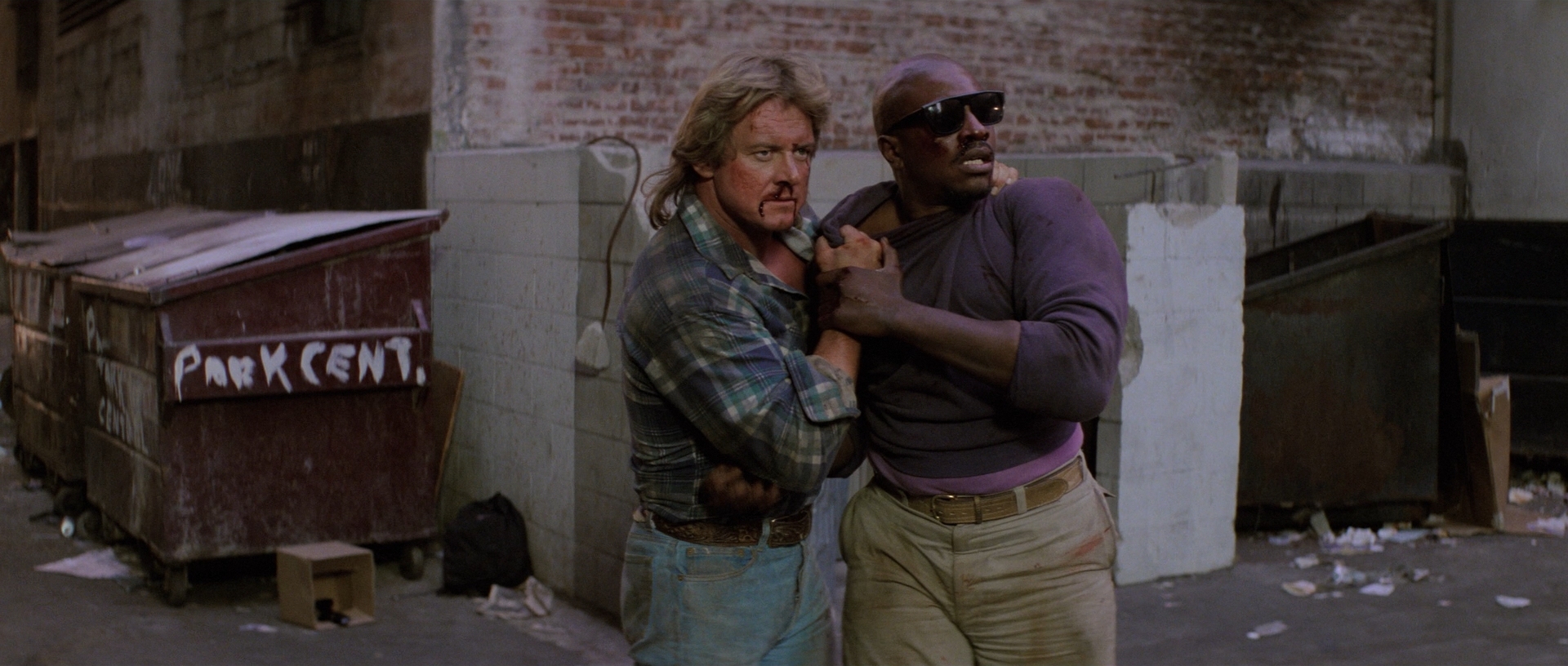
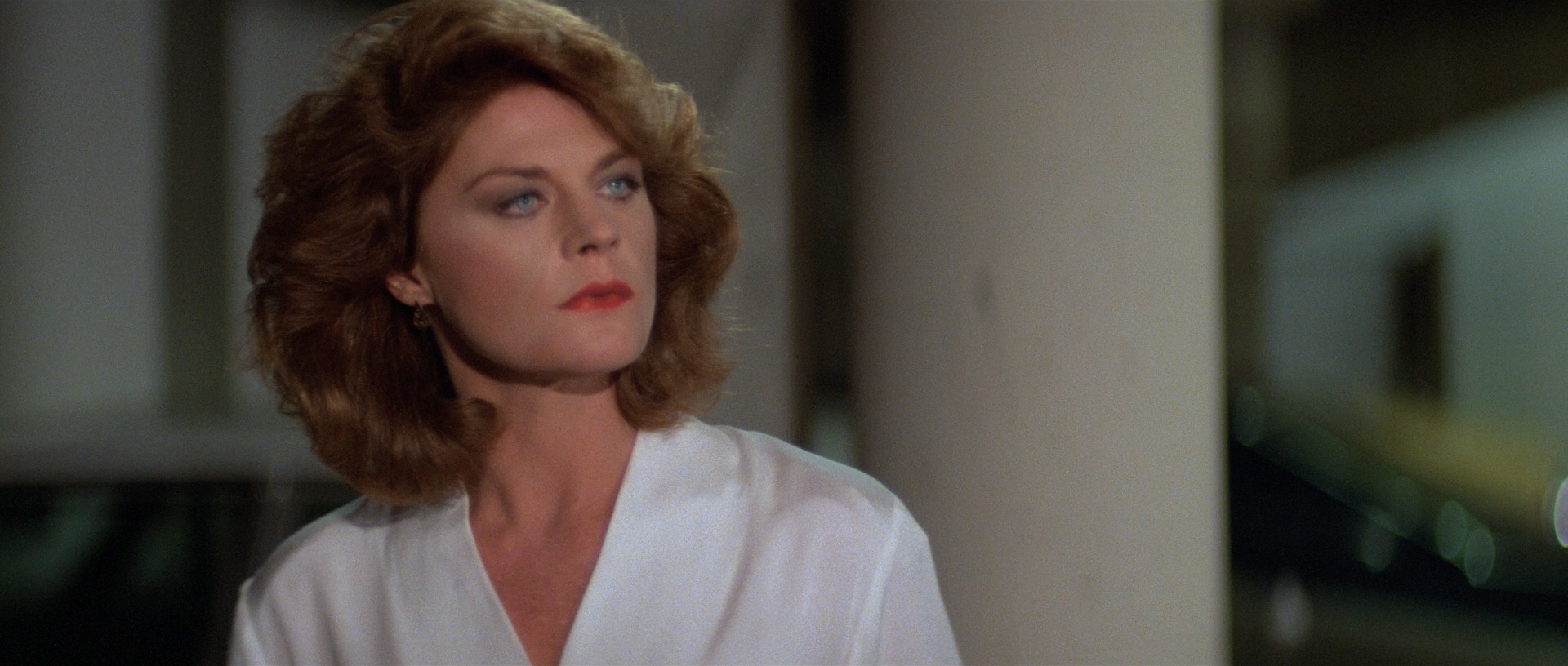
The movie’s plotting from that point is pretty straightforward, even simplistic. Nada joins a small group of resistance fighters who plan to reveal the aliens and shut down their transmitter that’s been broadcasting hypnotic messages through television airwaves. Thus commence some shooting and explosions, on a fairly modest scale. Nada winds up kidnapping an innocent bystander (Meg Foster), whose piercing green eyes almost make her look a little alien even though the special sunglasses say otherwise. In order to get the skeptical Frank to believe his crazy story, the two men engage in a comically prolonged fistfight as hilarious as it is (deliberately?) pointless.
While Carpenter is a skilled craftsman and the execution of all this is both efficient and enjoyable, the genius of They Live is entirely in its concept, which will linger with you long after the specific details of the plot do. This is a story in which the subtext becomes the text, and it’s every bit as timely in the modern era as it was in 1988, perhaps even more so. As Nada learns, the true villains of the piece aren’t just the aliens themselves, but also the short-sighted human collaborators who enable them by happily selling out their own people for the promise of personal gain.
Frankly, with as increasingly divided down class lines (by intentional design) as our society grows every day, I can hardly imagine a future where this movie won’t continue to be relevant.
The Blu-ray and 4K Ultra HD Blu-ray
I bought They Live on 4K Ultra HD Blu-ray as part of a recent Amazon sale. It seemed like an appropriate choice of movie to watch before Halloween. Although I don’t particularly love the artwork on the SteelBook case, at sale pricing that edition was actually cheaper than the version in a standard keepcase.
Shout! Factory (via the Scream Factory label) first released They Live on Blu-ray in 2012. That was followed in 2021 by an upgrade to 4K Ultra HD Blu-ray. The latter also includes a remastered standard Blu-ray.
Unfortunately, my copy of the 4K disc proved to be defective. It freezes up at 45 minutes and won’t continue unless I skip past the entire chapter. I tried cleaning the disc, but doing so made no difference at all. I ultimately had to finish the rest of the movie on the Blu-ray copy.
As it turns out, this particular movie doesn’t have much visual difference between the two formats anyway. The 2.35:1 image is a little soft by 4K standards, but settles nicely into the zone for 1080p. HDR use on the UHD is subtle enough that the movie doesn’t miss much without it. The Blu-ray’s contrast looks perfectly fine. If anything, colors seem slightly stronger on Blu-ray.
I’ll feel no regrets about watching the movie on Blu-ray from now on. It’s just not worth my time to try returning this disc to Amazon and hoping another copy will function any better. The sale price I paid was worth spending for the Blu-ray alone.

Unlike the older Shout! Factory Blu-ray, which only offered the movie’s soundtrack in DTS-HD Master Audio 2.0, both the 4K disc and the remastered Blu-ray upgrade that to Dolby Atmos. The 2.0 track is preserved as well for those who want it, and the 4K disc also has an additional 5.1 option (not on the Blu-ray for some reason).
I’m generally skeptical of Atmos remixes of older movies, which more often than not filter out all the bass and low-end, but this one turned out pretty well. Right off the bat, John Carpenter’s musical score has a surprising amount of bass. The music sounds rich, surrounds are very active, and helicopters fly overhead a few times. On the other hand, gunshots and explosions are a little weak. However, that’s also true of the 2.0 and 5.1 options, and may be endemic to the original sound design.
The 4K disc only has a couple trailers as extras. Everything else is found on the Blu-ray. Items include an audio commentary by John Carpenter and Roddy Piper, interviews from 2012 with Carpenter, Piper, Keith David, and Meg Foster, a retrospective featurette, a vintage making-of piece, extended versions of the fake commercials seen in the film, a trailer, TV spots, and a still gallery.
Related
- Keith David
- Meg Foster
- Alien Takeover Theme
Note: All screenshots on this page were taken from the standard Blu-ray edition of the film and are used for illustration purposes only.
 The Video File Blog
Josh…I think you meant “all-time classic Big Trouble In Little China“.
You should watch that one for your next Film At 11 show…
LikeLike