
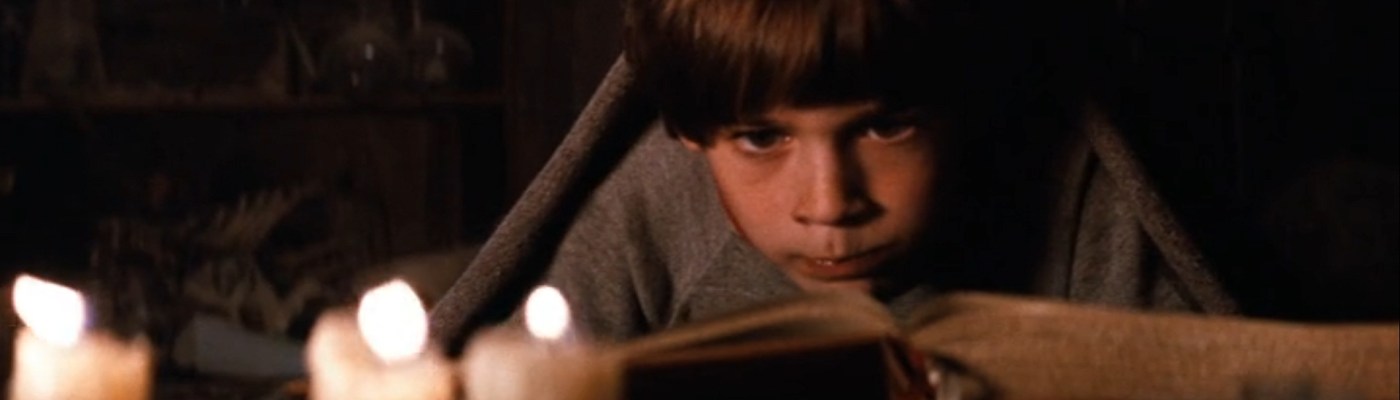
To the best of my recollection, I may have last watched The NeverEnding Story when I was about 11-years-old myself. I recall liking it at the time, but honestly, hadn’t given it much thought in the following four decades. At the prompting of a family friend, I sat down with my own 11-year-old son to review the movie for our Film at 11 podcast and see how well (if at all) this story holds up.
Going into this viewing, I worried that the 1984 animatronic fantasy creatures and other visual effects (not to mention the disco-adjacent Giorgio Moroder score and theme song!) would just seem too cringeworthy forty years later, for both myself as an adult and my son as a modern-day kid raised on CGI spectacle. I wasn’t necessarily wrong about that. Frankly, I think those parts were pretty cheesy even in 1984.
However, what I didn’t remember very clearly is that The NeverEnding Story also has some deeper layers that I may not have picked up as a kid. This is a story about coping with loss and grief, and learning how to avoid being swallowed up by sadness and, worse, apathy. Those aspects still resonate. I can understand why some viewers have really latched onto this movie and still love it.

| Title: | The NeverEnding Story |
| Year of Release: | 1984 |
| Directors: | Wolfgang Petersen |
| Watched On: | Fandango at Home (VUDU) |
| Also Available On: | Blu-ray 4K Ultra HD Blu-ray (Germany & Australia) Tubi Various VOD rental and purchase platforms |
Video Streaming
Warner Home Video released The NeverEnding Story on Blu-ray in the United States back in 2010. I don’t own that disc. European studio Constantin Film remastered the movie in 2021 and released it on 4K Ultra HD Blu-ray in Germany, but only the German version (known as Die Unendliche Geschichte) at that time. More recently, a 4K edition of the English-language version was released in Australia as a very expensive limited collector’s edition, with replica hardcover storybook, from label ViaVision. I don’t have that either, and am not inclined to pay the kind of money it fetches.
For this viewing, I could have watched the movie for free on Tubi, but with forced ads and undoubtedly terrible audio/video quality. I didn’t want to put either myself or my son through that, so I paid a few dollars for a streaming rental from Fandango at Home.
Available in Fandango’s so-called “HDX” format, the movie streams in 1080p high-definition from what I assume is the same source as the 2010 Blu-ray. While it leaves plenty of room for improvement, it looks acceptable enough for one-time viewing needs. The 2.40:1 image has decent sharpness and colors in the “real world” portions of the story, but those in the fantasy kingdom are generally softer with oversaturated reds and oranges that make flesh tones look sunburned and sometimes give Falkor, the white dog-dragon thing, a pinkish hue.
Grain can be a little noisy even in the best-looking scenes, but it really comes in thick and heavy during the many optical effects in the second half. That’s to be expected for a 1984 production. I have no doubt that the remaster probably looks better, but I also suspect that the movie’s photography and visual effects have many limitations that may not be possible to overcome. (I also fear that any new color grading may have been given a teal-and-orange makeover.)
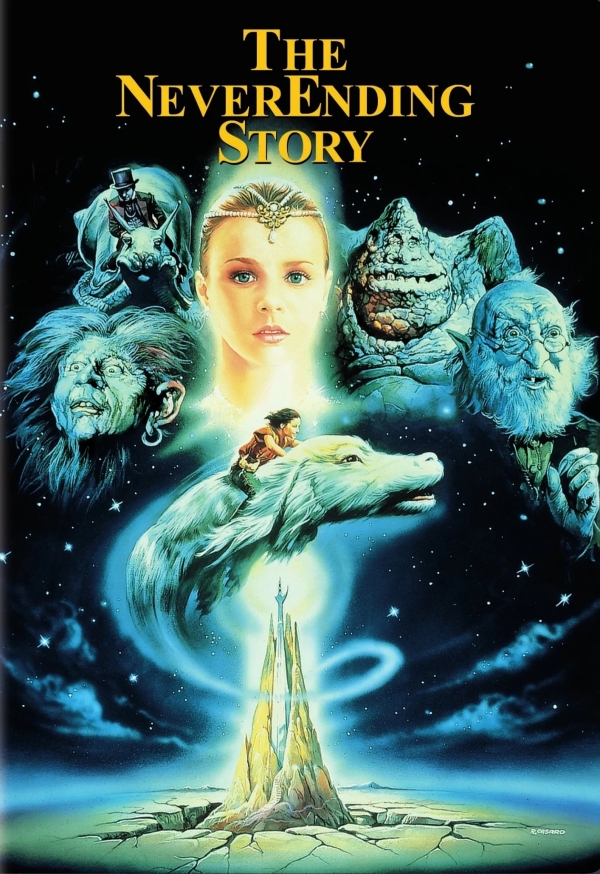
My streaming rental from Fandango played in Dolby Digital 5.1 surround. The opening theme song has some surprising kick, and the soundtrack features many scenes with loud, rumbly bass. This mix seems to have been prepared before the modern trend of compressing dynamic range. It also has some pretty good use of directional effects to the surround channels. Unfortunately, the ADR dubbing of most of the actors (many of whom likely spoke different languages on set) is often distracting.
 The Video File Blog