
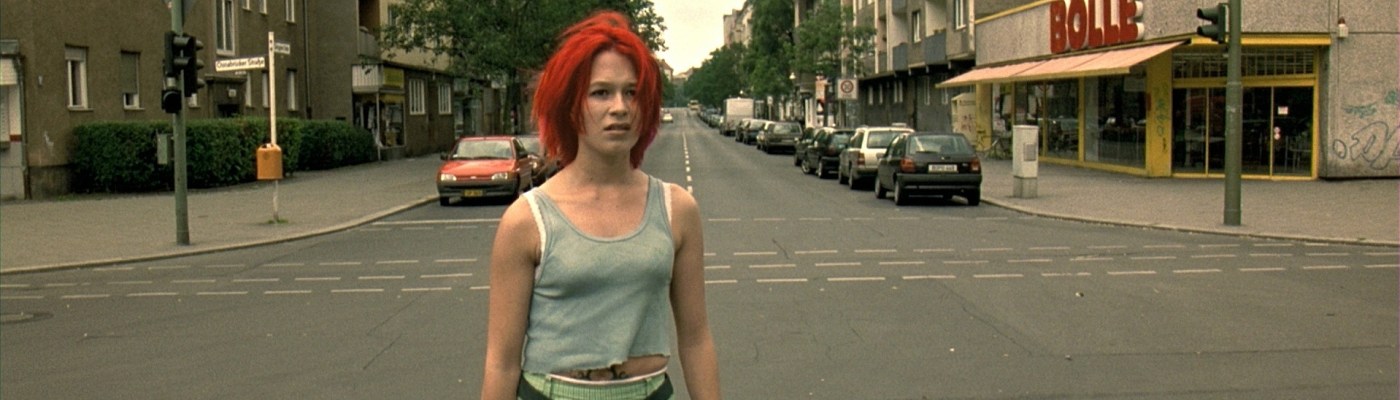
Having come out of film school just a couple years prior, Run Lola Run is exactly the sort of movie I wish I’d been talented and audacious enough to make myself at the time. Thrown together on a shoestring budget with more ambition and nerve than actual filmmaking resources, the movie is equal parts pulse-pounding action thriller and pretentious art film, with enough purely visceral excitement and entertainment value to please mainstream audiences before they notice the philosophical underpinnings sneaking in around the edges.
When it was released back in 1998, Run Lola Run seemed to signal the emergence of both a new auteur in writer/director Tom Tykwer and a new superstar in actress Franka Potente. While both have had reasonably successful careers since then, neither fully capitalized on the promise of their early breakout. Perhaps living up to such a singular work was too difficult a task? Regardless, the film itself still holds up as a pure blast of adrenaline and creativity.
| Title: | Run Lola Run (a.k.a Lola rennt) |
| Year of Release: | 1998 |
| Director: | Tom Tykwer |
| Watched On: | 4K Ultra HD Blu-ray |
| Also Available On: | Blu-ray Various VOD rental and purchase platforms |
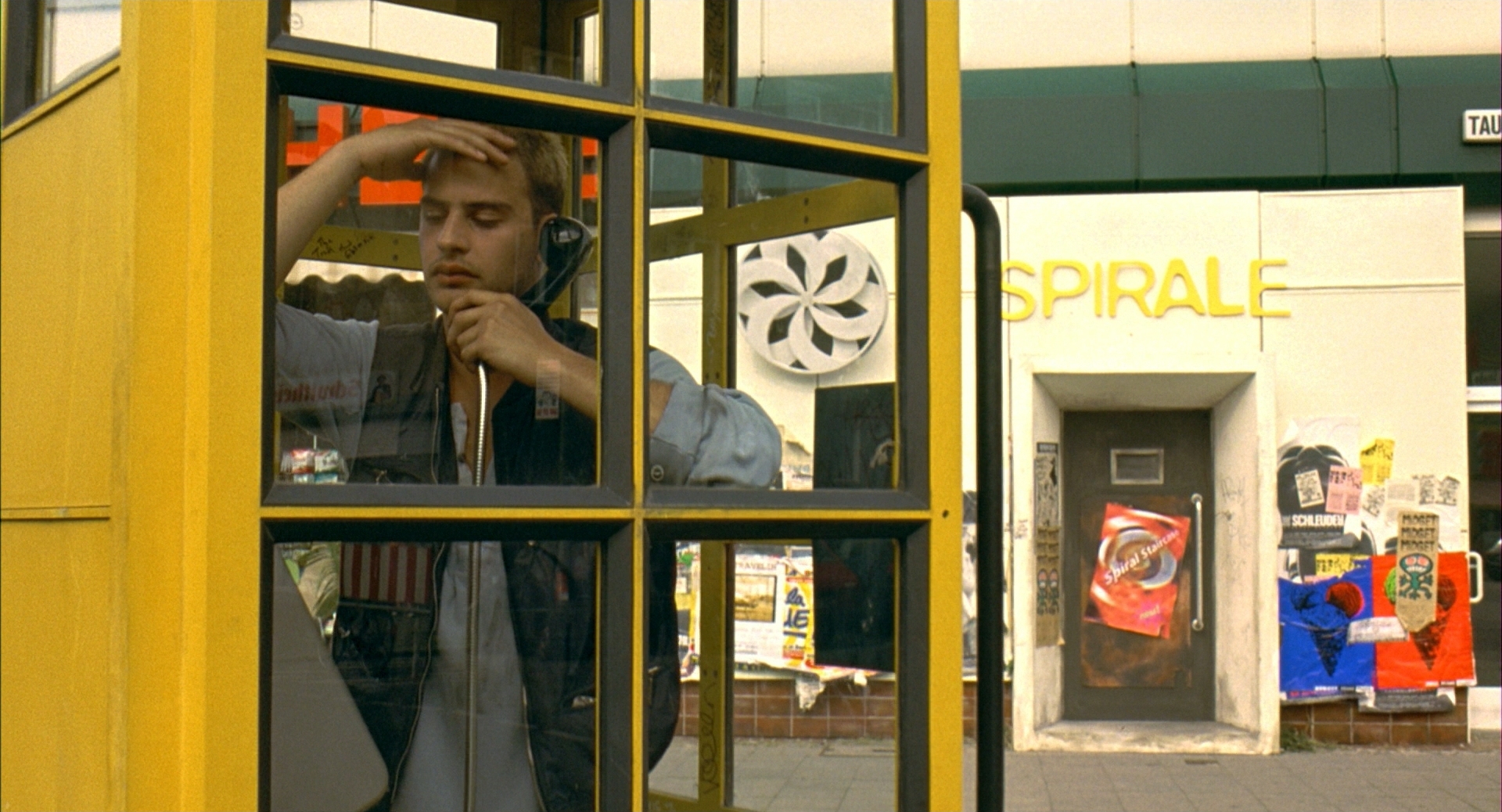
On its surface level, Run Lola Run is a very simple story about a girl (Potente) whose fuck-up of a boyfriend, named Manni (Moritz Bleibtreu), has just made a terrible blunder that he’s certain will result in him being killed if he can’t come up with 100,000 Deutschmarks (this being 1998, before Germany converted to the Euro) in twenty minutes. Needless to say, neither of them has any means of obtaining that much money – frankly ever, much less on short notice. Desperate, Manni contemplates doing something very rash and very stupid. Trying to talk him down, the best Lola can do is convince him to stay where he is until the deadline, and promises that she’ll figure something out and get the money to him before that time runs out.
Her moped having been stolen that same morning, Lola doesn’t even have any way of getting across the city to Manni except to run as fast as she can, stopping briefly to beg her father, a bank manager, for help. Unfortunately, the father is kind of a prick, unsympathetic to Lola’s plight while he’s in the middle of his own personal drama.
That’s basically all there is to the plot. The movie starts off with a moment of panic, upon which Lola immediately dashes out the door and runs… and runs… and runs… trying to get to Manni before something awful happens, hoping blindly that a solution – any solution at all – will present itself on the way. We begin knowing nothing about whom these characters were before this event, and what little we learn is doled out in extremely concise nuggets of information, mostly by way of how they react and what choices they make, moment by moment.
Don’t confuse simple for simplistic. Although Run Lola Run may not have a very elaborate story, it’s told in a highly stylized and extremely complex manner, utilizing multiple film and video formats, dynamic camerawork, and rapid-fire editing so dizzying it may have even given Oliver Stone pause at the time. Like Lola’s journey, the movie is a relentless race from start to finish, full of unexpected surprises that pop up along the way. One particular twist, that I’d forgotten since my last viewing a long time ago, is so hilarious it got me laughing for several solid minutes.
As he’d prove in much of his later work, Tykwer is actually an intellectual filmmaker, not an action movie bro. While Run Lola Run takes the form of a hyper-charged action flick, the director uses that framework to ponder existential thoughts about fate, coincidence, and the consequences of seemingly unimportant choices. Because Lola’s run only lasts twenty minutes, essentially depicted in real-time, Tykwer tells it three times, each with small but important differences that build to different conclusions. Yes, this is a story of alternate timelines, made long before that trope became so overplayed in comic book movies.
Clocking in at a super-tight 80 minutes, the film throws all these ideas (and more!) at you and dares you to keep up with them, wasting no time to debate their meaning or significance. For Tykwer, momentum and kineticism are more than just a means to get the viewer’s blood pumping. They’re narrative tools with form and purpose essential to telling the story.
Potente is magnetic in the lead role. Her movement and expressions convey her character arc even with a minimum of dialogue. She’d go on to co-star with Matt Damon in the blockbuster The Bourne Identity, but then mostly settled into a more sedate career as a character actress. I’ve seen a few of Tom Tykwer’s later movies, and some (not necessarily all) I’ve found fairly interesting, but from what I can tell he hasn’t made anything else half as electrifying as Run Lola Run. Even three decades later, it’s still a dazzling movie, perhaps even better in repeat viewings than the first.

The 4K Ultra HD Blu-ray
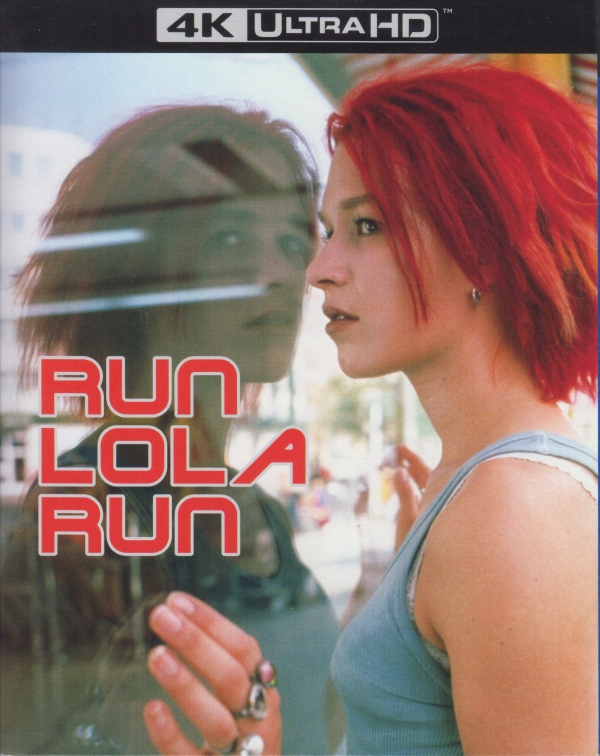
Run Lola Run is a movie that, quite honestly, has no need at all to be in 4K. Yet two 4K Ultra HD copies of it have been released already. The first came in 2022 as part of an 11-film Sony Pictures Classics 30th Anniversary box set. (That’s how I got mine.) In 2024, select titles from that set were broken out and also released separately. As far as I’m aware, the discs themselves are the same. In addition to the outer box, copies from the anniversary set came with slipcovers over each keepcase that I believe the standalone versions didn’t receive. All the movies in the box include only a 4K disc, with no standard Blu-ray for backup.
While primarily shot on 35mm film, Run Lola Run was made in a very run-and-gun fashion on real city streets with handheld cameras racing to keep up with the lead actress. Even the slightly more static interior scenes (brief as they are) have a deliberately gritty and jittery aesthetic. It’s also a mixed-media production, with some color footage, some black-and-white, some animation, and more than a little bit of extremely low-res analog video for reasons motivated entirely by style or mood rather than story. (At no point are we meant to assume the characters are being videotaped.) This is all done with intention, but the movie never really looks to have 4K worth of detail in the photography. Nor does the extremely subtle HDR grading do much for it.
The first Blu-ray edition of Run Lola Run came out back in 2008, still quite early days for that format. In many cases, I’d say that usually leaves room for improvement. However, I still have a copy of that disc, and putting it in for a quick comparison against the 4K, neither version stands out to me as discernibly better or worse than the other. Perhaps the color grading is very slightly different, but the movie is highly stylized with garish colors and pushed contrast (including some clipped highlights) in either case. For the most part, this is an example of a movie being released in 4K for marketing purposes rather than a real technical improvement.

To the best of my knowledge, the DTS-HD Master Audio 5.1 soundtrack is unchanged since the first Blu-ray. The movie has a very aggressive mix, with lots of immersive surround activity, including a couple helicopter flyovers that upmix well to height speakers if decoded with Dolby Surround Upmixer. On the other hand, it’d been a while since I last watched the movie, and I remembered it having a much bassier thumping beat in the techno music score. In this viewing, bass action seemed a lot lighter than I expected, but I put in the old Blu-ray and got the same result, so maybe it was always this way and my memories were exaggerated.
The 4K disc has a clunky menu system that seems to be Sony’s default layout for the format. Bonus features start with two audio commentaries by director Tom Tykwer, one featuring editor Mathilde Bonnefoy and the other star Franka Potente. After that are a 40-minute making-of documentary, a 17-minute retrospective featurette from the film’s 10th anniversary in 2008, a very cheesy music video in which Franka Potente tries to be a pop star, and a trailer.
Note: Screenshots on this page were taken from the 2008 Blu-ray edition of the film and are used for illustration purposes only.
 The Video File Blog