

For a movie nerd who’d only recently come of age and started young adulthood at that moment, the early- to mid-1990s were a very exciting time in cinema. The independent film movement was flourishing, and even within traditional Hollywood circles, a new generation of writers and directors were rising up to make their voices heard. Bridging the gap between these two ends were emerging filmmakers such as Robert Rodriguez, whose first major studio feature, 1995’s Desperado, brought an indie D-I-Y sensibility to perhaps the most mainstream of genres – the shoot-’em-up action movie.
In retrospect, some of my memories about how Desperado was received at the time may be suspect. I remember it as a huge smash hit that everyone was raving about, but looking up some of those details now, it seems that established critics of the day were lukewarm to negative on the film, and its box office (while certainly profitable compared to its budget) was fairly moderate.
Nevertheless, to those members of the audience properly tuned into it, the movie was a really big deal. Its success, however modest, was inspirational to waves of hopeful young filmmakers convinced that anyone with the right amount of talent could hit the big time like Rodriguez had. As it turns out, that’s still rarely the way Hollywood works.
| Title: | Desperado |
| Year of Release: | 1995 |
| Director: | Robert Rodriguez |
| Watched On: | 4K Ultra HD Blu-ray |
| Also Available On: | Blu-ray Various VOD rental and purchase platforms |
Two years prior, Robert Rodriguez made a splashy debut with his micro-budget action flick El Mariachi, which defied all odds and got picked up by Columbia Pictures for distribution, where it built tons of buzz in the festival circuit and limited release. According to Guinness, it set a record (which I believe it still holds) for being the lowest-budget film to gross more than $1 million at the box office. The director having proven his worth, the studio quickly signed him for a follow-up feature to be made with proper Hollywood resources.
Originally, the project was to be an English-language remake of El Mariachi. At some point, a decision was made to turn it into a sequel instead. Eventually given the title Desperado, the final product turned out to be a little bit of both. The film acknowledges and recaps some of the events of El Mariachi, but also winds up telling a pretty similar story. If that seems like it would be redundant for viewers who’ve seen both, nobody gave a damn because Desperado is unquestionably a way better movie than El Mariachi ever was. Simply, Desperado is the movie El Mariachi wanted to be.
Budgeted at $7 million USD, the sequel cost literally a thousand times more to make than the original had, but was still a very meager production by Hollywood standards. To stretch each one of those dollars as far as it would go, Rodriguez put every cost-saving technique and bit of ingenuity he’d used on El Mariachi to work again, resulting in a $7 million movie that looks ten times as expensive.
Where El Mariachi was essentially a homemade student film, Desperado is a proper theatrical feature in every respect, with professional actors and good-looking production values. Antonio Banderas takes over the lead role as a traveling musician who comes to an impoverished Mexican town and wages war against a local drug kingpin, here named Bucho (Joaquim de Almeida from the previous year’s blockbuster Clear and Present Danger). In this version, the mariachi wants revenge for what happened to him in the first movie, but those details are quickly summarized and only amount to a convenient excuse for tons of gunplay, fighting, and over-the-top violence. The shooting starts early and rarely lets up for the rest of the movie’s brisk 104-minute length.

Banderas, a Spanish star who’d worked quite a bit with Pedro Almodóvar in titles like Women on the Verge of a Nervous Breakdown and Tie Me Up! Tie Me Down!, had made some small inroads into Hollywood in movies such as The Mambo Kings and Interview with the Vampire, but was still little known to most American viewers at the time. This was his first English-language headlining role, and the actor brought the full force of his charisma to it. He’s absolutely magnetic on screen, both in the intensity of his performance and the playful physicality he brings to the action scenes. Desperado deservedly propelled him straight to much bigger stardom.
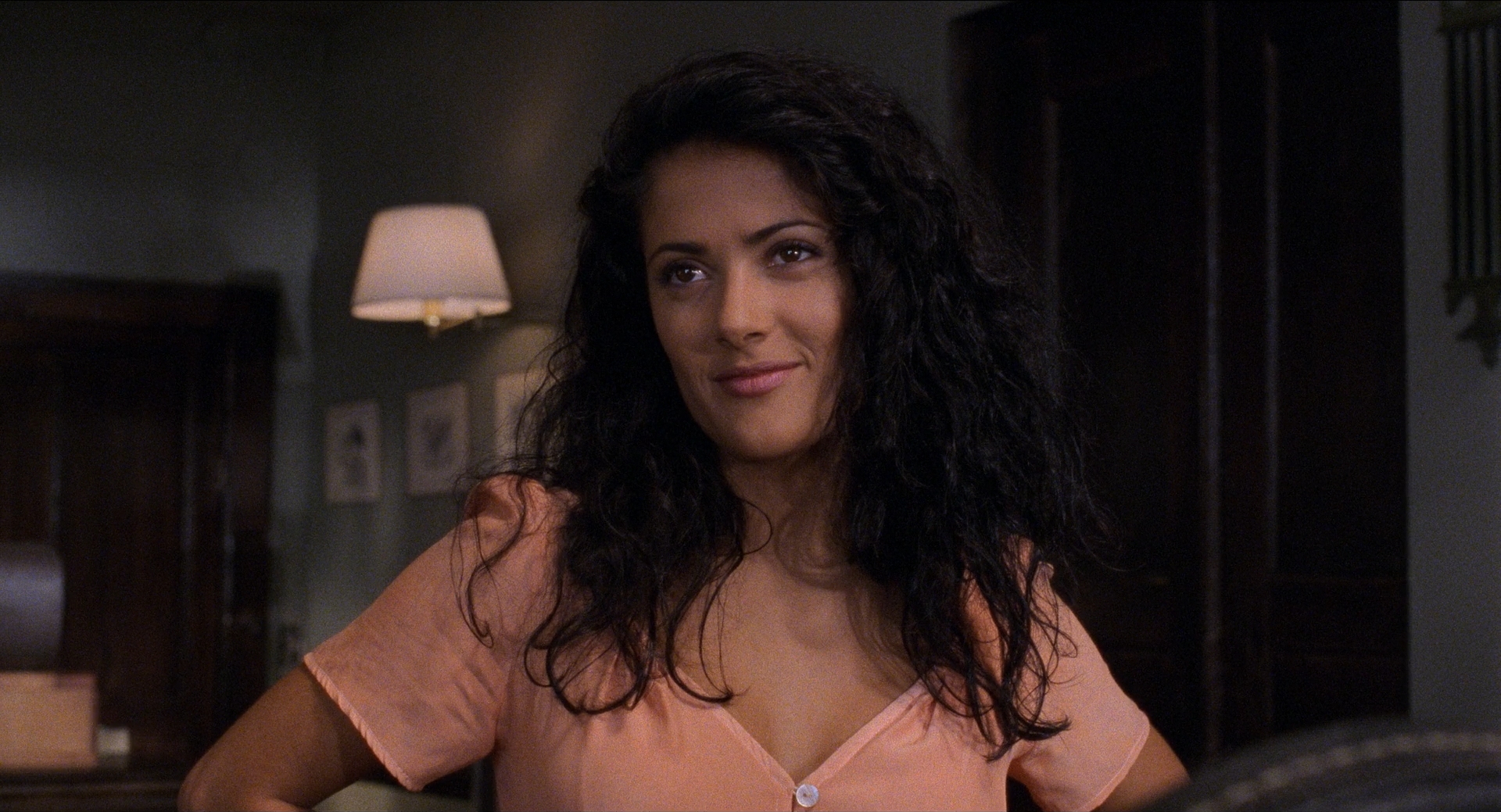
Also delivering her own star-making turn is a former Mexican soap opera actress by the name of Salma Hayek, playing the mariachi’s love interest. Both actors were (arguably) at the peak of their physical attractiveness in this movie, and their chemistry together is explosive. Hayek of course would also achieve her own enormous fame and success, including an Oscar nomination in 2003.
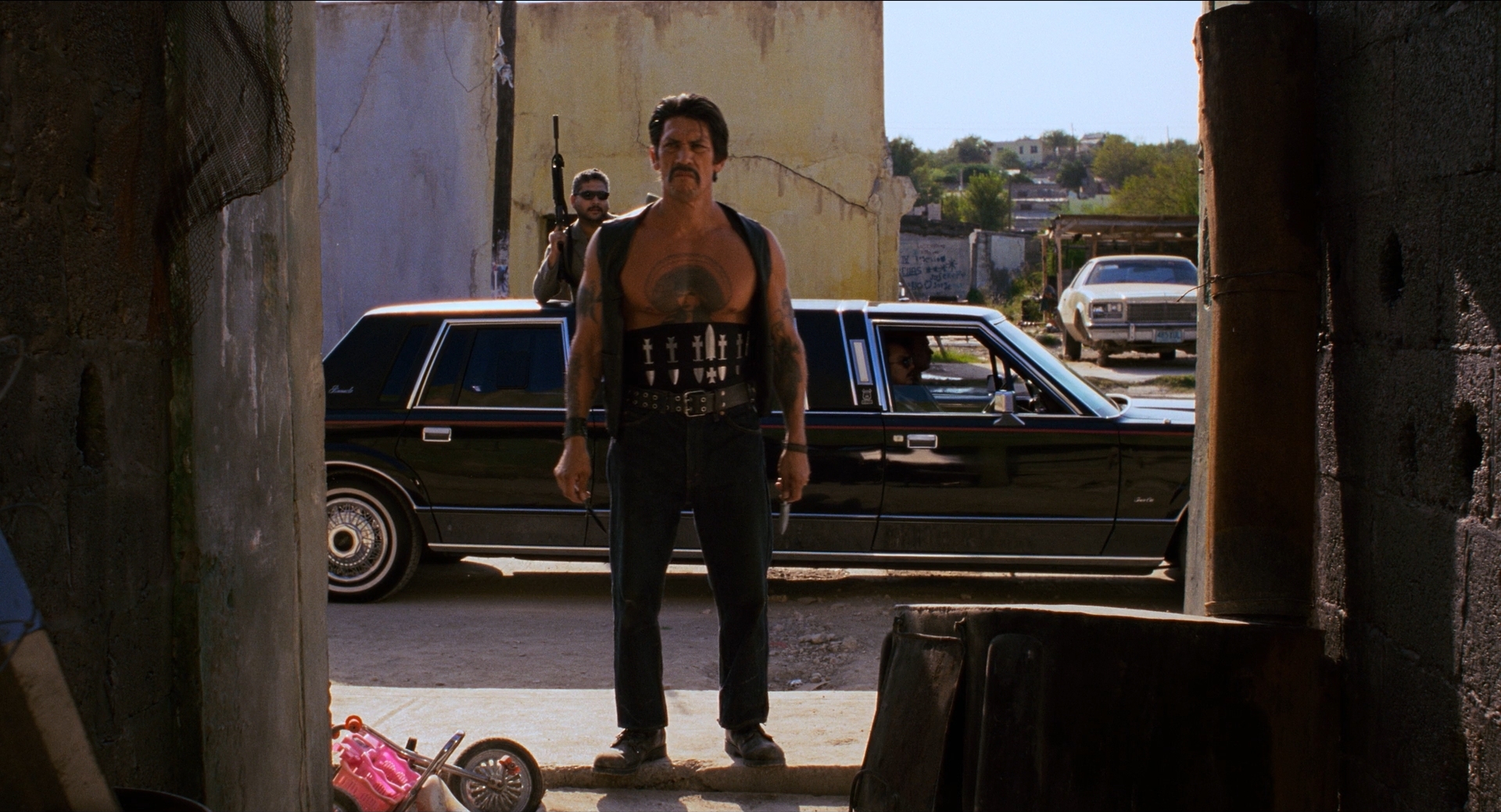
Lending further support are amusing cameos by Steve Buscemi, Cheech Marin, and Quentin Tarantino, as well as a brief but very memorable appearance by Danny Trejo as a dagger-tossing assassin with just about the meanest scowl you’ll ever see.
Behind the camera, the real star of Desperado is Robert Rodriguez himself. Still working with just a fraction the budget of what any comparable production would get, the director managed to assemble a super-fun action movie overflowing with inventive and kinetic stunt set-pieces that would make John Woo proud, skillfully interwoven with plenty of genuinely funny comic relief.
Rodriguez would go on to a very prolific career, often working with much larger budgets than this. Even so, for my money (no pun intended there), Desperado remains his most perfectly realized movie. To be honest about it, unfortunately, little of his later work lives up to the promise he showed here.
As I said earlier, I remembered Desperado being a bigger hit than it actually was. From what I can find, the film grossed about $25 million in North America, which may have been a very tidy return on investment for the budget, but was hardly blockbuster money. Regardless, it proved very important and influential for a lot of people, and would become a popular home video staple on every media format to come down the pike. I can hardly count the number of times I’ve watched the movie since that first theatrical screening, and I’ll continue to enjoy it immensely no matter how many more times I do so in the future.
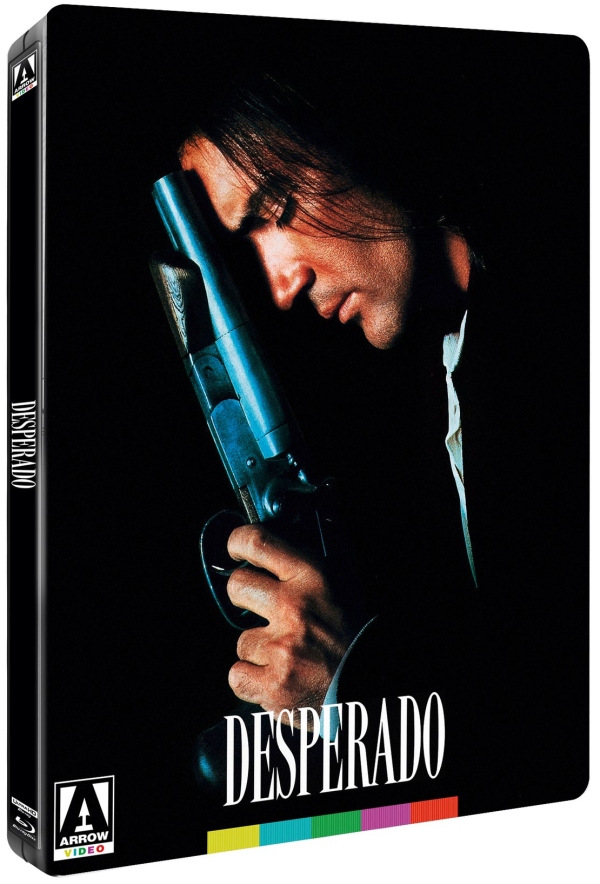
The 4K Ultra HD Blu-ray
Desperado first came to Blu-ray back in 2011 as part of a Double Feature with its predecessor, El Mariachi, stamped onto the same disc. Sony later released a standalone copy of just Desperado a few years later. The license for the franchise currently resides with Arrow Video, which released a box set called the Mexico Trilogy in 2024, containing a newly remastered 4K Ultra HD edition of Desperado along with regular Blu-ray copies for the first film (El Mariachi) and third (Once Upon a Time in Mexico). If that sounds like a strange configuration, know that Desperado is the only of the three movies shot on 35mm film and has much better photography and production values than either of the others.
I saw Once Upon a Time in Mexico in the theater in 2003, and that was more than enough of that one for a lifetime. I have no interest in ever watching it again or owning it on physical media. I also already had that original Double Feature Blu-ray in my collection, which I still find a serviceable enough way to watch El Mariachi. Fortunately, Arrow saw fit to issue a standalone 4K Ultra HD Blu-ray for Desperado in its own, rather handsome SteelBook. I happily bought that copy.
The 2011 Blu-ray for Desperado looked pretty good, all things considered, especially by the standards of the time. According to the notes in the included booklet, the film’s new 4K master was provided by Sony. It definitely offers an upgrade, though perhaps not dramatically so.
First, comparing Arrow’s 2024 Blu-ray against the Sony 2011 Blu-ray, the two discs look very similar in many respects. The Arrow copy is a small bit sharper and more detailed, with better resolution of background grain. Without the burden of being crammed onto a double-feature disc, the compression and encoding appear more stable. The color grading is also brighter in mid-tones. These are welcome improvements, but the 2011 Sony disc is far from unwatchable. The larger your screen, the more the differences will be noticeable.
(Note: I don’t have the ability to take 4K HDR screenshots, so the following comparison is for Blu-ray against Blu-ray. Click the links in the caption to expand the images to full size.)
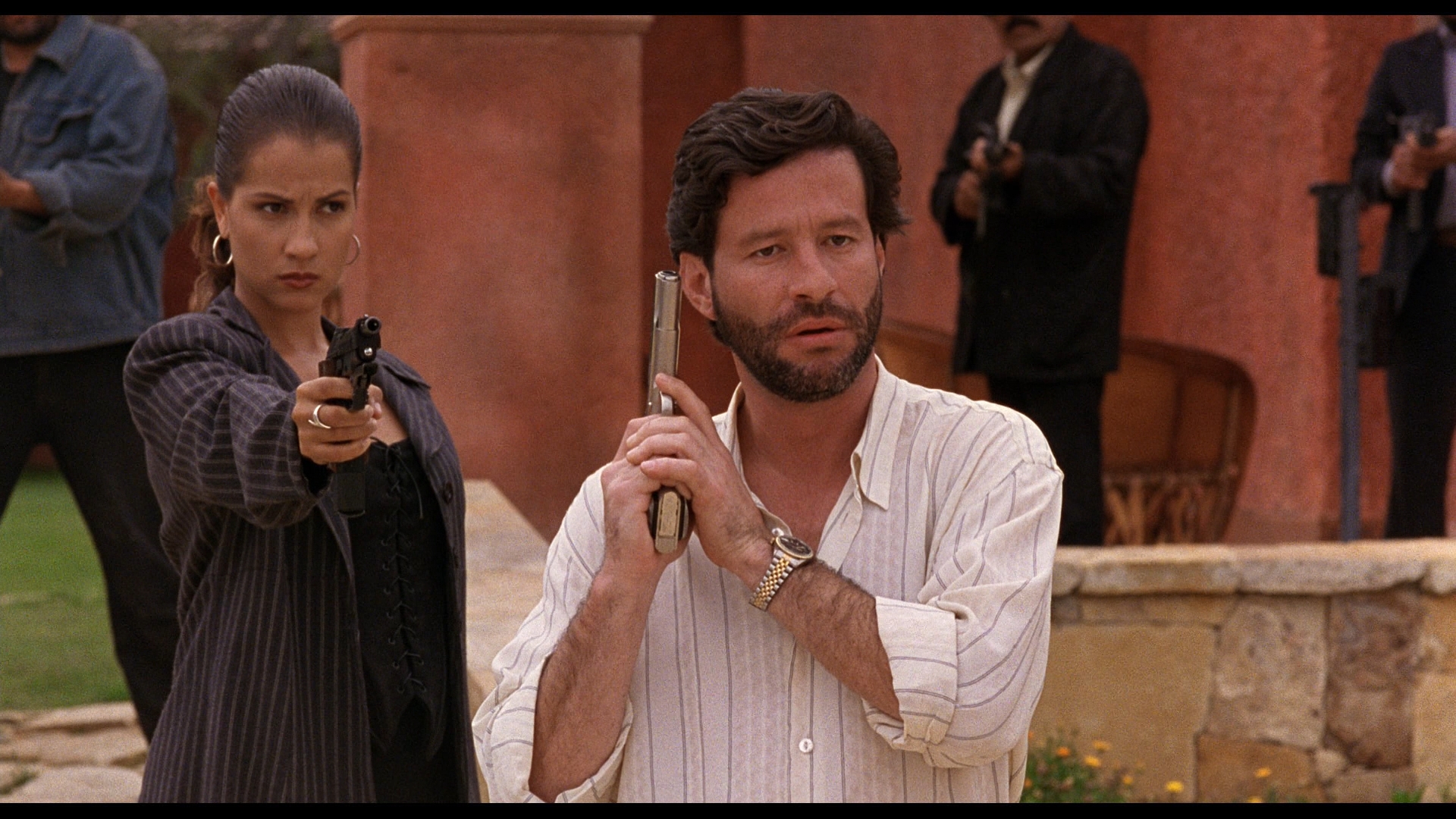

Moving up to 4K Ultra HD brings another small boost in detail. Far too many 4K remasters of 35mm film wind up over-exaggerating grain, and I feared that might turn out to be the case here, but grain remains well-handled even in 4K. With HDR grading, the 1.85:1 image has deeper, richer colors and contrast. If I have any complaint, I think the HDR may be a little too strong. Dark parts of the frame often seem too dark, losing detail in shadows or the Mariachi’s black outfit. However, generally speaking, this isn’t too serious a problem. The 4K disc is very appealing on my projection screen.
Back in 1995, Desperado played in theaters in either Dolby Stereo or SDDS sound formats. The 8-channel SDDS was a short-lived market failure and has never had a home video equivalent, but typically translates to 5.1 pretty well. Arrow offers both DTS-HD Master Audio 5.1 or PCM 2.0 sound options. The disc prioritizes 5.1, and that was my default for this viewing.
I saw Desperado in the theater in 1995, I believe more than once. I don’t recall which sound format the theater(s) used, probably Dolby Stereo. What I very vividly remember is the massive, booming sound of the gunfire thundering through the cinema auditorium. It was quite an experience.
Desperado has always had an incredible sound mix in any format. The film comes from that period during the 1990s where Hollywood sound mixers wanted their action movies to be loud and bombastic, with hyper-aggressive surround activity, and bass viewers could feel in their chests. The Ultra HD disc’s 5.1 audio conveys that very nicely. Gunshots are powerful, as they should be. Even without Atmos, the surround channels light up with pinpoint directionality, and sounds regularly matrix to the height speakers with Dolby Surround Upmixer decoding. Meanwhile, the music and songs are conveyed with pleasing fidelity.
I sampled the PCM 2.0 briefly. That sounds fairly decent as well, but doesn’t have quite as much punch. The 5.1 track is more like what I remember from seeing this movie theatrically. That LFE channel really makes a difference.
Extras start with two booklet essays, by critic Carlos Aguilar and film journalist Nicholas Clement, respectively. All other features are duplicated on both the 4K and Blu-ray discs. Carried over from way back in the Laserdisc days is a 1996 audio commentary by director Robert Rodriguez. Only slightly newer than that (originating on DVD around 1998) are an entry in Rodriguez’s Ten Minute Film School series, a couple trailers, and a TV spot. (The teaser trailer is still fantastic.)
New to Arrow are 2024 interviews with Robert Rodriguez, producer Bill Borden, stunt coordinator Steve Davison, and special effects coordinator Bob Shelley, plus an appreciation by filmmaker Gareth Evans (The Raid) and a textless version of the opening credits sequence.
Related
- Mariachi franchise
- Robert Rodriguez (as producer)
- Antonio Banderas
- Steve Buscemi
- Quentin Tarantino
Note: Except where otherwise noted, screenshots on this page were taken from the 2024 Blu-ray edition of the film and are used for illustration purposes only.
 The Video File Blog