
As a longtime movie collector with many hundreds of Blu-rays and 4K and DVD discs (and even still some Laserdiscs!) cluttering my shelves, the films of John Huston have a special place of honor in my collection. Not only was Huston a masterful director from Hollywood’s golden age who made a number of revered classics – his 1941 detective noir The Maltese Falcon prominent among them – the man himself actually spent time in my home theater room.
How many fans can claim a personal connection like? Not many I’d reckon, though I suppose you never know. The guy did get around a bit in his day.

| Title: | The Maltese Falcon |
| Year of Release: | 1941 |
| Director: | John Huston |
| Watched On: | Fandango at Home (formerly VUDU) |
| Also Available On: | 4K Ultra HD Blu-ray Blu-ray Various VOD rental and purchase platforms |
Of course, it wasn’t a home theater at the time. Nor did I own the house. I never met John Huston myself, sadly. I was still a child when he died in 1987, and lived a few states away. However, decades later, when I purchased the house, I learned that the prior owner (then deceased) had Hollywood connections and had worked on Huston’s 1982 adaptation of the musical Annie. She and Huston had been close friends, and I was told by members of her estate that the filmmaker had spent many evenings drinking liquor and smoking cigars in her basement rec room.
Remodeling that basement into a home theater and home office space was my first order of business upon buying the house, so it has no vestiges of the former decor left, but I often like to tell friends the story of how the desk where I sit to write my reviews and articles resides in a spot (previously a bar area) that John Huston often frequented, sometimes accompanied by other celebrity pals.
Somehow, The Maltese Falcon is the first John Huston movie I’ve reviewed since founding this site. I felt it relevant (if only to myself) to start by sharing that anecdote here. The film itself, as everyone surely knows, is one of the great masterpieces of 1940s cinema. I love it immensely for numerous reasons, but doubt I have any great insight about it that hasn’t been analyzed and discussed endlessly by others over the decades.
Technically a remake, Huston’s film was the third screen adaptation of a novel by mystery author Dashiell Hammett, following a mostly-forgotten movie from 1931 that had to be removed from circulation due to enforcement of the oppressive Hays Code, and a comedic take called Satan Met a Lady that was released in 1936 to disastrous results.
The story follows Sam Spade (Humphrey Bogart), a private detective working in San Francisco who, upon taking a job initially presented as a simple matter of rescuing a young girl from her supposedly dangerous boyfriend, eventually becomes embroiled in a much more complicated plot to locate a priceless historical artifact. The original client (Mary Astor) proves to be not quite whom or what she pretended, and the case involves countless crosses and double-crosses at every turn. Other scheming players Spade must navigate include Sydney Greenstreet as the wealthy magnate who desperately desires the little statuette, and his henchmen, one for muscle (Elisha Cook, Jr.) and the other simply a conniving weasel (the great Peter Lorre).
Despite the story’s over-exposure in popular culture by that point, Huston’s version of The Maltese Falcon was both a big box office hit and praised by critics, earning Oscar nominations for Best Picture, Screenplay, and Greenstreet’s supporting turn. Released the same year as the also-successful High Sierra, the pair of films marked Bogart’s transition from a mostly B-movie actor to one of the biggest stars in show business. Huston, who’d written both pictures and made such a strong directorial debut with Falcon, actually left Hollywood for a few years afterward to make films for the Army Signal Corps during World War II. He’d return later with another classic, The Treasure of the Sierra Madre, which would catapult him to the top of the industry ladder.
As great a film as The Maltese Falcon may be, I must acknowledge that it is an artifact itself, from a very different era in cinema that held little pretense of realism. Movies at the time were meant to be seen as larger than life, both in storytelling and performances. In form a melodrama, characters rattle out their dialogue at a delirious pace that defies a viewer to keep up, and enunciate their words with authority and force, like theater actors projecting their voices to the rafters.
Their actions and behaviors rarely resemble those of real-life human beings. The cold-hearted Spade barely flinches when his partner is murdered, and wastes no time changing all the signage in their office the next morning. He and Astor’s character regularly proclaim love for each other, neither one meaning anything they say nor believing a word from the other’s mouth. Even though the relationship was more explicitly sexual in both the book and the earlier adaptation, their love story is a deliberate contrivance from both sides, totally lacking any feeling or meant to be convincing – to the point that one must wonder why they’d even bother with the charade.
Qualities like these may prove jarring for younger viewers accustomed to a more naturalistic style of acting in modern movies (which, frankly, can be equally unrealistic in different ways). I’ve witnessed this happen, and can understand the reaction, even if I don’t share it. The rhythm at which classic films like this move is an aesthetic choice that may take some getting used to.
Likewise, the plotting in The Maltese Falcon is a sometimes dizzying series of twists and counter-twists that don’t always seem to make much logical sense. While not as incoherent as certain parts of The Big Sleep can be, even having seen it multiple times before, I still have little idea what purpose the fake story about the missing sister serves anyone, beyond an excuse for Sam Spade to jump into the case and foil everyone else’s plans. All the other characters would be better off if they’d never involved Spade at all.
The story of The Maltese Falcon (both film and original book) is heavily reliant on metaphor. Famously, the bird statue itself is one of cinema’s greatest MacGuffins, an object that does nothing and holds no actual value beyond instigating the plot. To that end, Sydney Greenstreet makes a marvelous villain, a pure embodiment of corpulent Capitalist greed. The man already has wealth beyond measure that he doesn’t know what to do with, and is clearly aging and in poor physical condition. The statue will do nothing for him. He has no need for it at all – except that it’s a thing no one else can have, so therefore he must have it, no matter the cost. Lacking any trace of morality, human life means nothing to him – whereas winning this game, proving that nothing is beyond his power or grasp, means everything.
In that regard, this eighty-plus-year-old movie is as timely as it ever was, with clear relevance to our modern day.

The 4K Ultra HD Digital Copy
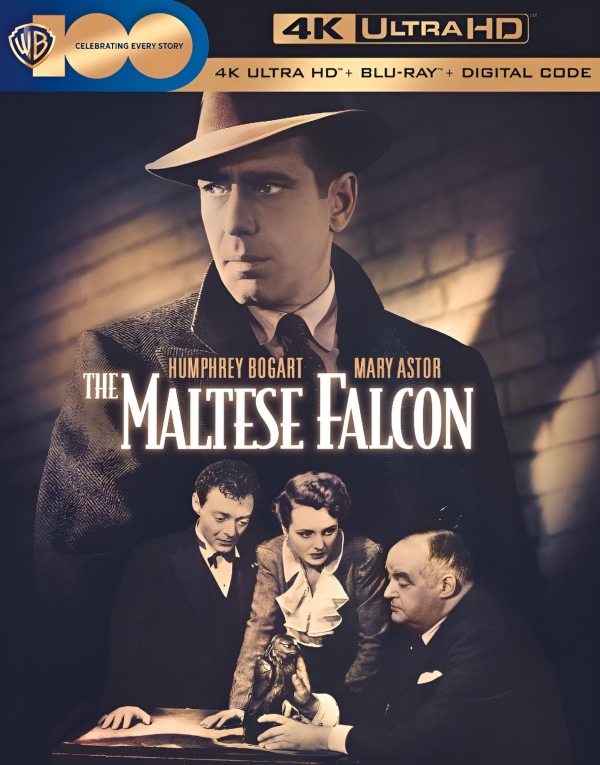
The Maltese Falcon was released on Blu-ray in 2010, and was remastered for 4K Ultra HD Blu-ray in 2023. I purchased a copy of the latter not long after release, but had let it sit unwatched for a while. I finally got an urge to watch the movie recently, only for the disc to glitch-out and totally fail playback after about eight minutes. Cleaning the disc and resetting my player made no improvement despite multiple attempts. This copy is toast, and I bought it long enough ago that exchanging it likely isn’t an option anymore.
Unfortunately, the accompanying Blu-ray in the case is a copy of the older edition from 2010 and – although respectable enough for the time it was released – doesn’t look nearly as good as the new master. To finish the movie, I wound up streaming the provided Digital Copy in 4K from Fandango at Home (which, dammit, I stubbornly still want to call VUDU). The 4K stream looks better than the Blu-ray, but appears visibly more compressed than what I was able to watch of the UHD disc, with less sharply resolved detail or film grain. That’s extremely frustrating, because the 4K master looks just about as good as a movie from 1941 could be expected to look.
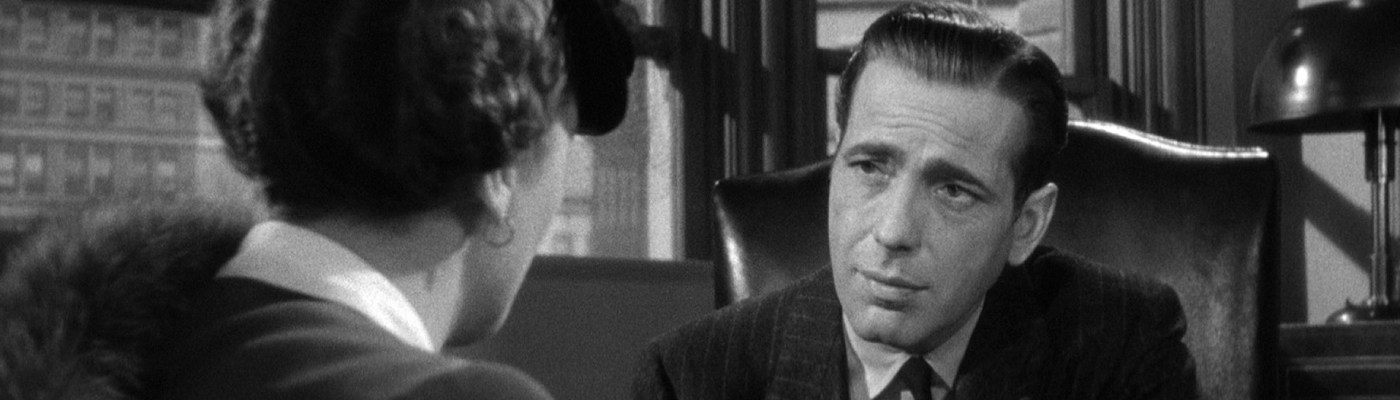
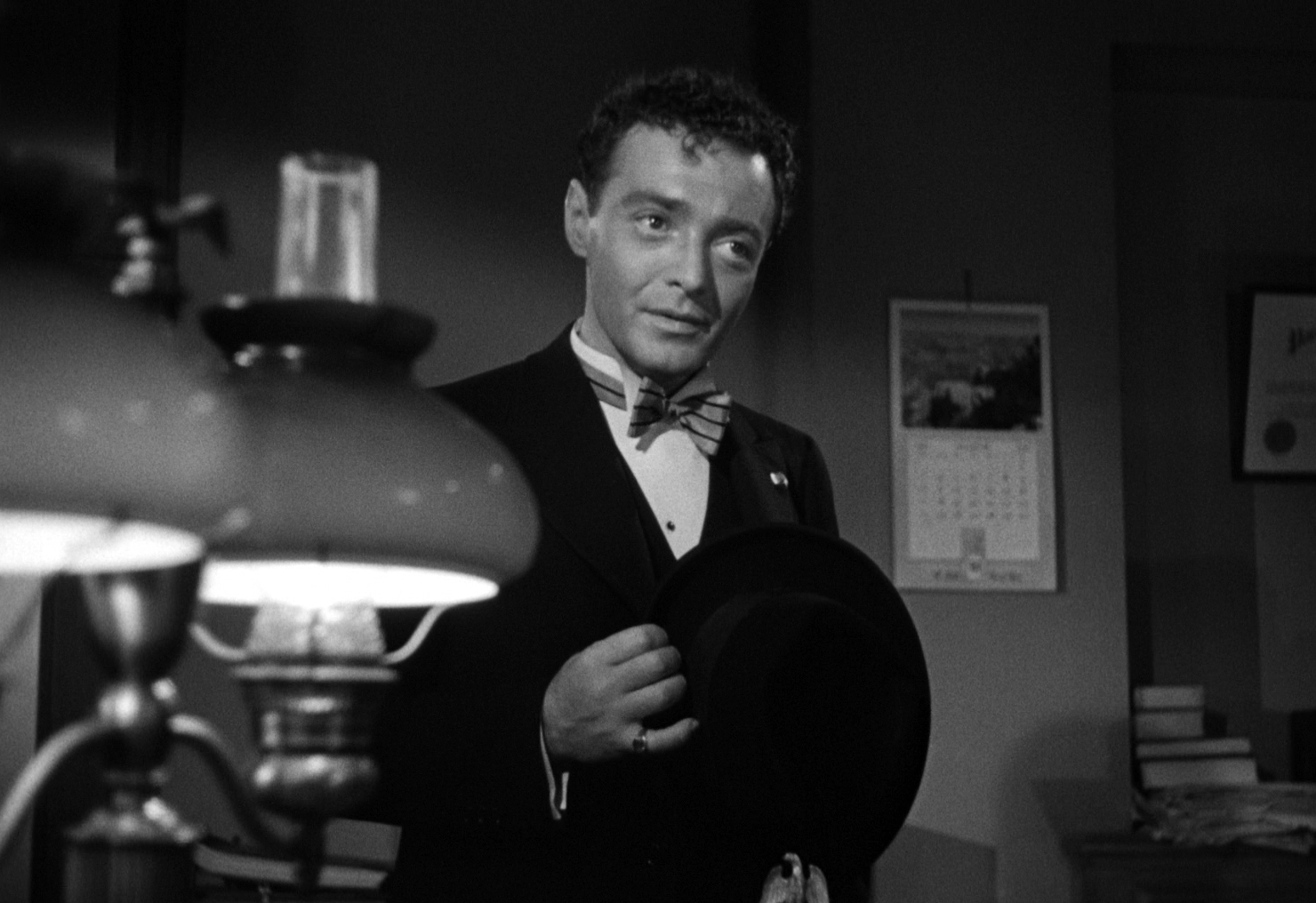
Cameras and film stocks from that era often captured less than 4K worth of detail, but the 4K scan and master for The Maltese Falcon look decidedly better than the old Blu-ray. The credit and prologue text is crisper, newspaper props are more clearly readable, and grain texture is more consistent. Aside from some occasional opticals that are softer than the footage around them, the 1.37:1 black-and-white image is quite vivid and striking. Gray scale is just about perfect, and the overall contrast range is richer in HDR.
Again, however, I really wish I could have finished the disc, because all of these qualities are slightly heightened on physical media compared to streaming.
Meanwhile, the 2.0 mono soundtrack (DTS-HD Master Audio on the disc, Dolby Digital Plus on streaming) sounds roughly equivalent on either format. Dialogue is clear, but the music’s a little thin and sound effects such as Bogart’s punches are weak. Sound recording and mixing in 1941 had their limitations, and I don’t know how aggressively the studio may have filtered the track in an effort to reduce hiss and crackle (which are still sometimes audible, if barely so).
The 4K disc has an audio commentary by Bogart biographer Eric Lax. The Blu-ray also offers three vintage audio-only adaptations of the Maltese Falcon story, a half-hour documentary, a blooper reel, makeup tests, a selection of Bogart trailers, and a “Warner Night at the Movies” collection featuring a newsreel, a musical short, classic cartoons, and other relevant trailers. Disappointingly, aside from one Porky Pig cartoon, most of those are in standard-definition video.
Related
- A Walkthrough Tour of the Cinema Zyberdiso
- John Huston (director)
- Dashiell Hammett (writer)
Note: All screenshots on this page were taken from the Blu-ray edition of the film and are used for illustration purposes only.
 The Video File Blog