

Upon its belated release in this market in 2004, Zhang Yimou’s Hero set a milestone as the first foreign-language film to open at the top of the American box office. That achievement was notable in a few respects, not least of which is that the movie was already two-years-old by that point and a good chunk of the fans who trekked out to see it in theaters probably already owned copies of it on DVD.
Admittedly, as a late August release, Hero didn’t face very stiff competition that weekend. (The biggest movie opening against it was the junky sequel Anacondas: The Hunt for the Blood Orchid.) Its box office victory was also arguably manipulated by a misleading ad campaign from distributor Miramax that tried to disguise the film’s subtitled dialogue – a fact that angered many patrons and caused theaters across the country to install “No Refunds Will Be Offered” signs in their lobbies. Consequently, its earnings dropped off precipitously in the following weeks. Nevertheless, Hero was a sizable crossover hit with both martial arts genre fans and foreign art film connoisseurs.
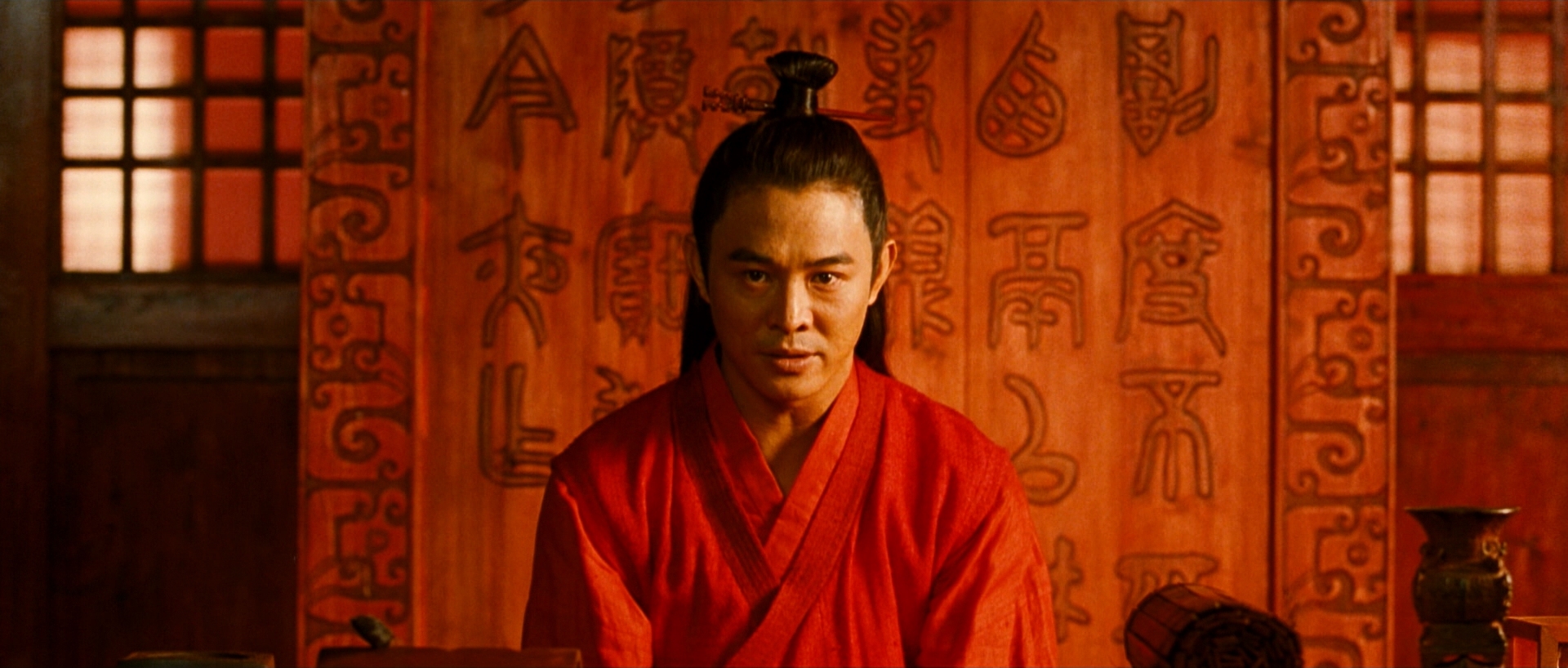
| Title: | Hero (a.k.a. Ying xiong or 英雄) |
| Year of Release: | 2002 |
| Director: | Zhang Yimou |
| Watched On: | Imprint Limited Edition Blu-ray (Australia) |
| Also Available On: | DVD Kanopy Various VOD rental and purchase platforms |
Due to a host of similarities, Hero has often been compared, usually favorably, to Ang Lee’s Crouching Tiger, Hidden Dragon. Certainly, this film would not exist at all if not for that global sensation from 2000, which gave license for another critically-lauded director known for smaller-scale dramatic work (Zhang’s Ju Dou and Raise the Red Lantern had been nominated for Best Foreign-Language Film Oscars) to dabble in a historical wuxia epic. Both movies also feature breakout actress Zhang Ziyi playing largely similar characters.
For his part, Zhang stepped up his game and brought the full force of his craftsmanship and artistry to bear on the project. Working with acclaimed cinematographer Christopher Doyle (Ashes of Time, In the Mood for Love), Hero is an exceptionally beautiful movie filled with countless arresting images. With a cast of genre veterans including Jet Li, Donnie Yen, and Maggie Cheung, it’s a more intensely action-focused film than Crouching Tiger, with a greater volume of swordplay and impossible kung-fu acrobatics packed into its tighter running time. The filmmaker also marries these qualities to a narratively ambitious and complex script that tells multiple versions of the same story from differing perspectives in a Rashomon style.
I’ve reviewed Hero as a movie a few times before, on DVD and Blu-ray (linked at the end of this article), and don’t want to repeat all that work again here in what will end up being another lengthy article for other reasons. Revisiting it now for the first time in a while, I still love the film, but have to admit that I think the overly-convoluted storytelling that repeatedly folds back onto itself and contradicts previous events ultimately works to its disadvantage, preventing viewers from ever developing attachments to the characters or getting a firm grasp on the plot. Several of the story threads prove redundant, if not completely pointless to the final outcome. No matter how many times I’ve watched it, I still have no idea what purpose the lake battle between Nameless (Jet Li) and Broken Sword (Tony Leung Chiu-wai) is supposed to serve, other than to look pretty on camera – which it absolutely does!
To my Western sensibilities, I think Crouching Tiger, Hidden Dragon pulls off a more satisfying fusion of kung-fu fantasy and compelling emotional drama. Having said that, I’m aware that the Ang Lee movie was not entirely embraced by Asian audiences, many of whom rejected it as too much of a Hollywood sell-out – whereas Hero was a huge hit in its native country, topping the 2002 box office in China and setting a record as the highest-grossing Chinese movie of all time (since surpassed).
Of course, movies like these don’t really need to be pitted against each other. I’ve watched both Crouching Tiger and Hero many times over the past two decades and will do so again. The latter offers so much savor. Sadly, it has never had a fully satisfying home video release to date.
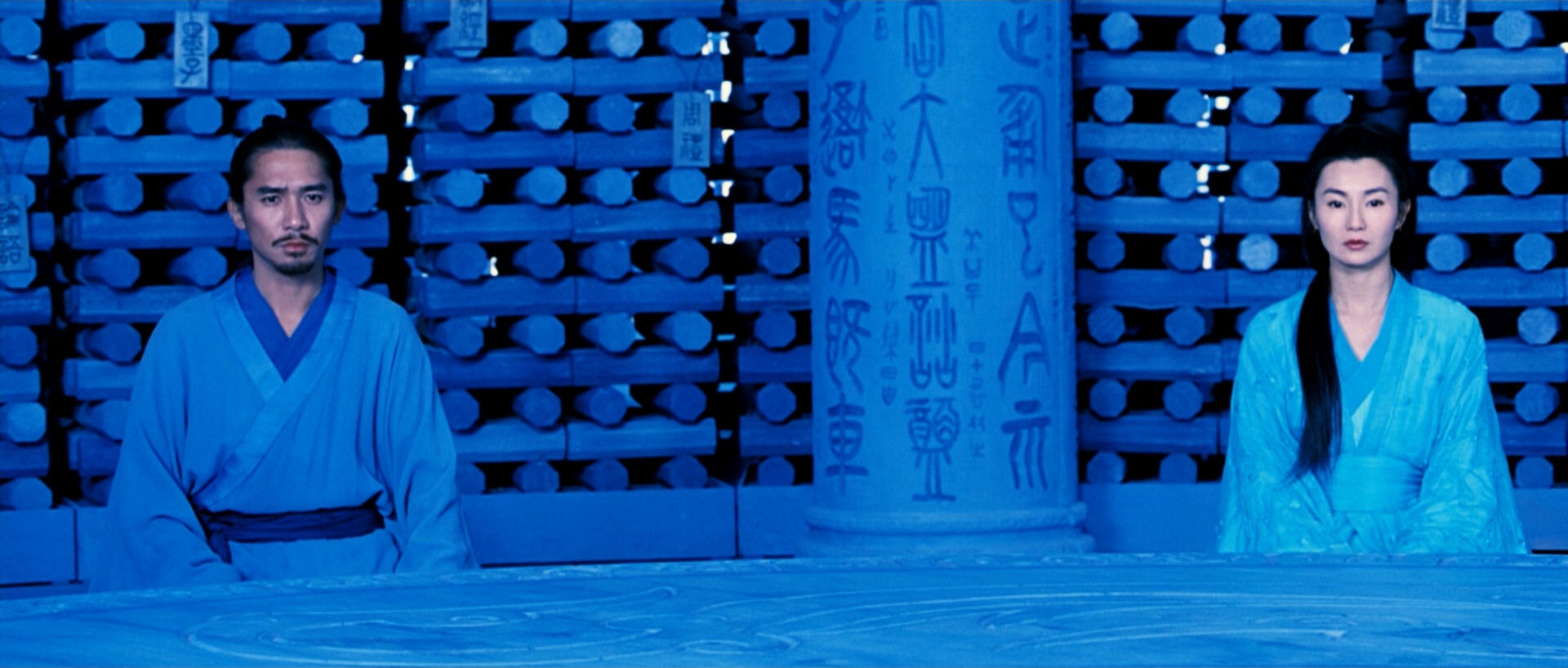
A Brief History of Hero on Home Video
After its October 2002 theatrical release in China, Miramax sat on the North American distribution rights to Hero for almost two years, delaying its official debut in the American market until August 2004. That it got released here at all was mainly due to the intervention of Quentin Tarantino, who pleaded with Miramax chief Harvey Weinstein on its behalf and agreed to lend his name to the marketing campaign.
In the interim, the film was released on DVD in Hong Kong in early 2003. Despite technically being coded for Region 3 playback, copies of that disc were mass imported to the United States and widely distributed well ahead of the domestic theatrical release. Anyone willing to spend $99 on an easily-hacked Apex DVD player had no problem getting around the region coding. Although video quality of that DVD was somewhat lacking even by standards of the day, its thunderous DTS 5.1 soundtrack was a real show-stopper that could blow the roof off any home theater.
Miramax eventually released its own DVD. Per that label’s m.o. at the time, the disc had more video quality issues, no DTS, and a markedly different English subtitle translation that simplified and lost the poetry of the dialogue in many scenes. As a fan, I became a little obsessed with the movie and began collecting multiple copies of it from around the world – some that promised (and rarely delivered) better quality, and some that just came in fancy deluxe packaging. In addition to several editions of the film on DVD and Blu-ray, I also own copies on the very obscure, short-lived Chinese EVD and HVD high-definition disc formats (that I no longer have working players for).

For a movie that was so critically praised and such a big box office hit, Hero has been quite poorly represented on the Blu-ray format. The American Blu-ray released by Miramax in 2009 suffered another mediocre video transfer, the same subtitles, and – worst of all – only lossy Dolby Digital 5.1 audio for the film’s original Mandarin-language soundtrack, while the terrible English dub was granted lossless DTS-HD Master Audio. Displeased with that, I imported a Blu-ray from Sony Pictures in Spain that, if nothing else, reverted to the original English subtitle translation, but is no better for video and has simply awful audio quality.
Over time, I’d more or less given up hope of ever seeing a proper high-definition presentation of Hero that would finally live up to the movie’s potential and do justice to its stunning photography and visuals. Then, in early 2024, word came that Imprint Asia, a sub-label of Australian distributor ViaVision, would issue the film in a new Blu-ray offering three different cuts of the film in a deluxe Limited Edition box set.
Could this, finally, be the definitive home video release of Hero I’ve waited so long to see?
Spoiler: Regrettably, no.
The Imprint Asia Limited Edition Blu-ray
To give it some credit, the ViaVision/Imprint Asia Limited Edition is a handsome physical collectible. Two Blu-ray discs are stored in individual keepcases within an attractive hard box.
Disc 1 contains two versions of the movie: the 98 min. 36 sec. “Original Cut” and the 99 min. 12 sec. “U.S. Theatrical Cut.” Disc 2 contains the 109-minute so-called “Director’s Cut” and a small handful of bonus features.

Both Blu-ray discs are region-free and should function in an American Blu-ray player without needing any sort of special hardware or region hack. Frustratingly, none of the discs have pop-up menus, or even chapter selection guides. If you want to change a setting after starting movie playback, you have to either use your Blu-ray player’s audio and subtitle controls, or return to the main menu screen and start the film over again from the beginning.
Of note, ViaVision has only provided the original Mandarin-language audio on all three versions of the movie. The label has chosen to omit the English dub entirely, even from the U.S. Cut.
The Theatrical Cuts
In terms of on-screen footage, differences between the two theatrical cuts of Hero are fairly minor. The roughly 30-second running time discrepancy mostly comes down to studio logos at the head of the film. The Original Cut then opens with prologue text over a black screen, while the U.S. Cut opens with different prologue text over a map of ancient China. The two also have different epilogue text at the end (though over the same footage of the Great Wall). Beyond that, the bulk of the movie between these two bookends is the same.
Note, however, that what ViaVision calls the “Original Cut” is actually an English-language print with English text at both beginning and end. The old DVD from Hong Kong had simultaneous English and Chinese text on screen at both spots, and I also own a DVD from Mainland China with only Chinese text.
Given the substantially similar content in both theatrical cuts, one might assume the logical course of action for a Blu-ray distributor would be to use seamless branching to replace the head and tail of the film. Bizarrely, ViaVision has chosen instead to author two entirely separate video transfers and encodes for the movie onto the same disc, each compressed onto a single data layer.
Except for the English prologue text, the Original Cut comes from a print of the movie with no other on-screen English translation for the Mandarin spoken dialogue. You must choose to enable player-generated subtitles, authored in a large, ugly font that dips into the lower letterbox bar. When you do so, redundant subtitles will appear on top of the prologue to translate the text that’s already in English.
Meanwhile, the source for the U.S. Theatrical Cut has permanent yellow English subtitles burned-in to the image throughout the movie. Needless to say, the subtitles on this version come from the Miramax translation. Comparing them again now for the first time in a few years, the Miramax subtitles are perhaps not as terrible as I remembered them being. The translation is coherent and workable enough overall, and some isolated scenes or specific lines may actually read superior to the other translation. However, it comes across as feeling dumbed-down on the whole, especially the groan-worthy “This was more than two thousand years ago” explanation in the epilogue.
Some subtle changes to the wording actually alter the meaning of the dialogue. In the original translation, when Nameless (Jet Li) comes to arrest him, Sky (Donnie Yen) dismissively scoffs, “What can a minor official do?” (the minor official being Nameless). The Miramax translation has him respond with a more polite, “What can I do for you?” This also reverses the subject and object in the sentence. Because I don’t speak Mandarin, I can’t say which translation is more accurate, but the original version seems to suit the scene better – unless you choose to read the “What can I do for you?” as sarcastic, which I suppose could be possible.


The most significant difference in translation involves repeated references to the King’s ambition to unite “all under heaven,” which Miramax reduces to the generic “our land,” as if fearing a negative reaction from Western audiences suspicious of secret Communist propaganda.
The Director’s Cut
In spite of being sold as a “Director’s Cut” (a label that has been used previously on multiple DVD editions), I’ve never seen confirmation anywhere that the 109-minute version of Hero is in fact Zhang Yimou’s preferred cut of the film, and I have reason to suspect that it’s not. Prior to its theatrical release with the Weinstein-imposed shortened length, rumor circulated that Zhang’s actual Director’s Cut ran 120 minutes – a version that has never been publicly released anywhere to my knowledge.
The added ten minutes in the 109-minute cut are mostly comprised of brief shot extensions and rearranged editing in existing scenes. The extended cut has minimal additional dialogue and only one entirely new scene that lasts a mere 30 seconds. Some of the editing extensions may arguably make certain scenes feel even more lyrical or poetic than they already were, but in my opinion, most of them are simply repetitive and cause the movie’s pacing to drag. To me, this 109-minute version feels like an unfinished rough cut, compared to the tighter and more effective 99-minute theatrical cut.
English subtitles on the extended cut are player-generated and come from the original (non-Miramax) translation. While the text is positioned to stay inside the movie image this time, the font has messed-up kerning with awkward gaps between random letters in some words. Most sentences also lack punctuation for some reason.

Video Quality
Ever since its debut, Hero has been rightly regarded as a visually striking film with beautiful photography and images. Unfortunately, those qualities have not always transferred well to home video. Honestly, I’m not sure how well they actually held up – in a technical sense – on theatrical prints either. I suspect that at least some of the issues may be endemic to the way the movie was made.
As a production from the early 2000s with a heavy amount of visual effects, significant portions of the movie were scanned onto a partial 2K Digital Intermediate. Much of the CGI looks like it was rendered below 2K resolution, and even many scenes without overt VFX had digital wire removal during the kung-fu and stunts. As a result, the majority of the movie has a soft, low-resolution appearance. Grain also typically has a very noisy, electronic texture with occasional macroblocking. How many of these problems were permanently baked-into the production chain and how many were actually the fault of poor video transfers over the years is a difficult question to ascertain, and even this latest Blu-ray set doesn’t clear it up.
From what I can tell, all three of the video transfers featured in the ViaVision Limited Edition – Original Cut, U.S. Cut, and Director’s Cut – are sourced from older existing masters. The two theatrical cuts in particular look quite aged, yet in different ways, with the Original Cut being softest and dullest. Even the problematic Miramax Blu-ray from 2009 looks better than either of them. (Click on the screenshots in the following gallery to enlarge.)


ViaVision’s Director’s Cut disc has the sharpest and most detailed 2.35:1 image, but even that suffers a host of problems, including boosted contrast that crushes blacks, clips whites, and blows out colors. The old Miramax Blu-ray (that I was quite critical of at the time!) has the best balance in that regard.


ViaVision’s own U.S. Cut is reasonably close to the Miramax disc here, but a little flatter.
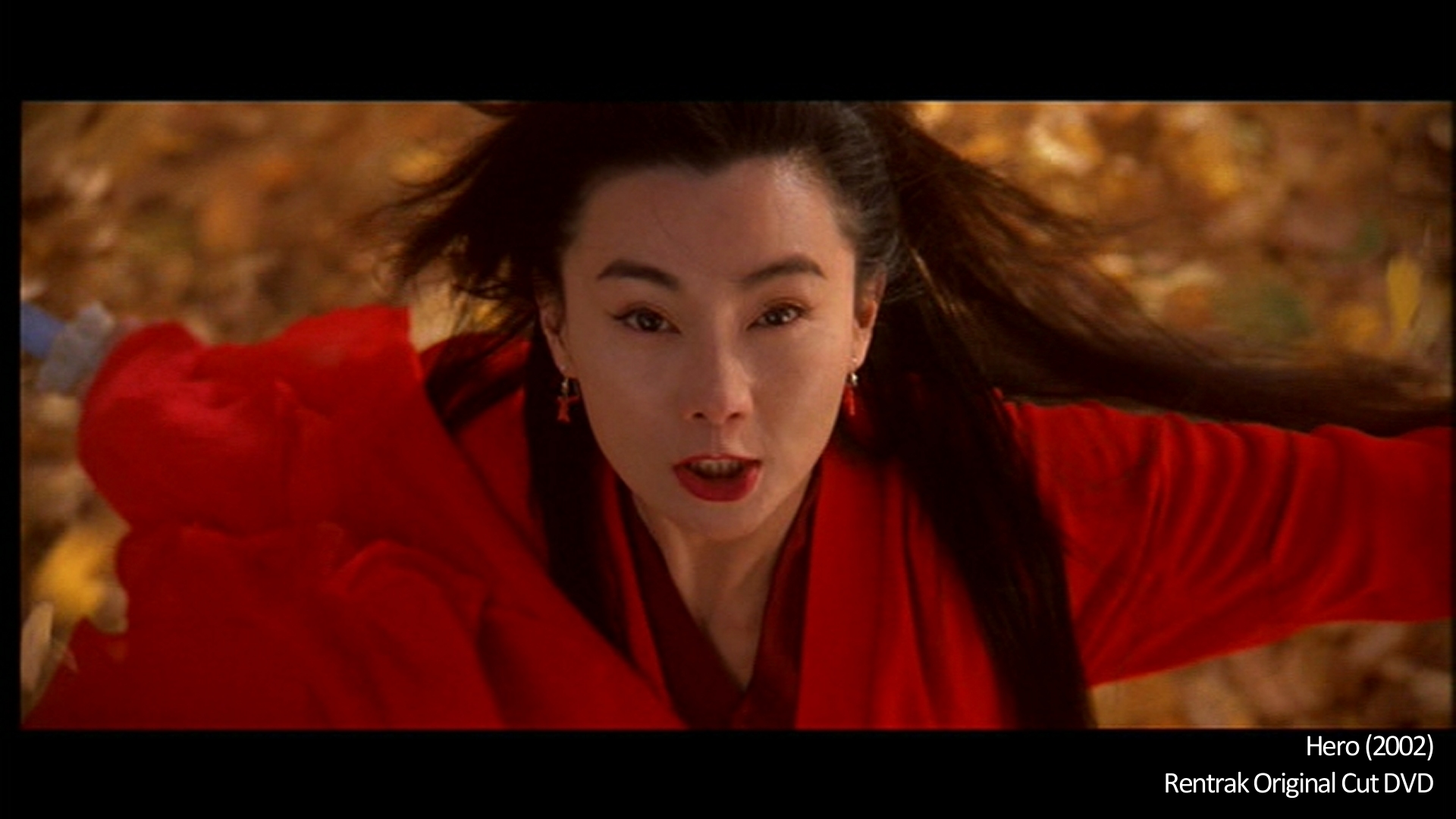
The most interesting variant of this movie I’ve encountered over the years was a DVD from a label called Rentrak in Japan, that applied a red push to the entire film, presumably in an attempt to make colors look warmer or more saturated. I knew fans at the time who swore by this, but it never looked right to me.

Audio Quality
Not only does ViaVision’s “Original Cut” have the worst-looking image, it also has by far the worst-sounding soundtrack. The DTS-HD Master Audio 5.1 track for is set for an extremely low default volume, and even after boosting amplification, sounds incredibly weak and seems to be entirely missing the LFE channel. This is a travesty for a movie with such a famously powerful sound mix.
The U.S. cut has alternate DTS-HD MA 5.1 or 2.0 tracks. Both sound much better than the Original Cut. They’re not only louder (don’t confuse volume for quality), but much stronger after level-matching. Dialogue and sound effects are sharper and crisper. If you have the ability to take advantage of it, the 5.1 is of course preferable, with hyper-aggressive surround activity swirling around you from every direction during the fight scenes.
The Director’s Cut (DTS-HD MA 5.1 only) is set for the loudest default volume, which can feel overwhelming when it first hits you, but after level-matching seems fairly comparable to the U.S. Cut, if a little brighter in character overall.
Both the U.S. Cut and Director’s Cut have a respectable amount of bass, especially from the drums in Tan Dun’s musical score. However, neither hit me quite as hard as I remembered from watching the DVD years ago in my old apartment. That led me down a rabbit hole of pulling out that old DVD and checking all my hardware settings and connections. (I cued up some of Amazon’s Fallout to reassure myself that my subwoofers are indeed working properly and can still give my home theater a good shake.) In the end, I’m still not entirely certain whether ViaVision’s discs are a bit tamer in the LFE department, or if my memories of this soundtrack were just a little exaggerated.
In any case, the U.S. Cut and Director’s Cut both sound pretty good. Only the Original Cut (my favorite version of the movie) has lousy audio.
Bonus Features
ViaVision’s marketing for this Blu-ray box set promises “extensive special features.” That’s rather hyperbolic.
All supplements are contained on Disc 2 with the Director’s Cut. The only new item is a 43-minute educational lecture about the film and about Chinese history from British film critic Tony Rayns. It’s informative if a bit dry.
Everything else is recycled from older home video releases, including the Close-Up of a Fight Scene and Hero Defined featurettes, the Conversation with Quentin Tarantino and Jet Li, and a small handful of storyboard comparisons.
 The Video File Blog
So would you say the Original Cut has the same sound as the Spanish Blu Ray? That disc seems to have the bass problem you describe here as well. Which of those two has better picture, do you think? Thank you for this review, by the way. It is incredibly helpful and a blessing for all interested in this wonderful film.
LikeLiked by 1 person
I didn’t do a direct comparison with the Spanish Blu-ray from Sony Pictures, but yes, it has very similar problems and I wouldn’t be surprised if both the video master and soundtrack for ViaVision’s “Original Cut” come from the same source.
ViaVision did not do any remastering of the movie themselves for this set, but rather recycled older existing masters for all three versions of the movie. The U.S. Cut came from Miramax (via Disney). I’m told that the weird subtitle font issues on the Director’s Cut match the NOVA Media Blu-ray, so that must have come from there. And I’m guessing the Original Cut came from Sony.
Thank you for the kind words and thanks for reading!
LikeLike
why did you sell your EVD/HVD players?
LikeLike
I had no call to ever use them again. Software support for either format was next-to-nonexistent, and the few titles that did get released were all Chinese with no English subtitles. Although both players were also compatible with regular DVD, they were mediocre at that and I had plenty of better options. Ultimately, they were just clutter that I needed to clear out.
LikeLike
Fair enough. Hope you made a profit.
LikeLike